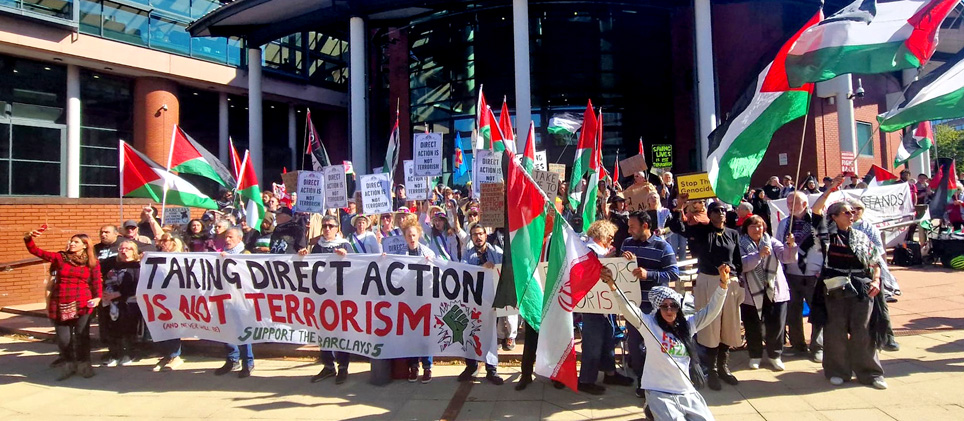
Hundreds turned out at Preston Crown Court on Friday to support five members of the Palestine Action group convicted over an attack on a Barclays Bank that caused damage of over £200,000 ($280,000). The judge ruled they will not be sentenced under terrorism provisions.
The five defendants, known as the ‘Barclays five’, were convicted over the August 5th, 2024, attack on the bank’s St James’s Street branch in Burnley, Lancashire.
They sprayed the bank with red paint to symbolise Palestinian blood, blood that has been shed due to British banks like Barclays financing Israel’s genocide of Gaza.
The defendants said the action was intended to pressure Barclays to withdraw financial support for Israeli weapons manufacturer Elbit Systems.
Barclays has since quietly rolled back its financing of Israeli bonds, but continues to provide over £8 billion in investments and loans to companies other than Elbit which are arming Israel’s settler colonialism and genocide.
Barclays also was the official ‘strategic partner’ of Farnborough International Airshow, an arms fair akin to DSEI that welcomed over a thousand arms trade aligned corporations to Hampshire last month. Huge numbers across the country have joined the campaign to boycott Barclays.
Judge Robert Altham told a packed room at Preston Crown Court on Friday that the damage the activists caused with their August 2024 direct-action protest in Burnley was ‘significant’.
However, Altham said he was ‘not satisfied’ that the damage met the statutory measures of ‘serious damage’ required under the terrorism act.
Visibly relieved, the defendants filed out of the tense courtroom to a gathering of family and friends who cheered and clapped. ‘Thank God,’ one said, hugging a friend.
Brendon O’Hagan, 28, Amanda Kelly, 31, Mohammed Malik, 28, Hmeera Atiqnisar, 31, and Alma Yaniv, 70, were convicted of criminal damage this June over the August 2024 protest which caused £212,805 worth of damage.
In the agreed facts of the case, the prosecution’s lawyers acknowledged that, at the time of the protest, Barclays provided investments and loans to Elbit Systems, Israel’s largest arms firm.
The action was carried out in the name of Palestine Action almost a year before the group was banned under terrorism laws, and before it was illegal to be a member or supporter of the group.
It was only after the trial concluded that the presiding judge, Philip Parry, said he intended to consider whether to apply a ‘terrorist connection’ when sentencing the defendants.
This came after the landmark decision days earlier to sentence four Palestine Action activists convicted of criminal damage as terrorists over their own direct action protest at an Elbit Systems site in Filton near Bristol.
It was the first time in British legal history that direct-action protesters convicted of criminal damage were sentenced as terrorists, a move human rights groups warned was a misuse of counter-terrorism powers.
Defendants and supporters said they feared the earlier decision had set a dangerous precedent.
If a terrorism connection was applied in their case, they could have faced lengthy prison sentences and treatment as terrorists for decades following their release.
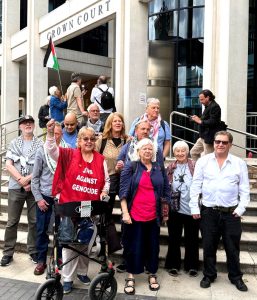
But after the ruling which followed a two-hour hearing, the five activists celebrated with around 200 supporters who beat drums and carried placards outside. Trucks, buses and cars passed by, honking support.
Addressing the crowd, Atiqnisar said that, while she was relieved by the ruling, she had not sought victory in the courtroom.
‘We are not victorious in the court rooms of a state that is protecting and sustaining the most monstrous entity in modern history and its biggest weapons supplier,’ she told the crowd.
‘We are victorious when we silence the drones before they occupy the skies of Gaza and before they turn Palestinian men, women and children into pieces.’
Ruth Ehrlich, director of external relations at rights group Liberty, welcomed the news, but said the fact that ‘a terror connection could even be considered highlights deep flaws in the UK’s laws’.
She said the consideration alone is likely to have a chilling effect on people’s willingness to exercise their right to protest and stand up for what they believe in.
‘What makes this case all the more shocking is that the jury and defendants were unaware that the terrorism connection could be applied after the verdict had been reached,’ she said.
She called for an urgent update to the current definition of terrorism ‘to enable current and future governments to uphold their duty to safeguard the public, whilst protecting people’s rights and preventing overreach’.
The five are scheduled to be sentenced on 4 September.
Responding to the news that Judge Altham at Preston Crown Court has ruled that a ‘terrorist connection’ will not be added to the criminal damage convictions of five Palestine Action activists, who sprayed red paint and damaged windows of Barclays branch in Burnley, Kerry Moscogiuri, CEO of Amnesty International UK said: ‘We welcome the judges ruling that the “Barclays 5” will not be sentenced as terrorists.
‘No one should be treated more harshly under the law because their crimes were part of a protest against genocide or any other issue, and the misuse of terrorism powers in this way should never have even been considered.
‘We now need to see the proscription against Palestine Action as a terrorist organisation lifted and an end to the misuse of sweeping counter terror powers against direct action protesters.
‘The government should begin the process of reversing the years of attacks on our right to demonstrate, one of the most effective tools we have to hold our leaders to account.’
Tony Greenstein, from Brighton, was found not guilty at Kingston Crown Court on Friday, August 21st, by a jury of five women and seven men after two hours and 11 minutes of deliberation.
The charge related to three social media posts made on October 7th, 2023, the day of the Hamas-led attack on Israel.
Greenstein, a Jewish anti-Zionist activist, described Gaza as a ‘human prison’ during the trial.
He told the court he believed the attack was ‘justified,’ but denied supporting Hamas.
He said: ‘When a colonial power holds another people down, they have the right to resist.’
On Thursday, Greenstein, whose father was an Orthodox Jewish Rabbi told the court that Palestinians had been ‘locked up’ for 57 years.
He said: ‘It was a cage in which people lived.
‘Imagine you could not escape 25 miles north of here and five miles wide, and imagine having to live there and not being allowed out.’
Judge Sarah Plaschkes KC interrupted Greenstein several times during his evidence, asking him to stop discussing the broader history of Israel and Palestine.
She warned him against treating the trial as a ‘political forum’ and reminded the jury that they were ‘not concerned with events in the Middle East’.
In one of the social media posts, Greenstein had written: ‘Please share. Full support for the Gaza ghetto uprising,’ the court heard.
Jurors were told that the posts included links to a blog, which stated: ‘The time to fight is now.
‘Whatever criticisms one can make of Hamas, we should congratulate them on this well planned and audacious attack on the Zionist enemy.’
Greenstein argued that ‘congratulating’ Hamas was a figure of speech and described the prosecution’s interpretation as ‘absurd’.
He also pointed out that he had written extensively about his disagreements with Hamas on his blog, which contains more than 3,500 posts.