On 4th October 1936 the people of the East End of London halted the march of Oswald Mosley’s Blackshirts through Stepney, in the Battle of Cable Street
The 1930s was a period of seismic political change throughout Europe.
Fascist dictators took power in Germany, Italy and Romania and left- wing and communist movements rebelled against expanding fascism in countries like Spain.
In Britain, this tension culminated in a violent event in the East London area of Stepney, on Cable Street.
Stepney at the time was one of the poorest and most densely populated suburbs of London and many new immigrants settled in the area.
By the 1930s the East End had a distinct Jewish population and culture.
The East End had been the centre of Jewish life in Britain since Oliver Cromwell allowed Jews to resettle in the country in the 1650s.
The largest cohort of Jewish migration occurred at the end of the 19th century when 150,000 Yiddish speaking Jews came to the UK, to escape persecution in the Russian Empire.
Most came to the East End, arriving at Irongate Wharf (adjacent to the Tower of London and St Katherine Docks) and via the port of Harwich in Essex, and then by train to Liverpool Street Station.
In the 1930s, Sir Oswald Mosley was the leader of the British Union of Fascists (BUF).
Mosley had created a new, sinister organisation – The Blackshirts – a quasi-military group of around 15,000 thugs, modelled on Mussolini’s Squadrismo.
When Mosley announced a march into the heart of the Jewish community in the East End of London, planned for Sunday 4th October 1936, the community was in disbelief and it was a clear provocation.
The Jewish People’s Council presented a petition of 100,000 names to urge the Home Secretary to ban the march.
But, the BUF had the support of the press and police, and with the Daily Mail running headlines in the 1930s such as ‘Hurrah for the Blackshirts’ the government failed to ban the march and the people of the East End set about organising to defend themselves.
The Daily Worker called people to the streets on the day of the march, to block Mosley’s way.
But as the number of fascists was growing, so too was the opposition against them.
Trade unionists, communists as well as the Jewish community were becoming increasingly mobilised.
On Sunday 4th October thousands of anti-fascists began to gather at Gardeners Corner in Aldgate.
The battle lines were set as Mosley gathered his men at the Royal Mint by The Tower of London.
The police amassed 6,000 officers to clear a path for them into Whitechapel.
The police used mounted officers at Aldgate to beat back the crowds onto the pavements but thousands more were streaming into the area.
Four sympathetic tram drivers strategically abandoned their vehicles to help block the road to the fascists.
‘Down with the fascists!’ chants were heard across East London as the police clashed with the community blocking their way.
Communists, Jews, Irish dockers, trade unionists all united under the chant ‘They Shall Not Pass!’
As the police could not get through the crowds towards Whitechapel, Mosley decided to change the route and head down narrow Cable Street, that ran parallel to his original route.
The Blackshirts were headed up and flanked by the Metropolitan Police as they headed into Cable Street.
The community was ready. They had begun constructing barriers in Cable Street early that morning to block their path.
To stop mounted police charges, Glass and marbles were left in the street and pavement slabs pulled up.
Nearby the Communist Party established a medical station in a café.
The police were met with fierce resistance. Everything from rotten fruit to boiling water rained down on them from windows on all sides.
The Met reached the first barrier, but brawls broke out and the police withdrew and demanded that Mosley turn around.
Celebrations broke out across the East End that afternoon.
79 antifascists were arrested, many of whom were beaten by the police, some even sentenced to hard labour.
Only 6 fascists were arrested.
The events of the day directly led to the passing of the Public Order Act in 1937 which banned the wearing of political uniforms in public.
Mussolini, disappointed in Mosley, withdrew his substantial financial support for the BUF.
Two days after the events at Cable Street, Oswald Mosley was married in Germany, in the home of Joseph Goebbels, with Hitler as a guest.
Mosley and other leaders of the BUF were imprisoned in 1940.
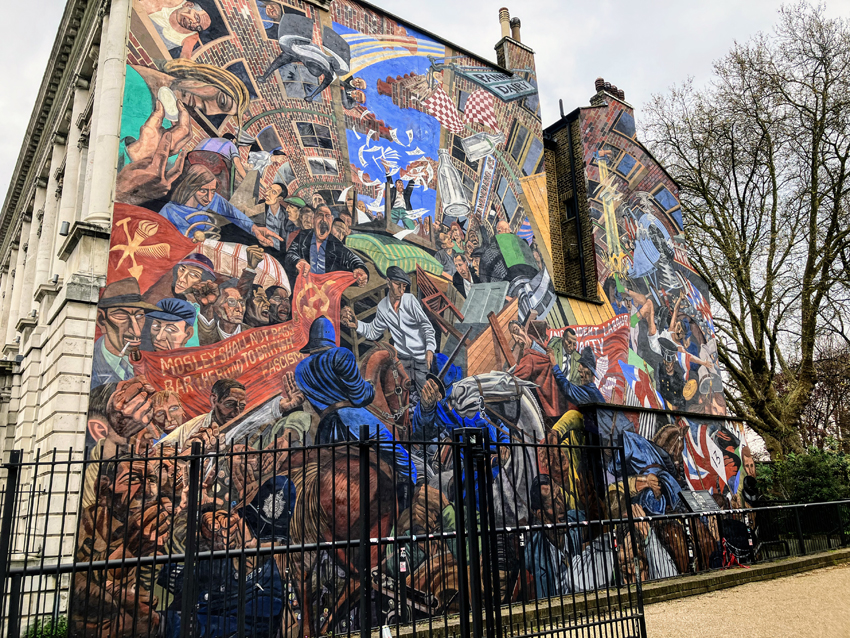
A large mural depicting the battle is painted on the side of St George’s Town Hall to commemorate the event.
It stands in Cable Street, about 350 metres east of the main barricade that stood by the junction with Christian Street.