
FINANCIAL decisions being taken by a strike-hit university are ‘deeply offensive’ to staff, a union has claimed.
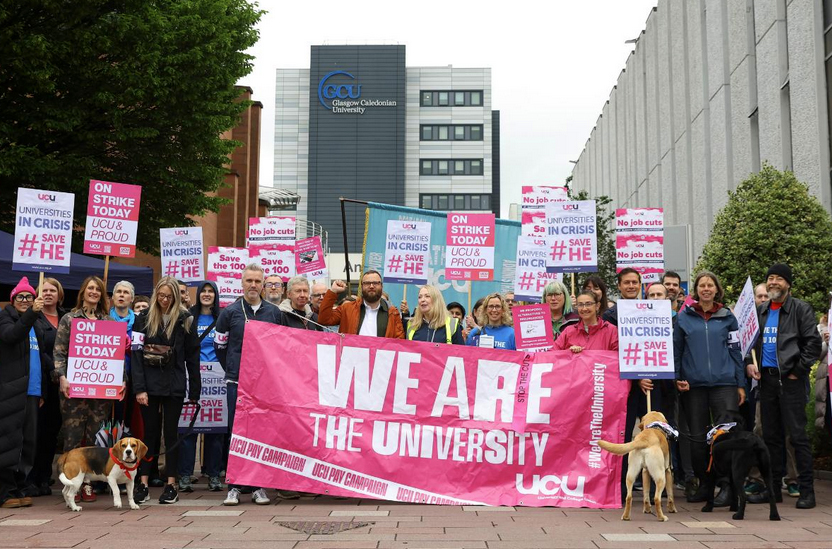
Members of the University and College Union (UCU) working at Glasgow Caledonian University (GCU) have walked out on the first of six days of strike action.
UCU claims the university’s priorities are ‘out of step’ given the decision to make investments while simultaneously cutting staff.
However, a spokeswoman for GCU said it was ‘unfortunate’ the unions were not explicit that the university is purchasing for development and selling vacant sites as part of a long-standing land strategy.
Karen Lorimer, GCU UCU branch president, said: ‘The fact that university management are investing millions in property for which the use is unclear at the same time as cutting staff simply doesn’t make sense and will be deeply offensive to those staff losing their jobs.
‘We’ve engaged openly with management to try and find a way forward that doesn’t involve swingeing job cuts but with no success.
‘GCU is in a strong financial position with operating surpluses and with cash reserves.
‘There is no financial requirement for management to make these cuts.’
The university announced in March plans to cut up to 100 posts.
With staff taking voluntary redundancy, the number of roles management want to cut is now approximately 50.
GCU, UCU members have already taken three days of action. They were out yesterday (October 1st) following action on 24th and 29th September, and will be out on strike again on the 6th and 9th October.
Other unions on the campus have also taken industrial action.
The cuts and job losses have been raised in the Scottish Parliament.
Jo Grady, UCU general secretary, said: ‘GCU celebrated its 150th anniversary last month which should be a time for celebration.
‘But instead staff are having to strike to defend jobs and stop possible compulsory redundancies.
‘It’s clear that the university’s financial position was and remains strong and management’s decision to spend millions on property reinforces this.
‘It’s the staff and students that make a university, and choosing land and buildings over them throws into question the judgement of the university’s senior management.’
Meanwhile, more than 30 Unite union members at Oxford University Press (OUP) are taking further strike action this week in a dispute around offshoring.
Workers in its finance operations team already walked out earlier this month after their employer announced plans to move the department to EXL Services. This firm provides its services from India, meaning the almost 50 affected OUP staff will be unable to TUPE transfer and will lose their jobs.
The affected staff have also been asked to stay on for six months to train their replacements, which has been described as an ‘insult’.
Unite general secretary Sharon Graham said: ‘Our members have been cast aside and treated extremely poorly by their wealthy employer, who is clearly putting profits over people.
‘Unite will always fight plans to offshore our members’ jobs, and our members at OUP have our full support during this dispute.’
The latest offshoring plans at OUP come on the back of several larger groups of its employees being made redundant, including 113 proposed redundancies last November in its education and English language teaching divisions.
OUP is the publishing house of the University of Oxford and is the largest university press in the world. According to its most recent annual report, OUP made profits of £47.1m 2025/26 and has £329.5m in the bank while its CEO Nigel Portwood was paid $1,486,174 in 2024/25.
Unite members are striking until 9th October.
Unite regional officer Naomi Gravett said: ‘These workers are highly dedicated professionals who have been left devastated by this news and it is an insult they will be expected to train their replacements. They believe they have had no choice but to escalate strike action in a bid to save their jobs.’
- A strike over job cuts at the largest grain distillery in Scotland began on Monday, bringing the plant to a ‘standstill’.
Drinks giant Diageo has introduced a huge programme of job cuts, with 2,000 roles to go across its operations.
Members of Unite at its Cameronbridge distillery have backed strike action, with 72 roles under review at the plant and up to 10 job losses.
Workers protested at the distillery’s main gate from 05.00 at the start of the industrial action with pickets taking place throughout the day until 22.00.
The strike will last until until 15th October with picketing each day of strike action.
Unite says Diageo has failed to properly consult on the job cuts at Cameronbridge, and the company has provided no explanation and only minimal detail on the proposed redundancies.
In its latest registered accounts, Diageo Scotland recorded after tax profit of £595 million for 2025, and £736 million in 2024.
Unite deputy Scottish secretary Dougie Maguire, said: ‘Time is up for Diageo. The company has refused to properly engage with Unite, despite repeated attempts, and it persists in covering up the true scale of its proposed cuts.
‘We fully expect this period of industrial action to bring production to a standstill and Diageo has only itself to blame.’
Diageo produces brands including Johnnie Walker, Crown Royal, J&B, Buchanan’s and Windsor whiskies, Smirnoff, Cîroc and Ketel One vodkas, Captain Morgan, Baileys, Don Julio, Tanqueray and Guinness.
- Hospital theatre assistants in Leeds are to begin an indefinite strike next week in a dispute over pay grades.
Staff will walk out from Wednesday 7th October on a continuous, indefinite strike unless bosses at Leeds Teaching Hospitals NHS Trust return to talks.
The health workers say they should be moved up a grade as they carry out clinical duties including handling samples, supporting surgical teams, using specialist equipment and maintaining safe, sterile operating environments.
Workers have already taken 40 days of strike action since the dispute began last December and their union Unison says interim chief executive Brendan Brown must now return to the negotiating table.
Brown oversaw a similar deal at Calderdale and Huddersfield NHS Foundation Trust, where theatre and maternity healthcare assistants were moved up a grade and awarded five years’ back pay.
The union says he has the experience to unlock the dispute and should do so before a new permanent chief executive is appointed.
Unison Yorkshire and Humberside regional organiser Jack Hemingway said: ‘Theatre assistants have already made enormous sacrifices, taking 40 days of strike action simply to be paid fairly for the work they do.
‘They want to be in work, caring for patients. But they’ve been left with no option but to head back to the picket line.’
- Former workers of a timber supplier in administration have won a 90-day protective award at an employment tribunal.
The 13 ex-employees of the National Timber Group Scotland won claims that the company failed to ensure employee representatives were elected and then consult them as required by law.
Employment judge Leslie Murphy found the firm, which went into administration on 26 November last year, had failed to comply with section 188 and section 188A of the Trade Union and Labour Relations (Consolidation) Act 1992.
The 13 all worked for the company at its Grangemouth site.
The case followed a successful claim by 54 other ex-staff from the same site over the same issue, the outcome of which was published in April.
Two employees who worked for the firm in nearby Falkirk and another who worked at Grangemouth have also won cases against the company individually, tribunal records show.
In both the latest case and the earlier 54-person case, the tribunal made protective awards covering a 90-day period beginning on 26 November 2025.
The cost of the claims will be covered by the taxpayer-funded Redundancy Payments Service. They followed a long line of similar actions regarding defunct businesses in recent years.
Five group companies of the Sheffield-headquartered National Timber Group, the UK’s largest independent timber supplier, went into administration in November 2025.