A NATIONWIDE strike by public sector workers took place in France on Tuesday with over 170 demonstrations and rallies taking place across the country.
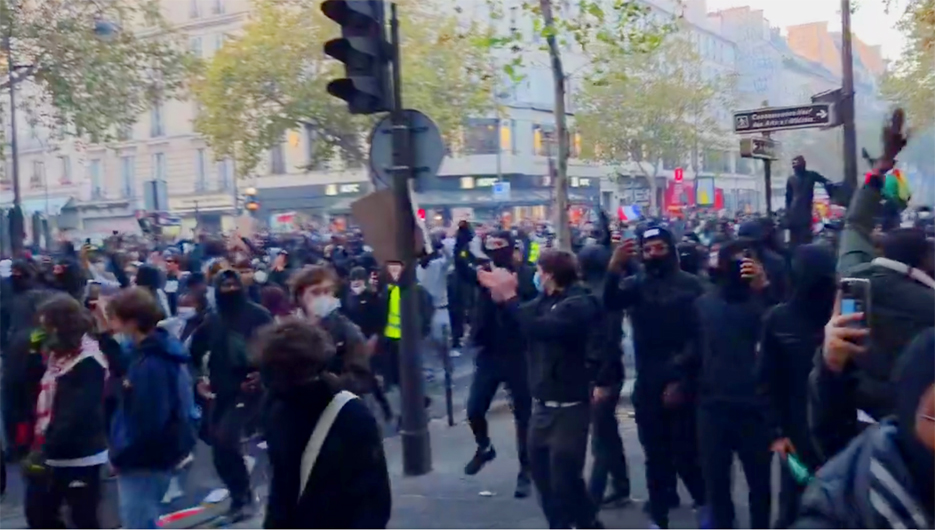
Alongside the strike, teenagers set fire to rubbish bins and hurled projectiles in clashes with police, as they kept up a blockade of some high schools demanding better conditions.
High school students have staged protests outside their schools since last week over grievances including timetables, class sizes and a shortage of teachers as well as overheated classrooms in the wake of the recent heatwaves.
The movement in the lycées, which handle the final years of school in France, started in the Ile-de-France region around Paris, where blockades in some 10 schools were reported by education authorities on Tuesday.
It has now spread to other cities nationwide.
Civil servants are demanding pay rises and increased funding for public services ahead of the presentation of the draft budget for 2027.
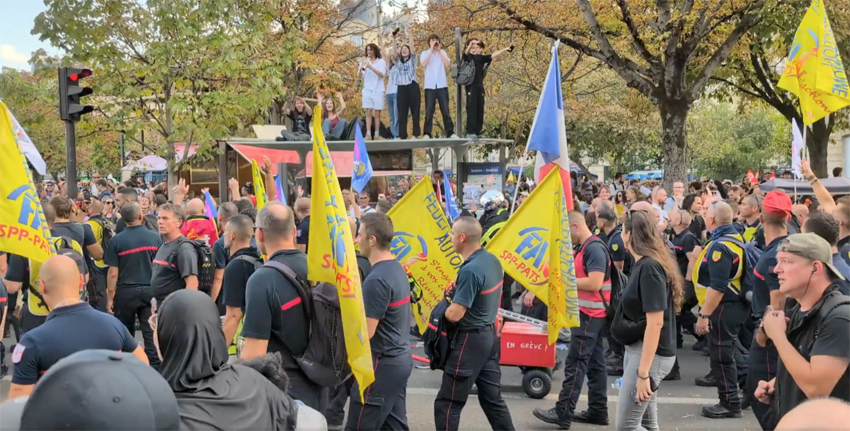
Teachers, healthcare workers, firefighters and employees of other public sector organisations are joining the protests.
Eight major trade union federations in the French public sector — the CGT, Force ouvrière (FO), The French Democratic Confederation of Labour (CFDT), The Union Nationale des Syndicats Autonomes (UNSA) , The Fédération Syndicale Unitaire (FSU), Solidaires, Confédération Française de l’Encadrement – Confédération Générale des Cadres) CFE-CGC and Fédération Autonome de la Fonction Publique (FA-FP) were all involved in the action.
One of the main reasons for the protest was the government’s planned further freeze on the so-called index point, on which the basic salary level for French civil servants is based.
Trade unions are calling for a general increase in wages and a rise in budgetary funding for public services. They argue that current resources are insufficient to ensure the proper functioning of education, healthcare, emergency services and other sectors.
The protests took place two days before the planned presentation of the draft French budget for 2027.
The trade unions hope that this large-scale mobilisation will force the government to reconsider some of its planned decisions.
The largest demonstration is due to take place in Paris. The main march by civil servants was from the Place de la République to Place de la Nation via the Bastille.
The French authorities expect 20,000 to 40,000 participants, not including the fire brigade.
Firefighters are holding a separate march. According to the authorities’ estimates, as many as 5,000 to 10,000 rescue workers. Their route runs from Place d’Italie to the Bastille, where the firefighters are due to join the main demonstration by civil servants.
Firefighters are protesting not just over pay. Their demands include an increase in staffing levels, improved working conditions and additional funding for the fire and rescue services following a difficult season of large-scale wildfires.
The involvement of education workers should be significant.
The largest trade union for primary school teachers predicted that around 40 per cent primary school teachers.
Calls for a work stoppage have also spread amongst staff at state hospitals and other healthcare facilities.
For the first time since 2018, all trade union organisations within the French public employment service, France Travail, have separately called for a strike.
Alongside the civil servants’ protest in France, the mobilisation of secondary school pupils is continuing.
‘In several regions, activists are blocking the entrances to secondary schools, demanding more funding for education and improved learning conditions.’
The student protests began the day before and spread to a number of French cities.
In some places, the demonstrations were marred by clashes and arrests.
The organisers describe the strike as a means of putting pressure on the government just before the finalisation of budgetary priorities.
The scale of participation in the demonstrations will become clear once the main marches in Paris and the regions have concluded.
The CGT said in a statement: ‘Our needs are increasing: an ageing population, access to healthcare, the ecological transition, new technologies.
‘To meet these needs, we need more public services, more staff, and more resources.
‘Public services also mean guaranteeing equal access to rights across all territories.
‘The equation doesn’t hold up. When a service closes, moves further away, or deteriorates, you have to wait longer, travel more kilometres, often give up, and sometimes even be put in danger.
‘When a service is privatised, it costs more because for-profit private companies seek to make profits, not public services.
‘Reducing public services under the guise of saving money is false!
‘Public money plays a major role in the economy. A business doesn’t operate in isolation. To produce and grow, it needs infrastructure, energy, trained employees, research.
Public services and investments directly contribute to our capacity to produce and develop employment.
‘Reindustrialising, successfully completing the urgent environmental transition, and meeting needs: this requires significant investments.
‘While further cuts are being demanded in public spending, why should corporate subsidies be exempt from the debate on the use of public funds?
‘Austerity always benefits the same people, exploiting divisions between those who have little and those who have even less.
‘Meanwhile, handouts to the wealthiest and public subsidies to private companies continue.
‘For the CGT, there needs to be a different distribution of the wealth produced: increasing wages, developing employment, strengthening our social protection and financing the public services we need.’
Nearly one million public sector employees have seen their base salaries decrease by 15 per cent in 10 years, and have been overtaken, or even surpassed, by the minimum wage.
In the private sector as well, increasing wages, preserving and developing employment, and improving working conditions are urgent priorities.
Ahead of the nationwide strike FO stated: ‘We are focused on wage demands and purchasing power. This is the number one demand: unfreezing the index point, increasing salaries and career prospects, and making the profession more attractive.
‘This was also the demand of the police and energy workers who demonstrated on September 15th.
‘The common thread running through all these mobilisations is the issue of purchasing power.
‘The mobilisation on September 29th is also be a mobilisation against austerity!’
The FA-FP said: ‘The government’s lack of an immediate response to the salary crisis facing the six million public sector workers dedicated to public service.
‘Our organisations reaffirm their demands:
- general salary measures and in particular a significant increase in the value of the index point;
- measures to increase salaries and overhaul salary scales allowing, in each category, genuine career progression and the easing of starting salaries from the minimum wage level, as well as the revaluation of predominantly female professions;
- the reinstatement of the payment of the individual purchasing power guarantee;
- maintaining 100 per cent of the remuneration paid to employees who are on ordinary sick leave and the abolition of the waiting day;
- equal pay and professional equality between women and men;
- Guarantees on the effective implementation of the European directive on pay transparency, accompanied by concrete means for equality policies.
‘They believe that the budgetary calendar cannot be used as a pretext to further delay the responses expected by public employees.’