YEMEN’S military spokesman Brigadier General Yahya Saree said on Sunday that Saudi fighter jets had carried out two attacks on the main market in the city of Ta’iz around noon local time.
The same fighter jets had carried out four other attacks on the province of Jawf in northern Yemen.
Saree warned the attack on the Mawiyah marketplace in Ta’iz, which killed or injured some 50 civilians, would carry huge costs for Saudi Arabia.
Yemen’s al Masirah news channel said the toll is initial and the number of fatalities from the attack is expected to rise, as other sources said wider Saudi attacks on areas in the province of Ta’iz had killed or injured 20 more people.
A spokesman for Yemen’s ruling Ansarullah movement described the attack on people shopping in Ta’iz as a mass killing.
Mohammad Abdul Salam said on his X account that the attack is a clear sign that Saudi Arabia is determined to ruin the civilian infrastructure in Yemen.
‘The Saudi regime continues to commit massacres and target civilian infrastructure and facilities, including bridges, buildings, and markets,’ Abdul Salam said in the post.
Another statement from Yemen’s military said that Saudi Arabia had carried out some 1,059 attacks on Yemen since July, when a Saudi attack on the main airport in the Yemeni capital of Sana’a triggered a new round of escalation in the decade-old conflict between the two neighbours.
The Yemenis have responded to Saudi attacks by targeting military and energy sites in the kingdom.
Earlier on Saturday, in a statement, Brigadier General Saree reported that Saudi warplanes had carried out 27 airstrikes across several Yemeni provinces over the past 24 hours, targeting bridges, roads, and other civilian infrastructure.
The strikes were carried out by F-15 and Typhoon fighter jets that took off from Saudi airbases in Khamis Mushait and Taif.
They targeted civilian sites in the provinces of Ta’iz, Marib, Saada, Amran, Ibb and Hajjah, according to Saree’s statement, which did not provide details on possible casualties.
These latest strikes have brought the total number of Saudi air and missile attacks since the beginning of the recent escalation to 1,059.
A senior member of the Ansarullah resistance movement says Saudi Arabia’s pleas to foreign powers to deploy military forces to help it fight Yemen’s Armed Forces clearly show its weakness.
Speaking on Monday, Mohammed al-Farah, from Ansarullah’s political bureau, said the Riyadh regime’s policy of rallying Muslims and the international community to support its war on Yemen has failed.
‘Ever since the beginning of the Yemen war (in March 2015), Saudis have sought to instill fears in Muslims worldwide, terrify them of assaults on holy sites (in Mecca and Medina) and agonise the international community about maritime navigation (in the Red Sea) and commercial supply routes.’
He added that such attempts are meant to legitimise the ongoing aggression on Yemen, and garner support for Saudi Arabia’s criminal policies.
‘Following baseless allegations of a Yemeni drone attack on the holy city of Mecca, the Sana’a government made it clear to the international community that Yemeni Armed Forces solely target strategic sites and military installations deep inside Saudi Arabia in reprisal for the ongoing blockade and aggression against their homeland.
‘The Riyadh regime is now speaking of dangers posed by Yemeni air defence systems in a new attempt to cause fears over international aerial traffic, and create pretexts for intervention.
‘Such a strategy, anchored in falsehood and distortion of facts, will fail to achieve its objectives,’ the top Ansarullah official said.
Farah pointed out that world leaders are ‘not servants of (Saudi Crown Prince and de facto ruler) Mohammed bin Salman’ and their armies are ‘not a police force under his command.’
The international community has just started to recognise Yemen’s legitimate right to self-defence, and its calls for an end to the Saudi aggression and blockade, he emphasised.
The high-ranking Ansarullah official stressed that the Yemeni army’s operations are entirely defensive and are based on Islamic principles as well as international law.
‘Yemeni forces will never target anyone who poses no threat,’ Farah underscored.
He called on Saudi authorities to confront Yemen directly, rather than resort to international coalitions, proxy forces and propaganda campaigns.
The Sana’a administration declared a naval blockade against Saudi Arabia on July 20, in response to ‘an unfair and tyrannical siege’ on Yemen that has lasted for nearly 12 years.
The Yemeni military has announced several successful operations aimed at ships linked to Saudi Arabia in the Red Sea.
In March 2015, Saudi Arabia and its allies imposed a blockade on Yemen and launched a sweeping military campaign, backed by military, political, and logistical support from the United States and several Western countries.
The war has killed tens of thousands of Yemenis.
However, Saudi Arabia has failed to achieve its stated objective of reinstating a puppet regime that serves its interests.
In its latest terrorist act, some 50 people were killed or injured in Saudi air strikes on a marketplace in southwest Yemen on Sunday.
On July 20, the Sana’a administration declared a naval blockade against Saudi Arabia in response to the kingdom’s ‘unfair and tyrannical siege’ and air strikes.
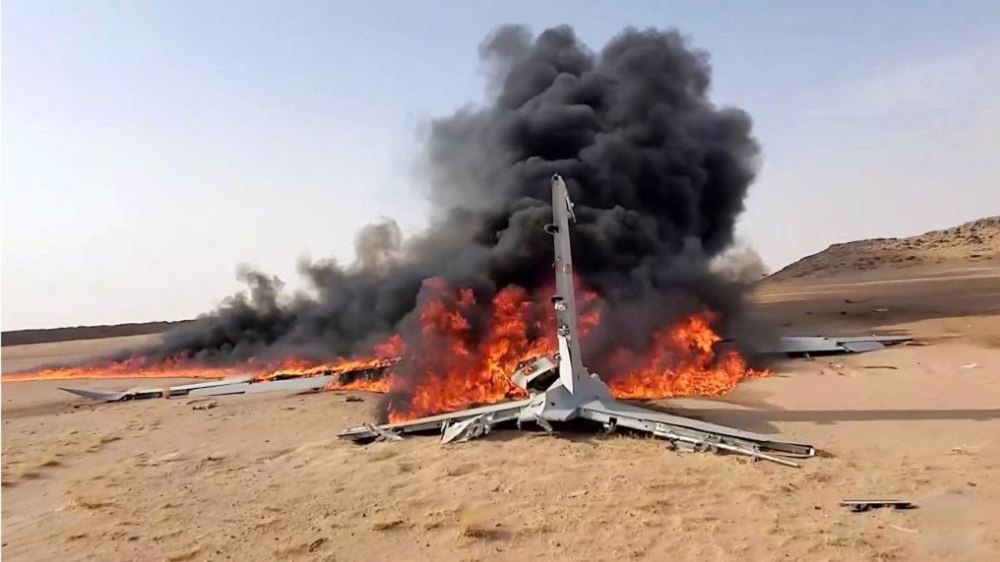
The Yemeni armed forces have released footage showing strikes targeting the positions and military trucks of Saudi troops in various locations across the kingdom, using a new homegrown strike-reconnaissance drone.
The video footage, released by the media bureau of Yemen’s Operations Command Centre on Saturday, showed Yemeni Rajum (Sling) unmanned aerial vehicles being employed in the retaliatory operations.
The strike-reconnaissance drones precisely monitored their targets before dropping high-explosive projectiles on Saudi troop concentrations and military vehicles, causing significant losses.
The footage showed the Yemeni drones targeting armoured vehicles, battle tanks, as well as fortified positions of Saudi military forces. In one instance, Saudi troops camouflaged under trees were dealt a heavy blow.
It further documented fires, thick plumes of black smoke rising from targeted vehicles and military positions, as well as strikes on Saudi troops as they were building trenches and fortifications.
The footage also showed Rajum drones targeting fortified Saudi troop concentrations and destroying tanks. The surprise strikes caused utter confusion and mass exodus among Saudi forces.
The Yemeni military has also announced a number of successful operations aimed at ships linked to Saudi Arabia in the Red Sea.
- Around 71,000 children are among some 130,000 people displaced across Yemen over the past three weeks, as escalating violence due to Saudi-backed attacks continues to disrupt healthcare and deepen hunger and malnutrition among children, the United Nations Children’s Fund (UNICEF) says.
UNICEF Country Representative in Yemen, Akhil Iyer, told reporters at the Palais des Nations in Geneva last Friday that the majority of those displaced had been forcibly relocated from or within the southwestern governorate of Ta’iz, with children bearing a particularly heavy burden of the worsening humanitarian crisis.
‘Conflict drives hunger, and hunger makes children more vulnerable to conflict,’ Iyer told reporters via videolink.
He added that UNICEF is ‘very concerned about a very visible increase in acute malnutrition among children.’
UNICEF’s mobile teams have conducted screening assessments for approximately 2,900 children across accessible regions during the past several weeks.
Iyer reported that over 25 per cent of these children exhibited acute malnutrition, with 200 cases classified as ‘severe’ – representing the most critical classification.
According to UNICEF, the rising cases of child malnutrition recorded in accessible areas represent only part of a much wider crisis across Yemen.
The agency estimates that 2.2 million children under the age of five will suffer acute malnutrition this year, including more than 500,000 expected to experience severe acute malnutrition.