
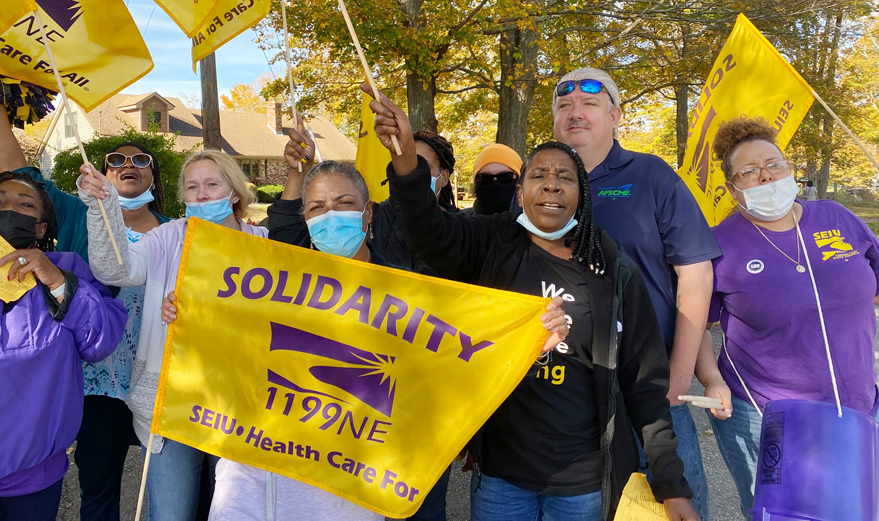
Healthcare workers gathered outside Lenox Hill Hospital in Manhattan last Thursday as part of a nationwide day of action focused on immigrant workers, with the SEIU trade union warning that changes to immigration protections could deepen staffing challenges and affect patients who rely on the healthcare system.
The rally was one of several held across New York City as part of ‘Healthcare Needs Us All,’ a campaign hosted by Local 1199 of the Service Employees International Union (SEIU) and other labour organisations.
Workers and organisers called on Congress to restore legal status for immigrants with Temporary Protected Status (TPS) and other forms of work authorisation, and create pathways to citizenship.
The demonstrations came as the Trump administration expands immigration enforcement and moves to end or alter protections for some immigrant populations. Haitian TPS holders have been especially vulnerable while also comprising a large segment of healthcare workers in the US
The concerns raised at the rally reflect a larger issue for the workforce, organisers said.
Nearly 20 per cent of essential caregivers and providers working in US hospitals, nursing homes and home and community-based care were born outside the United States, organisers said. Roughly one million healthcare workers have legal work authorisation that is threatened by current immigration policies.
Vernon Jefferson, a rehabilitation aide who has worked at the Lenox Hill Hospital for 40 years, said that the national immigration policies have severely disrupted the work environment.
‘Some of the workers, especially the immigrant workers, are nervous because they’re not sure what’s going to happen.’
Jefferson also said that four hospital workers had been sacked and deported.
Jasmine Braithwaite, a social worker who has worked at Lenox Hill for nine years, said the uncertainty can weigh on healthcare workers – whose jobs intrinsically involve caring for others – while worrying about their own security and ability to remain in the country.
‘How can you focus on completing your work and caring for other people, especially when you work in a hospital setting, when you have to worry about whether or not you’re going to be okay,’ she said.
Nadine Williamson, Local SEIU 1199’s senior executive vice president, linked the immigration issue to broader concerns about federal healthcare funding. She said the healthcare system is already facing pressure from $1 trillion in federal Medicaid cuts contained in the Republican budget bill.
‘The attacks on immigrants are making it even worse,’ Williamson said in a statement, calling for Congress to restore healthcare funding, reverse Medicaid cuts and provide a path to citizenship for Dreamers while restoring TPS.
Henry Garrido, the executive director of the union’s District Council 37, said: ‘Many of our own members are now facing the excruciating challenge of how to provide for their families while facing the threat of deportation.’
Other union demands include ending travel bans and processing delays that organisers say prevent qualified immigrants from working legally in or even reaching the United States, as well as redirecting money currently being used for deportation operations toward healthcare programmes.
The day of action extended beyond Manhattan. In Brooklyn, SEIU Local 1199 and New York State Nurses Association members rallied at Maimonides Medical Centre, emphasising the need to protect immigrant workers and patients.
Healthcare workers also gathered at Interfaith Medical Centre, holding signs and chanting in support of their foreign colleagues.
At Lenox Hill, the rally also highlighted the longstanding role of unions in organising healthcare workers.
Meanwhile last Tuesday, New York City officials announced a record $131.5 million settlement with the app-based delivery company DoorDash, as the delivery company has illegally underpaid more than 260,000 workers.
The settlement includes more than $115 million in payments to workers and more than $16 million in civil penalties and costs. It is the largest worker settlement in the history of both the city and the state.
Mayor Zohran Mamdani said: ‘For years, DoorDash failed to count every hour worked by delivery workers.
‘This was not a rounding error or an accidental mistake.’
The settlement covers workers who were underpaid between April 22, 2022, and June 28, 2026.
The city said it identified workers who are owed money through its analysis of DoorDash’s records.
Under the settlement, workers who were not paid at all will receive roughly three times the amount they were owed, while those who were paid late will receive roughly twice the amount.
Rosendo Tacam, a DoorDash delivery worker and leader of Los Deliveristas Unidos, an organisation that advocates for tens of thousands of delivery workers, said: ‘For many years, we delivery workers have been out here every day, working more than 80 hours a week, delivering food and medicine to keep New York City moving. I gave DoorDash everything I had, and then they “deactivated” me and didn’t pay me for my last week of work.’
Ligia Guallpa, executive director of Workers Justice Project, said the settlement was the result of years of organising by delivery workers.
Guallpa said: ‘This settlement puts money back in workers’ pockets and holds DoorDash accountable.
‘We celebrate this victory, but the fight continues: we will keep organising for job security, safer working conditions, higher pay and respect.’
- Starbucks plans to close 250 North American stores this week.
It is the second big round of store closures under Starbucks Chairman and CEO Brian Niccol, who joined the company in 2024. Last September, Starbucks closed 627 stores in North America and Europe.
In a letter to employees, Starbucks Chief Operating Officer Mike Grams said the locations targeted ‘either aren’t delivering acceptable financial results or can’t provide the kind of experience that Starbucks wants for customers and employees’.
Starbucks Workers United, represents more than 12,000 workers at the 700 company-owned US Starbucks stores that have voted to unionise.
The union said: The closing continues Starbucks’ trend of carrying out a betrayal of what workers and customers loved about the company.
‘As Starbucks continues to close stores, violate labour law, hike up our healthcare premiums,it has never been more clear why baristas need the backing of a union.
‘We love our jobs, and we know Starbucks doesn’t run without us, so we’re organising together to demand a better future and a fair contract.’
Starbucks stores have been voting to unionise since late 2021.
A nationwide strike of more than 4,500 workers across 130 stores late last year failed to result in a contract agreement and this summer the union called for a nationwide boycott of Starbucks.
In the midst of that boycott workers at a Queens Starbucks voted 19-1 to unionise with Workers United, the union announced on Sept. 15, becoming the 65th Starbucks in New York to unionise.
Meanwhile, members of Teamsters Local 767 at Safran Seats were forced to launch an unfair labour practice (ULP) strike in Gainesville, Texas, after the employer refused to offer a contract that did not require mandatory overtime.
Dave Reeves, President of Local 767 said: ‘Instead of addressing Safran Teamsters’ concerns with a provision in the tentative agreement, the company has decided to play games at the bargaining table and forced us to the picket line.
‘Due to Safran’s unwillingness to present a revised agreement without mandatory overtime, Teamsters will be on strike until the company gets serious and offers a fair contract.’
More than 350 Teamsters build airplane seats for major airlines at one of the nation’s largest suppliers.
Michelle Shero, a Teamsters member, said: ‘We are out here striking because we want no mandatory overtime, our holiday pay back, and fair wages for all of us Teamsters. We deserve a strong contract for all of the hard work we put in day in and day out.’