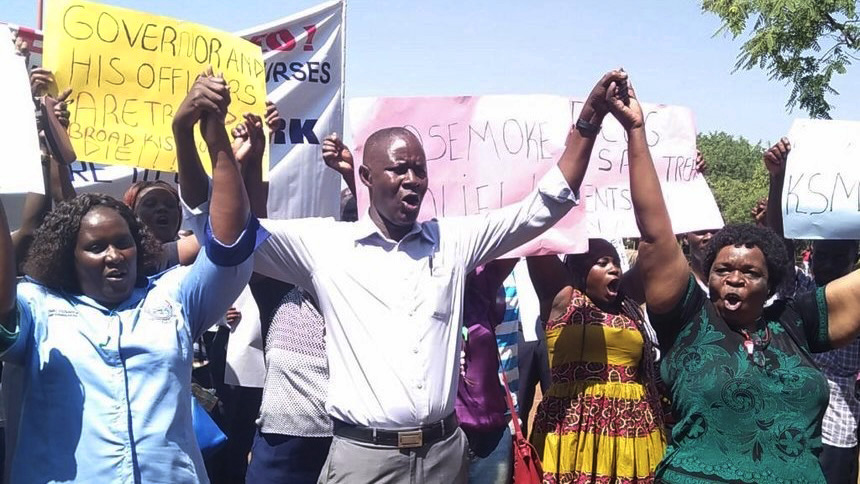
The Kenya National Union of Nurses (KNUN) has vowed to continue its strike despite court orders directing the striking health workers to resume duty, escalating the standoff with the government over the implementation of a 2017 return-to-work agreement.
KNUN Secretary General Seth Panyako said on Saturday that nurses would not return to work until the government honours commitments contained in the agreement.
‘Up to now, the return-to-work formula of 2017 has never been implemented by the current government,’ Panyako said.
The union leader accused the government of treating nurses differently from other groups involved in the labour disputes of 2017, saying some workers had since received outstanding arrears arising from agreements reached at the time.
‘Our colleagues that had an argument in 2017 have had those arguments honoured and arrears have been paid.
‘We don’t understand why the government feels like nurses are not important.’
Panyako also rejected calls for the union to call off the strike in compliance with court orders, saying KNUN is prepared to face the legal consequences of continuing with the industrial action.
He accused the courts, the Council of Governors and the Salaries and Remuneration Commission of frustrating efforts by nurses to secure implementation of their agreements.
Panyako said: ‘We are therefore, as law-abiding citizens, ready to appear in court and ready to tell the court that we want to take the punishment that might be meted out to us. Otherwise, there is no going back to work.’
The continued industrial action has disrupted services in public health facilities, with patients facing delays and some facilities advising those seeking non-emergency treatment to consider alternative hospitals.
On Friday, Kenyatta National Hospital advised patients seeking non-emergency services to seek treatment at other health facilities as the strike continued to affect its operations.
The latest position by KNUN sets the stage for a renewed confrontation between the nurses’ union and the government, with the dispute now extending beyond the implementation of the 2017 agreement to questions surrounding compliance with court directives.
Meanwhile, The Trade Union Congress of Nigeria (TUC) has thrown its weight behind the ongoing strike by aviation workers, who are demanding the immediate remittance of five per cent ticket charges by airlines and insisting that workers’ right to unionise must be respected.
TUC president-general, Comrade Festus Osifo, made the position known in the capital Abuja while addressing journalists on economic and labour issues affecting Nigerians and workers.
Osifo said the aviation workers’ action, involving affiliates of the labour centre, was triggered by unresolved grievances including alleged refusal by some airlines to allow workers to organise under trade unions and failure to remit the statutory five per cent ticket charge meant for workers.
He said the TUC had been engaged by aviation unions ahead of the strike and had intervened with relevant authorities to seek an amicable resolution. However, he warned that merely persuading workers to suspend the action without addressing the underlying issues would only create conditions for another industrial dispute.
‘One of the principal issues is that this airline, they have refused members who want to unionise to unionise and any company who does not want a member to organise, what you are actually doing is, you are subjecting them to hardship. You know that you are not taking care of their welfare and you know that you just want to wake up and get them terminated.
‘It is our right to unionise. We have the right so no employer can stop an employee from belonging to the union.’
The TUC also urged the government to sustain food imports until domestic production and security conditions improve enough for farmers to return fully to their farms.
Health workers are also calling on the Nigerian government to improve working conditions and welfare as concerns grow over the migration of young healthcare professionals.
The President of the West African Health Workers Unions Network and Medical and Health Workers Union of Nigeria, Kabiru Ado Minjibir, made the call at an event marking International Youth Week in Abuja.
Young health professionals make up a significant part of Nigeria’s continuing health-sector brain drain.
Available data indicates migration across the health worker sector rose by about 200 per cent between 2023 and 2024.
Kabiru Ado Minjibir says better working conditions, welfare and career opportunities are critical to retaining health workers and protecting gains in the sector.
Representatives of the Nigeria Labour Congress and youth leaders also identified mentoring as important in encouraging young professionals to build their careers within the country.
Their concern is that without retaining more trained professionals, shortages of health workers could continue to affect healthcare delivery across the country.
- The Congress of South African Trade Unions (COSATU) said on Monday that it stands with its affiliate, the South African Transport and Allied Workers Union (SATAWU), against the claim that progress has been made limiting the number of workers affected by sackings at the Passenger Rail Agency of South Africa (PRASA).
COSATU stated: ‘Department of Transport released a statement this week lauding the progress made by the Section 189 Ministerial Task Team limiting the number of workers to be affected by retrenchments at the rail agency.
‘Late last year, PRASA initiated a Section 189 consultation process following a decision to cut staff in its long-distance division, Shosholoza Meyl. At the time the total number of staff affected was 580.
‘Both SATAWU and the United National Transport Union (UNTU), participated in the consultation process facilitated by the CCMA conciliation service.
‘In June this year, Minister of Transport, Barbara Creecy, appointed a Section 189 Ministerial Task Team comprising organised labour, the Department of Transport and PRASA management, to explore alternatives to limit the number of workers affected.
‘In its statement, the Transport Department said 43 workers had opted to take early retirement packages effective as of 1st August 2026.
‘Another 102 workers had been placed in identified vacancies across other PRASA divisions and departments; while a total of 208 Protection Services workers were set to be transferred to Transnet in line with the transfer of stations and related assets.
‘According to the statement, Minister Creecy had extended the term of the Task Team to end of August to ensure options were explored for the remaining 227 workers. But SATAWU argues that the 227 workers are likely to be unemployed by the end of August.
‘Given the latest unemployment figures have shown a steady climb towards dangerous territory at 43.8 per cent, COSATU agrees with its affiliate that the possible retrenchment of 227 workers is not progress.
‘Everything must be done to ensure we preserve every single job, because losing 227 jobs would be a disaster.
‘COSATU is also disappointed that PRASA has not done more to revive long-distance rail travel given the carnage on our roads. The rail agency must consider investing in a consistent, prolonged marketing campaign to introduce a new generation to the magic of long-distance rail travel.
‘Outside of flying, only Shosholoza Meyl has the capacity to make travel from one province to another fuss free, scenic and utterly enjoyable.
‘It is unfortunate that we had to reach a stage where retrenchments were contemplated, because an opportunity to revive long-distance rail travel was not taken advantage of.
‘COSATU calls on Minister Creecy, the Transport Ministry and PRASA to do everything in their power to ensure that alternative placements for the 227 workers are secured to avoid the devastation wrought on by retrenchment.’