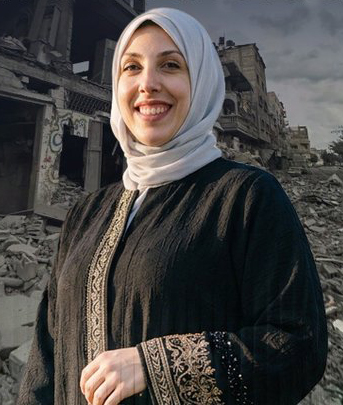
Dr Yasmeen Khamis Al-Bubu was not merely a new name added to the lists of war victims in the Gaza Strip, but a Palestinian academic who dedicated years of her life to science and education.
She was a woman who chose to make caring for her elderly mother an essential part of her life, before their story ended together on Saturday under the rubble of a house targeted by an Israeli strike west of Gaza City.
At dawn on Saturday 3rd October, a ground-floor apartment in the Al-Asala building in the Rimal neighbourhood, near the Haidar Abdel Shafi roundabout, turned into rubble after being targeted by an Israeli strike that resulted in the martyrdom of five Palestinians, including four women – Dr Yasmeen, her mother Hajja Halloum Al-Bubu, Maysa Khader Abu Dawoud, and her daughter Mary, alongside a young man Bilal Ouda, while others were injured.
The victims were united by nothing other than residency and neighbourhood; a Palestinian mother and her daughter, an academic and her mother, and all of them found themselves facing a single strike that ended their lives all at once.
Behind Yasmeen’s academic career lies a human story that was not widely known, represented in her relationship with her 80-year-old mother, to whom she chose to dedicate a large part of her life.
After her father’s death, Yasmeen did not marry, according to statements from her colleagues and relatives, and dedicated her time to caring for her mother and supporting her, remaining beside her during the years of displacement and war.
Her relatives described her attachment to her mother as extraordinary.
Her niece Iman said that Yasmeen was a source of hope and warmth for the family, and that she used to gather family members and maintain the bonds despite the conditions of war and displacement.
She also revealed that she had visited her just one week before her martyrdom, after she’d undergone surgery, and was still suffering physically from its effects, but that did not prevent her from retaining her spirit and usual kindness.
That operation was not the last pain Yasmeen was exposed to; the strike came before her wound could heal, ending both her and her mother’s life at once.
One of the most painful details of the story is that Yasmeen was talking on the phone with her niece about half an hour before her death, in an ordinary family call filled with laughter and jokes.
Her relatives were talking to her as they used to, without knowing that those laughs would be the last.
Her sister’s husband, academic and media figure Dr Hassan Al-Madhoun, says that Yasmeen was to him like the sister, adding that she accompanied the family during the stages of displacement, and was a model of calmness and humanity.
He recalls the final moments before the bombing, and that last call was full of laughter and family jokes, before everything turned into silence under the rubble.
Yasmeen was also a Palestinian academic who dedicated her career to education and science.
She worked as a lecturer in the Multimedia Department at the College of Intermediate Studies at the University of Palestine; she previously served as head of the Multimedia Technology Department, and held the position of Vice Dean of Administration.
She began her scientific journey by obtaining a bachelor’s degree in Management Computer Information Systems from Al-Quds Open University, then continued her higher studies and obtained three master’s degrees in the fields of management and information systems, computer science and information technology, and sustainable development.
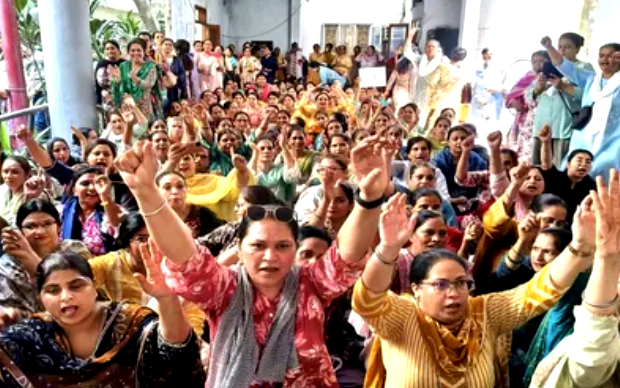
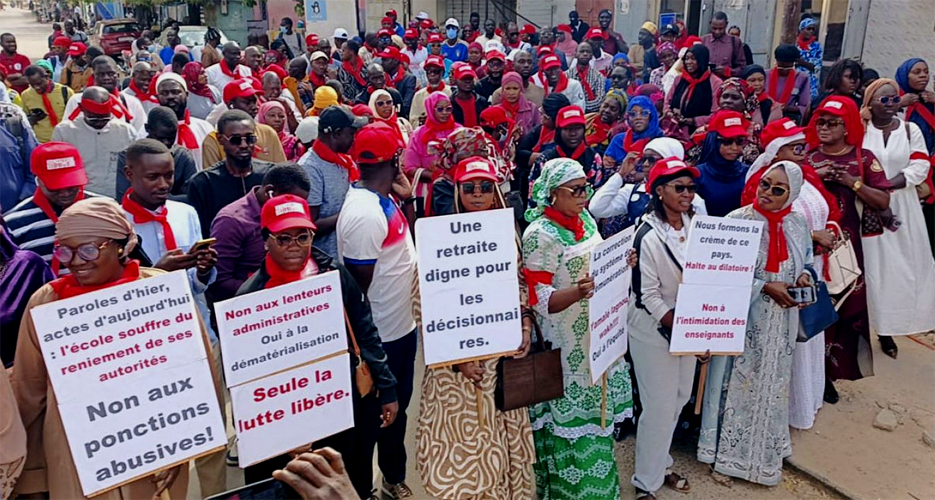
- The Palestinian education sector has suffered heavy losses in Israel’s ongoing genocidal war on the Gaza Strip, with more than 800 teachers killed, 3,300 injured, and over 170 kidnapped since October 2023.
Marking ‘World Teachers’ Day’, the ministry of education said on Sunday that these figures underscore the scale of the damage inflicted on the Palestinian education sector.
However, the ministry affirmed that Palestinian ‘teachers remain committed to their educational mission despite killing, destruction, displacement, and arrest.’
This year’s World Teachers’ Day is being observed under the theme: ‘Standing with teachers: 60 years of protecting the profession, advancing its status and shaping our futures.’
For Palestinian teachers, however, this occasion comes amid a vastly different reality shaped by Israel’s aggressive practices, whose impacts have extended beyond schools and educational facilities to affect teachers, students, and all components of the educational process.
Around 846,000 male and female students in Palestine’s West Bank schools began the 2026/2027 academic on Sunday, amid official preparations to provide the requirements of the educational process, at a time when Palestinian education in the Gaza Strip and Jerusalem faces extraordinary conditions and challenges because of the war and occupation.
West Bank students are distributed across 2,537 government, private, and United Nations Relief and Works Agency for Palestine Refugees (UNRWA) schools, supervised by around 54,000 male and female teachers.
According to data from the Ministry of Education and Higher Education, the number of students in government schools reached 634,294 male and female students distributed across 1,967 schools, while 163,787 study in 480 private schools, and 48,208 students study in 90 UNRWA schools.
The number of male and female teachers in government schools stands at 40,747; in private schools it’s 11,578, and in UNRWA schools 1,871, bringing the total teaching staff to 54,196 male and female teachers.
The Ministry of Education is working to implement new projects to enhance infrastructure and increase the capacity of schools.
The projects include building 17 schools for academic education, alongside 183 classrooms and facilities, at a total estimated cost of around 19.5 million dollars, and these schools are expected to be up and running during the current year.
Two Palestinian journalists abducted in the West Bank
Israeli military forces have abducted two Palestinian journalists in the West Bank, as the regime forces continue their crackdown across the occupied territory, kidnapping dozens of civilians and demolishing several homes.
Israeli troops raided the town of Arraba, south of Jenin, in the early hours of Sunday, and detained journalist Raja Maarouf Jabr after breaking into her home and ransacking it.
They also raided ‘Asira al-Qibliya village, southwest of Nablus, overnight and abducted journalist Sami al-Shami along with five other residents.
The latest abductions of Palestinian journalists come more than a fortnight after Israeli forces seized Press TV correspondent Naqaa Hamed in the West Bank.
Hamed, 38, was abducted on September 14 by occupation forces at a checkpoint near Tuqu’ in Bethlehem. She was set free on October 4th, after nearly two weeks in detention at Damon Prison.
Separately, Israeli forces rolled into the town of Kafr Dan, west of Jenin, where they kidnapped Ahmed Abdul Jabbar Salah and Mohammed Ahed Salah as they stormed several homes.
Palestinian security and local sources were also quoted as saying that an Israeli special forces unit raided the Old City of Nablus in the early hours of Sunday, before several Israeli military vehicles entered the area.
The forces barged into several homes in the al-Qaryoun neighbourhood before abducting two Palestinians, identified as Izzat Tabila and Jihad Qazour.
Furthermore, Israeli soldiers stormed the town of Qabatiya and Kafr Dan village, where they ransacked several homes and kidnapped several locals. They also raided the Jenin refugee camp and abducted a civilian.
In al-Mughayyir village, northeast of Ramallah, Israeli forces ransacked several homes before they searched several other Palestinian houses in Qalandiya refugee camp and the town of Hizma.