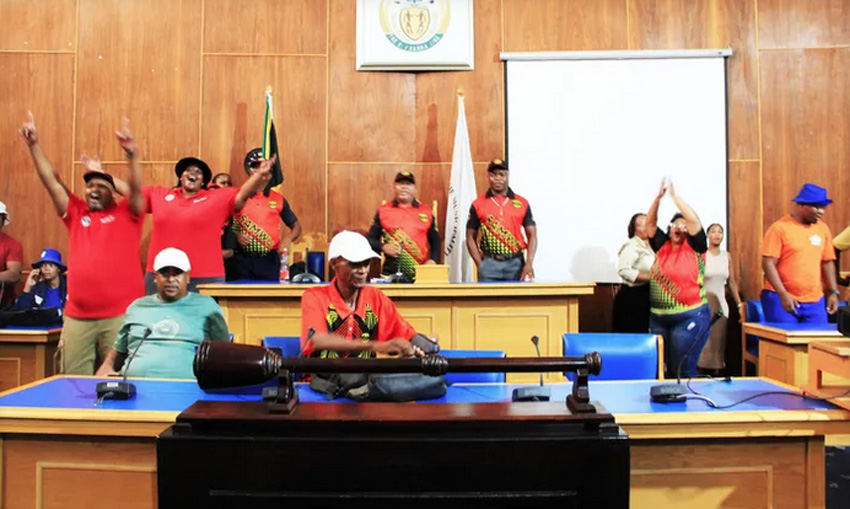
THE SOUTH African Municipal Workers Union (SAMWU) and the Independent Municipal and Allied Trade Workers Union (IMATU) occupied the Sol Plaatje council chambers last Thursday, vowing that services would come to a standstill unless casual workers were given permanent contracts.
A sit-in was held at the municipality while full-blown strike action is planned for this week.
An Integrated Development Plan (IDP) meeting held at the Kimberley City Hall last Wednesday was also disrupted, with chairs being grabbed from members of the public.
Samwu local chairperson Ronney Morwe said that after the municipality had promised to make 498 workers in permanent phases starting from 1st December 2025, they were later informed that there were no funds available.
Morwe said: ‘Council is only prepared to appoint 44 workers. That is a slap in the face of the union, which is being undermined.
‘It is not correct that workers must remain without a proper contract for 25 years.
‘They should automatically become permanent workers after three months.
‘Letters of permanent appointment as well as medical aid forms were signed and families were happy. But then they were stopped.’
Morwe added that the suspended municipal manager, Thapelo Matlala, wanted to absorb all 498 workers.
The chief financial officer now says there is no money.
Morwe said Sol Plaatje executive mayor Martha Bartlett should ‘take the fall’, as she was the supervisor of the municipal manager.
He alleged that the R2.5 billion Budget Facility for Infrastructure (BFI) grant to upgrade water infrastructure in the city was being ‘crippled’.
He asked: ‘How do you eat R900 million in six months?
‘It is shocking that the council is spending R3.5 million on car allowances and R1.8 million on cellphone allowances. These officials are sitting in air-conditioned offices and can make use of the office phone free of charge.
‘Why else do they need airtime and data, unless it’s to ask, “babe, where are you?”’
The South African Federation of Trade Unions and General Industries Workers Union of South Africa (GIWUSA) last Thursday said that a 1.44 rands (less than a penny in British money) increase to South Africa’s industry minimum wage which will come into effect next month is ‘pathetic’, ‘measly’ and an ‘insult to the workforce’.
GIWUSA also condemned the fact that public sector workers can work for as little as 16.62 rands (76 pence) an hour as a ‘disgrace’.
SAFTU general secretary Zwelinzima Vavi said: ‘In terms of the amendments, the national minimum wage is set at 30.23 rands (£1.39) for each ordinary hour worked.’
Farm workers and domestic workers are entitled to the same hourly rate, while workers employed under the Expanded Public Works Programme (EPWP) remain subjected to a sub-minimum wage of R16.62 per hour.
‘This two-tier wage system is indefensible.
‘At face value, the increase from 28.78 rands to 30.23 represents a nominal adjustment of approximately 5 per cent.
‘However, this increase does not meaningfully keep pace with the real inflation experienced by working class households
‘An hourly wage of R30.23 translates into a monthly income of R5,913.13 per month (£41.85) on a 45-hour working week, which still condemns millions of workers to poverty.’
Giwusa president Mametlwe Sebei said: ‘This proposed increase of R30.23 is not a step forward, it is a profound betrayal of the 5.5 million workers the government claims to protect.’
He proposed an immediate increase to a floor of 15,000 rands per month (£687), with a clear, binding plan to close the gap for all workers.
- The National Union of Mineworkers (NUM) has urged the Department of Trade, Industry, and Competition to intervene urgently and prevent job cuts at Cast Products SA, which is facing liquidation.
In a statement released by the NUM, it says the company initiated a voluntary Business Rescue process in 2022, with the goal of stabilising the company and finding a suitable equity partner.
Following years of uncertainty, the Business Rescue Practitioners (BRPs) approved a plan in which a new shareholder would take over the business and begin operations.
Despite this, the Industrial Development Corporation of South Africa (IDC) has rejected the finalised agreement and cut off all funding.
Union members protested outside the IDC’s offices on Wednesday, demanding that the liquidation process be halted.
NUM PWV regional organiser, Mpho Hlongwane said: ‘We want a high level meeting where we’ll also include our national office stewards of NUM to come and assist us on this particular matter.’
- Elsewhere, in Nigeria, a Nigerian court has ordered the British government to pay £20 million to each of the families of 21 coal miners killed in 1949 by the colonial administration in the south east of the country.
The colonial police, made up of Nigerians and Europeans, shot dead workers striking for better conditions.
Dozens more were injured in one of the most notorious acts of repression under British rule in Nigeria.
Historians say the killing helped galvanise support for the burgeoning anti-colonial movement that led to independence 11 years later, in 1960.
Families and rights groups have led a decades-long campaign for official acknowledgment and compensation.
The ruling, delivered by Justice Anthony Onovo in Enugu, described the massacre as unlawful and extrajudicial violation of the right to life.
Onovo said: ‘These defenceless coal miners were asking for improved work conditions. They were not embarking on any violent action against the authorities, but yet were shot and killed.’
The workers at the Iva Valley coal mine were protesting against harsh working conditions, racial disparities in wages and unpaid back wages.
When their demands were not met, they adopted a ‘go-slow’ protest and occupied the mine to prevent management from locking them out.
The suit was brought by human rights activist, Mazi Greg Onoh, who listed the British and Nigerian governments as respondents.
The killings took place on 18th November, 1949, in Enugu, which was the administrative capital of the Eastern Region of British administered Nigeria at the time.
Historian Damola Adebowale said: ‘Calls for independence already existed and talks were ongoing.
‘The massacre was a reference point for people outlining the need for the colonialists to go.’
During an official investigation at the time, the police defended the shootings by saying they feared being overwhelmed.
But among those that the inquiry blamed were the colonialists in charge of the police for inflaming the situation.
Those killed are now celebrated in the region as heroes.
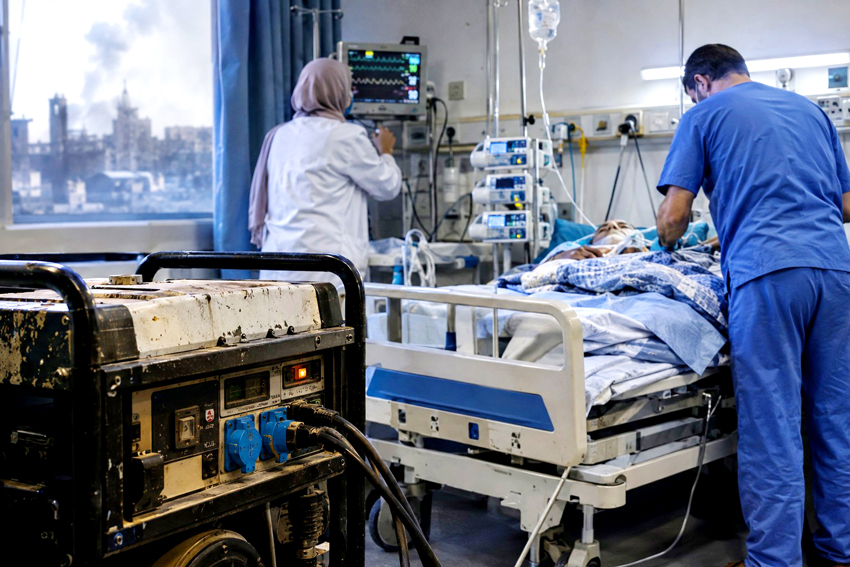
Striking health workers under the Joint Health Sector Unions (JOHESU) have reiterated that only an adjustment of the Consolidated Health Salary Structure (CONHESS) will end their prolonged industrial action, as talks with the Nigerian Federal Government remain stalled.
The strike, now in its 82nd day, has crippled operations in public hospitals nationwide, leaving many patients without access to care and forcing others to turn to private facilities for essential medical services.
In a joint statement signed by TUC Secretary General Nuhu Toro and acting NLC General Secretary Benson Upah, the labour centres accused the government of deliberately refusing to act on the salary review despite repeated engagements.
They rejected what they described as ‘the persistent and deliberate provocative refusal of the Federal Government to implement the report of the Technical Committee on the adjustment of the Consolidated Health Salary Structure’.
According to them, the delay ‘is no longer an administrative lapse but a conscious act of injustice, bad faith and institutional disrespect to health workers and organised labour’.
‘It is, therefore, unacceptable and a blatant provocation that while the government had no difficulty implementing the adjustment of the Consolidated Medical Salary Structure with effect from 2nd January , 2014, the same government has wilfully refused to implement the same for CONHESS,’ the statement added.
Speaking in Abuja, JOHESU National President Kabiru Minjibir said negotiations with the government had reached a standstill.