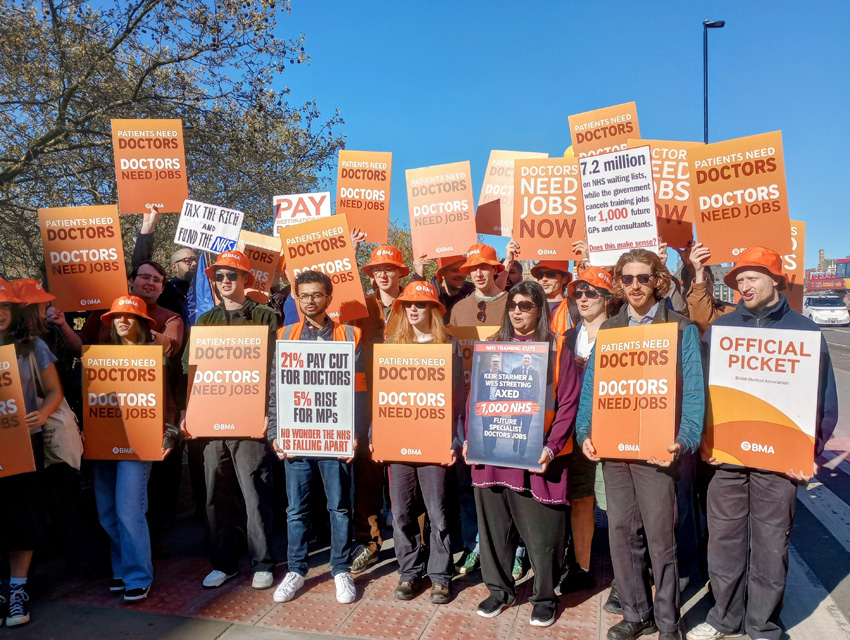
Doctors who work in London are campaigning for an increase to the allowance they receive for living and working in the capital – which has not risen in more than 20 years despite the cost of living skyrocketing in this time.
London Weighting is an additional payment to a worker’s salary to address the added expense of working in London.
This payment has not gone up for doctors since 2005, despite a significant increase in the cost of living in the last two decades – despite other sectors, including the civil service and other parts of the NHS, raising the payment accordingly.
British Medical Association (BMA) London is now launching an online indicative ballot to assess doctors’ readiness to take further action if the allowance is not raised.
This will open on Monday 19th October and run for six weeks, closing on Monday 30th November.
The current doctors’ London Weighting payment is a maximum of £2,162 a year for those working in inner London.
But for doctors working in outer London the payment is just £527, and for those working on the fringe of London it is a mere £149.
The NHS already recognises that working in London carries additional costs.
The pay system for all staff in the NHS – except doctors, dentists and senior managers – known as Agenda for Change, carries a maximum inner London weighting of £8,746, which has increased by 59% since 2005.
While doctors’ London Weighting has remained frozen, the costs of living and working in the capital have skyrocketed.
Since 2005, house prices have increased by 112% and the cost of rent has gone up by 128%.
Office for National Statistics (ONS) figures show average monthly rent in the capital reached £2,332 in August 2026, compared with £1,459 across the rest of England.
Tube fares are up 82%, rail season tickets are up 100% and the congestion charge is up 87%.
Council tax has gone up by 70%, while energy bills have gone up by 129%.
Doctors are demanding full parity with their NHS colleagues on London Weighting so that the payment properly reflects the additional cost of living and working in the capital.
A doctor who is in their first year of working, who lives in North London and receives the outer London payment, said: ‘Living and working in London is incredibly expensive and the cost of living is only becoming more unaffordable.
‘I live with my family, which I’m lucky to be able to do, but I simply can’t afford to move out because rents are so high.
‘I’m not the only one. Many doctors I work with are also living at home or having to go into their overdrafts just to afford the deposits needed to rent a flat.
‘It’s not just housing either. The cost of food shopping, commuting to work and even socialising is astronomical, making it increasingly difficult to afford to live and work in the capital.
‘Increasing the London Weighting would make a real difference, helping me save towards moving out while taking some of the financial pressure off the day-to-day cost of living and working in London.’
Dr Callum Parr, a resident doctor working in North West London and honorary secretary of th BMA London regional council, said: ‘Doctors and their NHS colleagues can work in the same hospital, travel on the same tube and face the same London rents, yet receive very different support towards those costs.
‘The NHS already recognises that working in London costs more. What we are asking is why doctors’ payments have been left frozen since 2005 while those for our colleagues have increased.
‘For doctors starting their careers, the cost of renting and travelling to work in London puts real pressure on their finances.
‘An allowance that has stood still for more than two decades is increasingly disconnected from the costs it was designed to recognise.
‘We are asking members in this ballot whether they are prepared to take further action to secure a fair payment. Doctors deserve the same recognition of London’s additional costs as their NHS colleagues.’
- The BMA’s UK resident doctors committee (UKRDC) has elected Dr Callum Parr as its new chair.
Dr Parr is a resident doctor based in London, working as an internal medicine trainee.
He said on the day of his election last Friday: ‘It is an honour to have been elected chair of UKRDC.
‘I am under no illusions about the responsibility of this position and I’m determined to stand up for the tens of thousands of doctors I now represent in a way that will deliver more progress and wins for them.
‘There is a huge amount to do. Pressure is piling on the profession from every direction: eroded pay, understaffed rotas, substitution of our expertise by an NHS management looking to cut corners, training bottlenecks and job insecurity are making the career we have chosen feel ever more precarious.
‘But this pressure is not inevitable: it is the result of decisions made by policymakers, and by applying our own pressure in turn we can fight back and fix the problems that face us.
‘We’ve done that before and we can do it again. That’s why I ran for this position and that’s what I intend to do.
‘We have made progress in recent years and I thank my predecessors for their work, but I now pick up the baton with a focus on implementing the 2026 deal in full and preparing for the DDRB’s pay recommendation in April.
‘We have already put the (doctors and dentists pay review body) DDRB on notice, and if we don’t make sufficient progress on restoring our pay, a dispute will be unavoidable.
‘I am going to lead a committee that listens to its members, builds on our current strength and organises so that we are never taken for granted.
‘Being a doctor is a privilege, and I’m determined that we will restore the value of our profession.’
Unison theatre assistants at Leeds Teaching Hospitals NHS Trust begin indefinite strike!
Theatre assistants at Leeds Teaching Hospitals NHS Trust begin continuous, indefinite strike today, Wednesday 7th October, as they step up their fight to be employed in the appropriate NHS pay grade.
The health workers are demanding to be moved up a grade as they carry out clinical duties including handling samples, supporting surgical teams, using specialist equipment and maintaining safe, sterile operating environments.
They have already taken 40 days of strike action since the dispute began last December and their union Unison says interim chief executive Brendan Brown must now return to the negotiating table.
Brown oversaw a similar deal at Calderdale and Huddersfield NHS Foundation Trust, where theatre and maternity healthcare assistants were moved up a grade and awarded five years’ back pay.
The union says he has the experience to unlock the dispute and should do so before a new permanent chief executive is appointed.
Unison Yorkshire and Humberside regional organiser Jack Hemingway said: ‘Theatre assistants have already made enormous sacrifices, taking 40 days of strike action simply to be paid fairly for the work they do.
‘They want to be in work, caring for patients. But they’ve been left with no option but to head back to the picket line.
‘Brendan Brown has already shown he can resolve this kind of dispute. He needs to get back round the negotiating table, show these staff the respect they deserve and get this sorted.’
Tower Hamlets health visitors 3-day strike
Nearly 120 East London health visitors and support staff are taking strike action this week over service restructuring after their employer failed to give guarantees it would fully align NHS Agenda for Change pay structures.
The workers have already forced Tower Hamlets GP Care Group (THGPCG) to scrap plans that included dangerous reductions in staffing levels for the borough’s zero to five years old health visiting services, which covers nearly 20,000 patients.
During consultations with the union Unite, however, THGPCG has failed to give commitments that all staff contracts will fully align with NHS Agenda for Change pay, terms and conditions.
Unite general secretary Sharon Graham said: ‘THGPCG’s refusal to commit to NHS Agenda for Change for all staff will leave workers on inferior pay, terms and conditions.
‘The workers at THGPCG are receiving Unite’s 100 per cent support in taking strike action to stop this from happening.’
THGPCG is undertaking formal consultations for a full-service restructure.
After protests by the workers in July, THGPCG rowed back on plans that would have resulted in redundancies and staff being reinterviewed for jobs they already hold.
These plans would have resulted in unmanageable increases in workloads for remaining staff and put patients at risk.
However, THGPCG is refusing to commit to fully implementing NHS for Agenda for Change pay, terms and conditions for all staff. Unite is demanding that support staff, who are not on Agenda for Change contracts are brought onto them.
The dispute is also over the THGPCG’s failure to commit to reviewing health visitor roles under the NHS Agenda for Change job evaluation scheme, after the NHS Staff Council recognised health visitor pay banding is incorrect for many roles.
The workers are walking out for three days this week (yesterday Tuesday 6th, today Wednesday 7th and tomorrow Thursday 8th October) and further industrial action will be scheduled if the dispute is not resolved.
Unite regional officer Gary Boodhna said: ‘Our members, who are dedicated to providing the best possible care to thousands of young families in Tower Hamlets, are being forced to strike to prevent THGPCG turning them into second class employees.’