DISPLACED Palestinians in Gaza are heading into a fourth winter in collapsing tents with half a million people cut off from UN food assistance, as figures released on Monday showed Israel allowed in barely a fifth of the aid trucks required under the ceasefire in October.
Gaza’s Government Media Office said 3,777 aid trucks entered the Strip last month, 20.3 per cent of the 18,600 stipulated, and only 247 fuel trucks against the 1,550 required.
The World Food Programme (WFP) announced on 19 October that it was reducing its food assistance in Gaza by around a third because of funding shortages.
The number of people receiving its food and cash support has fallen from 1.6 million to 1.1 million. Families now receive one food parcel a month instead of two and half the previous flour ration, while the number of daily hot meals has been cut from 250,000 to 150,000.
The agency said last week that food insecurity was already worsening, with parents skipping meals so their children could eat and people falling back on one meal a day.
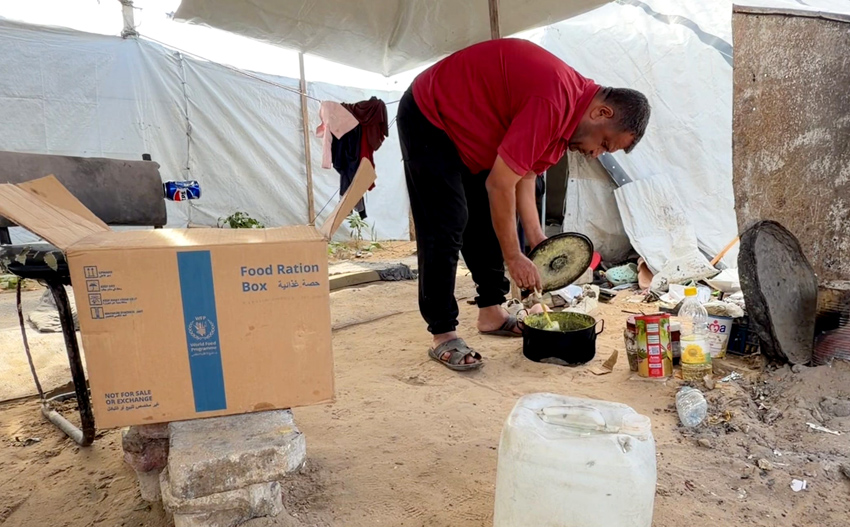
On the coastline west of Gaza City, Al-Abd Abu Beid sorted through a WFP box of sunflower oil, red lentils and canned hummus and beans.
‘We have no income at all,’ he told US Based Drop Site News. ‘We depend heavily on the brown boxes from the World Food Programme.
‘We were actually hoping they would improve the contents of these boxes, because they contain rice, lentils, and the same things over and over again.
‘Instead, we were shocked to hear that they’re going to cut it off.’
‘What is a family supposed to do? I have seven people in my family. How am I supposed to feed them?’ he said.
‘This is a humanitarian crime. People are being killed and slaughtered every day, and now you’re cutting off their food too. This is catastrophic.’
The cuts come a year after the ceasefire of October 2025, which was meant to end Israel’s assault and restore food, fuel and medicine deliveries.
Israel has killed 1,593 Palestinians since it took effect, according to the media office, and in October a UN Independent International Commission of Inquiry found that Israel continues to ‘commit genocidal acts even after the so-called ceasefire agreement, with the intent to destroy the Palestinian people, in whole or in part’.
The WFP estimates that 1.4 million Palestinians, 67 per cent of the population, face acute food insecurity at ‘crisis levels or worse’, and that 200,000 are in ‘emergency conditions’ requiring immediate food aid to prevent deaths from hunger.
Linda Abu Warda stirred a pot of rice stew over a fire in a thin metal box as her husband Fares fed it scraps of wood.
‘We depend on these parcels for everything: flour, rice, lentils, paste, chickpeas, and beans,’ she said. ‘I have children, as you can see. They’ll die of hunger.’
She added: ‘We were hoping they’d increase the amount of aid we receive, not reduce it.’
Famine took hold of Gaza in mid-2025 after Israel imposed a total blockade that March, followed by the US- and Israeli-backed Gaza Humanitarian Foundation (GHI), which replaced the UN.
Its four distribution sites, guarded by American mercenaries in areas occupied by Israeli troops, became death traps. More than 2,600 Palestinians were killed at or near GHI sites or the few UN convoys allowed in.
‘We hope they’ll allow this aid to enter officially and legally, instead of forcing us to go back to Zikim like before, when people had to risk their lives just to bring home a bite of food for their children,’ Fares Abu Warda said.
‘A man would go out and instead of coming home with a bag of flour, he’d come back in a body bag.’
Israel’s sudden halt to all commercial shipments in mid-October, lifted after several days, sent prices soaring.
‘When we want to cook a meal, we can’t even afford a single onion,’ Linda Abu Warda said. Onions now cost 30 to 40 shekels a kilo, against four or five before.
World Central Kitchen, Gaza’s largest provider of hot meals, halved its output to 500,000 meals a day in May, citing food prices driven up by the US-Israeli war on Iran and the closure of the Strait of Hormuz.
‘The famine has not ended in Gaza,’ said Ahmed Abu Qamar, an economic affairs researcher in Gaza City. ‘Since the ceasefire agreement last October, Israel has been pursuing a policy of engineered starvation.
‘In other words, it may allow people the bare minimum to eat each day, or even less than that, but it does not provide them with what they need to achieve food security and sustain their lives.’
In the same encampment, Mohammed Zayed was lashing tarpaulins and blankets to thin poles around his tent. ‘We’re extremely, extremely afraid of winter,’ he said. ‘People’s tents are worn out, falling apart, collapsing around them. Nobody has the means to replace a tent or change the tarps to prepare for winter.’
Pointing to the tarpaulins, he said: ‘All of this is just an illusion. All of this will be blown away.’
Nearly all of Gaza’s population has been displaced, and most now live in tent camps filling streets, squares, stadiums and fields.
Palestinians, mostly infants, have died of hypothermia over the past three winters, including 11 children last winter.
The UN Office for the Coordination of Humanitarian Affairs said in its latest report that ‘the near totality of the population’ was ‘bracing for a fourth winter without adequate protection from the cold, wind, rain and flooding risks’.
Since the ceasefire, Israel has pushed the ‘yellow line’ marking its military control further in, driving Palestinians west onto just 30 per cent of the territory, and has blocked reconstruction materials and mobile homes while restricting tents and shelter supplies in breach of the agreement.
‘This is the fourth year of displacement for most Palestinians in Gaza, the fourth winter in tents too flimsy to withstand the rain, and they are still under fire through it all,’ said Ajith Sunghay, head of the UN Human Rights Office in the occupied territories.
Khalda Ghattas once lived in an apartment in Gaza City’s Tuffah neighbourhood. ‘I used to live in an apartment building protected by concrete, with warmth, mattresses, furniture sets, and carpets,’ she said.
‘Then we were displaced to the port. The cold is already eating us alive. We can’t keep the wind out.’
A tarpaulin now costs 180 to 200 shekels. ‘Where am I supposed to get that money?’ she said.
‘This little girl has asthma, and I have children with respiratory diseases. I suffer from rheumatism, and my husband has a heart condition.’
Nasser Al-Shanbari, displaced from Beit Hanoun, sells shelter materials from a street stall. ‘A plank that used to cost 10 shekels now costs 150 shekels.
‘A small measure of nails that used to cost 10 shekels now costs 50,’ he said. ‘To fix up a shelter with wood, nails, and tarps, it would cost at least around 5,000 shekels.’
Many families have moved into bomb-damaged buildings at risk of collapse.
In September, at least 21 Palestinians, 12 of them children, were killed and 45 injured when a residential building sheltering more than 100 people collapsed in Gaza City.
In Jabaliya refugee camp, near the yellow line, Mohammed Al-Shabrawi is living in the ruins of his family home, where several relatives were killed in Israeli bombing.
‘We’re living in a bombed out house,’ he said. ‘When it rains tomorrow, the entire roof will leak. There isn’t a single part of it that doesn’t leak and let water pour down on us.’