ON the first Sunday in September trade unionists remember the Burston School Strike. It was the longest strike in history and lasted 25 years from 1914 to 1939!
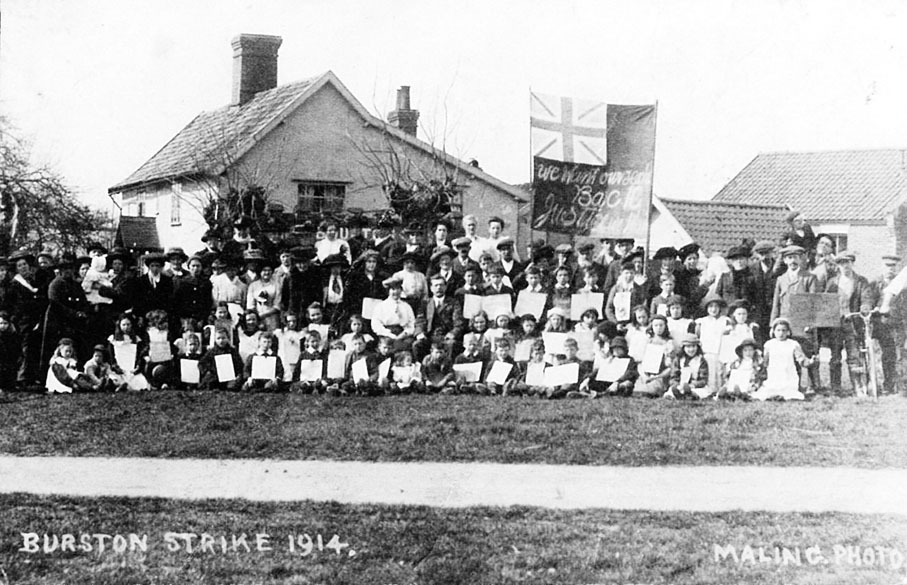
On April 1st 1914 teachers Tom and Annie Higdon were dismissed from their posts in the rural village of Burston, Norfolk and the strike began with children marching around the village with cards hanging from their necks demanding: ‘We Want Our Teachers Back.’
The banner at the head of the march was inscribed with just one word ‘Justice’.
Sixty-six of the local children had gone out on strike in support of their teachers, and the boycott of the local authority school lasted for the next twenty five years.
The longest strike in history was not staged by miners but by minors – the children of a small village in Norfolk.
On 1st April, 1914 pupils of the Burston village school, supported by their parents, took to the streets in protest at the dismissal of their teachers, Tom and Annie Higdon.
The strike began when teachers at the village’s Church of England school, Annie Higdon and her husband, Tom Higdon, were sacked after a dispute with the area’s school management committee.
Annie Katherine Schollick, known as Kitty, married Tom Higdon, the son of a farm labourer, in 1896.
They moved to Wood Dalling in Norfolk in 1902 which coincided with publication of an Education Bill in Parliament which offered education to working class children.
Kitty was appointed headmistress at Wood Dalling School, with Tom an assistant teacher.
Identifying themselves with the local farm labourers, the Higdons ran up against almost immediate resentment from the school managers, who were mostly farmers.
The Higdons had objected to the cold, insanitary conditions of the school and especially protested at the farmers taking children away to work on the land whenever they were needed.
Eventually, after a complete breakdown of relationships, the Norfolk Education Committee gave the Higdons a choice: Accept dismissal or transfer to another school.
They took up the latter offer and moved to the Burston School in 1911.
Arriving at Burston, the Higdons found conditions were no different.
The newly arrived rector, the Reverend Charles Tucker Eland, was appointed chairman of the School Managing Body.
He demanded deference and recognition of his right to lead the community.
His situation, with an annual salary of £581 and a large comfortable rectory, contrasted starkly with the farm labourers and their families, living on average wages of £35 a year in squalid cottages.
Their employers, themselves mostly tenants of brewery-owned land, naturally allied with the rector.
In 1913, after organising among the local agricultural labourers, Tom Higdon successfully stood for election to the parish council, topping the poll with Reverend Eland failing to be elected.
However, although the rector and the farm owners had been defeated in the parish council election, they still had control of the school’s managing body and used this power to victimise the Higdons.
Since their arrival in Burston, the Higdons had complained about conditions in the school, particularly the dampness, inadequate heating and lighting, lack of ventilation and general unhygienic conditions.
Looking for a pretext for action, the managers accused Kitty of lighting a fire without their permission – to dry the clothes of children who had walked three miles to school in the rain.
She was also accused of gross discourtesy when reprimanded for this act.
In addition, Kitty was accused of ‘beating two Barnardo’s girls’. Despite her pacifist principles, the school managers found there was ‘good ground for the complaints of the Barnardo foster mother’ and they demanded the Higdons be transferred.
Tom and Kitty demanded an inquiry be undertaken by the local Norfolk Education Authority Committee.
Due to illness, Kitty was unable to attend, and the legal representative appointed by the National Union of Teachers failed to call any witnesses in her defence.
Despite that, the beating accusation was declared to be not proven.
Only the final accusation of discourtesy to the managers was accepted and that was deemed sufficient to give the Higdons three months’ notice.
The Higdons’ dismissal took effect on 1 April 1914.
As the authorities were taking over, the sound of children marching and singing could be heard. Of the school’s 72 pupils, 66 had gone on strike, marching around the village waving flags.
The schoolchildren – led by Violet Potter – went on strike in their support.
None of them returned to the school, but instead had lessons on the village green.
Encouraged by the community, the Higdons went on to set up an alternative school, which was initially attended by 66 of their 72 former pupils.
Beginning in a marquee on the village green, the school moved to a local carpenter’s premises and later to a purpose-built school financed by donations from the labour movement.
Burston Strike School carried on teaching local children until shortly after Tom’s death in 1939.
This alternative ‘school’ was well equipped, maintained a full timetable and observed registrations with the full support of parents.
The authorities were in no mood to tolerate this defiance, and 18 parents were summonsed to court and fined for failing to ensure their children’s attendance at school.
Collections outside the court paid the fines, and since the parents were sending their children to the school of their choice, the authorities were soon forced to back down.
Word of the strike quickly spread and it became a central issue for trade unionists and school reformers throughout the country.
There were regular visits of supporters and speakers.
With the onset of winter, the school moved into empty workshops.
The authorities kept up their intimidation, with farmers sacking farm labourers (which also meant eviction from their tied cottages).
This could not be maintained, because a shortage of labour during the First World War meant that they had to be re-employed.
Striking families who rented land from the rector for growing food were evicted and their crops and property destroyed.
The village’s Methodist preacher, who held services on the village green on Sundays for families of the Strike School children, was censured by his church.
At the end of the first year of the strike, with the lease on the old workshops due to expire, an appeal was made for funds to build a new school.
By 1917, a national appeal had reached £1,250 with donations from miners’ and railway workers’ unions, Trades councils, Independent Labour Party branches and Co-operative Societies.
The new school was officially declared open on 13th May 1917, with the leader of the 1914 demonstration, Violet Potter, declaring, ‘With joy thankfulness I declare this school open to be forever a School of Freedom.’
The Burston Strike School continued until 1939.
Tom Higdon died on 16th August 1939.
By that time Kitty, now aged in her seventies, was unable to carry on alone, and the last eleven pupils transferred to the council’s school.
Kitty moved to a nursing home in Swainsthorpe and she died on 24th April 1946.
They are buried side-by-side in Burston churchyard, adjacent to the Strike School building.
Today, the school building stands as a museum to the strike.
Every year hundreds of people turn up for a rally to commemorate the 25-year strike of Annie and Tom Higdon.