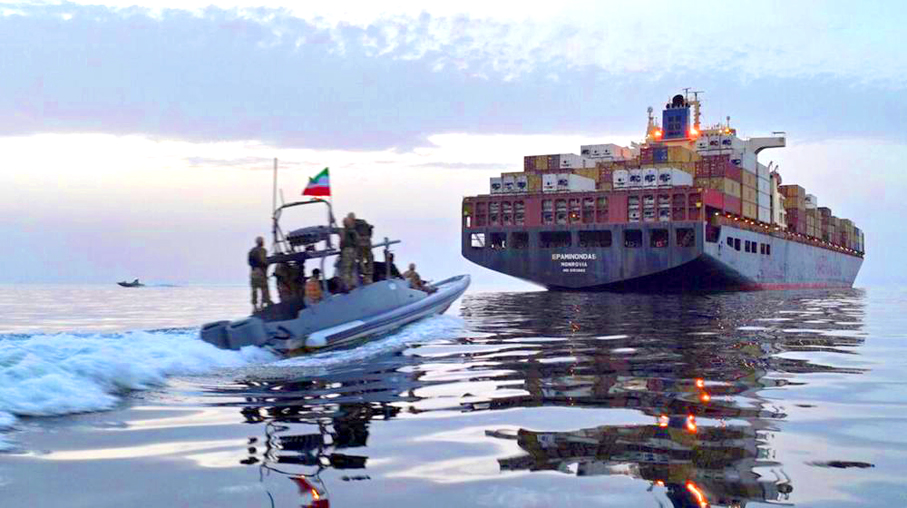
THE Islamic Revolution Guard Corps (IRGC) Navy has reported an increased rate of cargo transit via the Strait of Hormuz in the Persian Gulf, pointing to improved security in the key waterway under its control arrangement.
The IRGC Navy’s Public Relations Department said in a statement on Sunday that a total of 33 ships had passed through the Strait of Hormuz in the past 24 hours.
That marks a nearly 50% increase compared to figures announced last week and a major rise from the numbers reported in the early days of the US-Israeli aggression on Iran in early March, which prompted the IRGC to take control of the Strait and impose restrictions on transits.
Iranian state TV also reported that ships from China, India, and Pakistan recorded the highest number of passages through the Strait of Hormuz, thanks to their coordination with Iranian authorities.
Meanwhile, some 240 ships are waiting for clearance from Iran to pass.
The IRGC Navy said that those ships allowed to pass through over the past 24 hours included oil tankers, container ships, and other commercial vessels, adding that all of them had been cleared to pass after obtaining the required permits from the force under its security arrangements for the waterway.
The elite Iranian military force also hinted in its statement that transit through the Strait has returned to nearly normal levels with an improvement in the security situation in the Persian Gulf.
‘The IRGC Navy is vigorously enforcing the intelligent control of the Strait of Hormuz after insecurity was intensified because of the aggressive acts of the terrorist American military in the Strait,’ the force said in its statement.
The Strait of Hormuz is responsible for a fifth of the global oil supply, and Iran’s restrictions have caused a major surge in international oil and commodity prices since they were imposed last month.
Iran has indicated that it is ready to gradually reopen the Strait if it receives concrete guarantees about a permanent end to US-Israeli aggression and the lifting of all US sanctions and blockades on the country.
However, authorities have indicated that the situation in the Strait will never return to what it was before the war, and that restrictions and bans will continue to be applied to ships owned by or linked to hostile regimes, while others seeking to pass must pay tolls.
A senior Iranian military commander says outsiders will have no place in the future of the region based on the strategies devised by Leader of the Islamic Revolution Ayatollah Seyyed Mojtaba Khamenei.
Commander of Iran’s Khatam al-Anbiya Central Headquarters, Major General Ali Abdollahi, made the remark in a message on Sunday to commemorate the martyrs of the recent US-Israeli imposed war of aggression against the Islamic Republic.
‘We warn the enemies that the Leader’s plans and strategies for “managing the Persian Gulf and the Strait of Hormuz” will guarantee the future of the region and a new regional and international order within the framework of the strategy of a “strong Iran”, in which foreigners will have no place,’ Abdollahi said.
He added that the Iranian nation’s dignity and greatness at the most sensitive juncture of the history of modern humanity and its resistance in the face of the US-Israel enemies marked ‘one of the most amazing historical events’ and prepared the ground for a new geometry of global power centred on Iran.
In the midst of the third sacred defence against the enemy, he emphasised, Iran requires more vigilance and intelligence.
‘The Iranian nation will continue to stand firmly for its absolute rights and interests and calls upon everyone to continue the bright path of the martyrs and follow Ayatollah Khamenei’s guidelines,’ he noted.
General Abdollahi stressed the importance of continuing resistance, steadfastness, vigilance, and intelligence against the US-Israeli enemy, saying Iran would secure the Persian Gulf region by eliminating the enemy’s abuse of this waterway, and would bring welfare and progress to all regional nations.
The Iranian general reiterated: ‘We stand fully prepared to deliver a harsh and hellish response to any form of aggression.’
The US-Israeli aggression against Iran began on February 28 with airstrikes that assassinated senior Iranian officials and commanders, including Leader of the Islamic Revolution Ayatollah Seyyed Ali Khamenei.
Iranian Armed Forces responded by launching daily missile and drone operations targeting locations in the Israeli-occupied territories as well as US military bases and assets across the region.
Furthermore, Iran retaliated against the strikes by closing the Strait of Hormuz, which resulted in a significant increase in oil prices and its by-products.
On April 8th, forty days into the war, a Pakistan-brokered temporary ceasefire between Iran and the US took effect.
- Iranian air defence forces have shot down an Israeli ‘Orbiter’ reconnaissance drone over the southern province of Hormozgan, according to military sources from the country’s southeastern air defence command.
The drone, which is designed for espionage and surveillance, was intercepted and destroyed after entering the operational airspace under the protection of Iran’s southern air defence network on Sunday.
Officials said the drone (UAV) was targeted by a specialised defence system whose technical specifications have not yet been disclosed.
Military authorities based in Bandar Abbas stated that the system used in the operation is capable of detecting and engaging radar-evading drones and that no stealth UAV would be able to penetrate the airspace stretching from the Persian Gulf and its islands to southern and southeastern Iran.
The wreckage of the destroyed drone was later recovered with the assistance of maritime border police units operating in Hormozgan Province.
The interception comes at a time of increasing scrutiny over the vulnerability of advanced Western and American unmanned aerial systems in regional conflicts.
A recent Bloomberg report detailing the loss of multiple advanced US drones during the war against Iran has drawn attention to the growing challenges facing technology-driven aerial warfare.
Among the systems highlighted was the MQ-9 Reaper, long regarded as one of the symbols of American military and technological superiority due to its surveillance, tracking, and precision-strike capabilities in conflicts ranging from Afghanistan and Iraq to Syria.
Analysts say the significance of such incidents extends beyond financial losses. The downing of advanced drones increasingly carries political and strategic implications, raising broader questions about the effectiveness of modern airpower and the sustainability of prolonged military engagements.
In the United States, criticism has gradually intensified over the objectives and outcomes of the US aggression against Iran.
Analysts say that if Washington, despite possessing some of the world’s most advanced military technologies, is unable to achieve its strategic goals, the justification for continuing this war becomes increasingly difficult to defend.
- Officials in the Nicaraguan city of Corinto have named a street as ‘Angels of Minab’ to honour the memory of the martyred students of the Shajareh Tayyebeh Elementary School who lost their lives in a United States strike on the first day of US-Israeli aggression against Iran.
The mayor of Bandar Abbas, Mehdi Nobani, announced the naming initiative on Sunday at Bandar Abbas Park in the city, saying it is part of the ongoing cooperation between the two sister cities.
The event marks a significant moment in cultural and international relations between Nicaragua and Iran.
Meanwhile, Iran’s foreign ministry has lambasted CENTCOM’s (US Ministry of Defence Central Command) account of the Minab school massacre claiming it was a mistake as ‘baseless’.
The US and Israel launched an unprovoked war of aggression against Iran on February 28, killing over 3,300 Iranians.
On the very first day of the war, US Tomahawk missiles struck Shajareh Tayyebeh Elementary School in Minab, in southern Iran, killing at least 175 people – most of them schoolgirls.