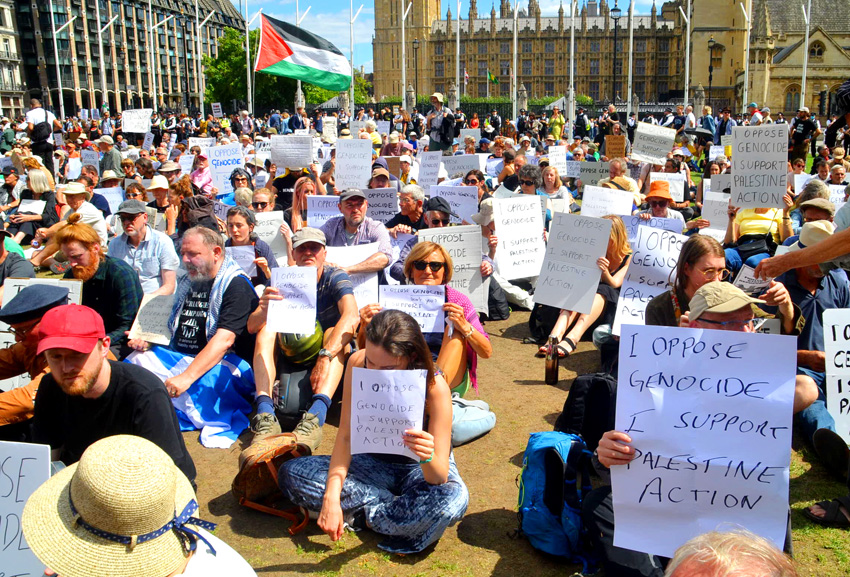
THE Supreme Court will decide the fate of the ban on Palestine Action on 4 and 5 November, after a year in which roughly 3,500 people have been arrested under terrorism law, most of them for holding cardboard signs.
Permission to appeal was granted on 30 July, and the justices ordered the case expedited.
It arrives at the end of the most sustained campaign of arrests for expression in modern British history, and one that has been condemned by five UN special rapporteurs, the UN High Commissioner for Human Rights, Amnesty International and Liberty.
A retired priest from Bristol was among the 27 people arrested on the day the ban came into force. Heather Brunskell-Evans, 75, was held in a cell for nine hours under the Terrorism Act after one sign-holding protest.
By late November 2025 the total had passed 2,350, with more than 250 detained in that month alone, and police forces had on several occasions simply been overwhelmed by the number of people they would have had to arrest.
Defend Our Juries, which has organised most of the sign-holding, counted close to 3,000 arrests by February, the overwhelming majority of them people carrying placards.
Detainees held over protest activity went on hunger strike. UN experts wrote to the government urging it to guarantee healthcare for every hunger striker and warning that preventable deaths in custody are never acceptable.
The same statement recorded serious concern about the overbreadth of the British definition of terrorism, the proscription itself and the mass arrests and terrorism charges that followed.
The volume broke the listing system last week.
More than 2,000 cases had been set down at Westminster Magistrates’ Court on 30 July before being adjourned days earlier. Every Palestine Action case is now put back to 26 October, and that date will itself be administrative rather than a hearing.
Defendants had travelled from Yorkshire, Wales, Merseyside and Scotland without being told, and the courts service faces a compensation bill running to thousands of pounds.
Police arrested 77 people outside the building that day, most for expressing support for a proscribed organisation, and confiscated a stage, a set of posters and the certificates from a mock graduation ceremony for defending fundamental freedoms.
Parliament approved the order on 2 July 2025 by 385 votes to 26. Nine Labour MPs voted against, the Liberal Democrats and the Scottish National Party abstained, and the government put Palestine Action into a single motion alongside two neo-Nazi organisations, so that a vote against the ban was a vote against proscribing all three.
The vote fell on the anniversary of women in Britain winning equal voting rights.
Nadia Whittome raised it in the chamber, pointing out that the suffragettes used direct action far more extreme than anything Palestine Action has done, and are commemorated for having changed history.
The same day, MPs posed for photographs wearing suffragette-style sashes.
The women being honoured planted bombs, set fire to buildings, cut telegraph and railway lines and starved themselves in prison.
Clive Lewis put that list to the Commons and said it remained direct action rather than terrorist action.
Lord Hain later described spraying paint on aircraft at Brize Norton as positively moderate by comparison. Zarah Sultana told MPs that equating a spray can of paint with a suicide bomb was not merely absurd but grotesque, and called it a deliberate distortion of the law to chill dissent.
The Home Office minister Dan Jarvis assured the House that proscription ‘will not impinge on people’s right to protest’.
Within a year, holding a sign reading ‘I oppose genocide. I support Palestine Action’ had become grounds for arrest under counter-terrorism powers carrying up to 14 years.
International criticism began before the ban took effect and has not let up.
Five UN special rapporteurs, Ben Saul, George Katrougalos, Irene Khan, Gina Romero and Francesca Albanese, warned the government that international standards confine terrorism to acts intended to cause death, serious injury or hostage taking in order to intimidate a population or compel a government, and that the definition being used did not meet it.
A later letter said mere property damage does not constitute terrorism by international standards, described the restrictions on expression and peaceful assembly as disproportionate, and noted that designating groups as terrorist when they are not is characteristic of states that are authoritarian and lack legal and political cultures of respect for human rights.
By September the rapporteurs were writing that the proscription appeared to have produced precisely the violations they had predicted it would.
Volker Türk, the UN High Commissioner for Human Rights, called the ban disproportionate and unnecessary. Amnesty International UK and Liberty intervened in the litigation at both levels, pointing to the sweep of offences that flow from proscription, including the criminalisation of meetings held to further a banned organisation’s activities.
The courts have gone back and forth. In February, a divisional court of Dame Victoria Sharp, Mr Justice Swift and Mrs Justice Steyn ruled against the Home Office, noting that where a small number of the group’s actions met the statutory definition of terrorism, the ordinary criminal law was there to prosecute them.
The judges called the decision disproportionate and a breach of free expression and said they proposed to quash it. Saul, who had intervened, invited the home secretary to accept the ruling and set the proscription aside. She did not.
The Court of Appeal reversed in June, with five judges holding that the ban ‘struck a fair balance’ between individual rights and national security.
Baroness Carr, the Lady Chief Justice, called it a justified and proportionate interference.
Shabana Mahmood, the current home secretary, said the government would defend the ban robustly at the Supreme Court and that Palestine Action ‘is not an ordinary protest or civil disobedience group’.
What the Supreme Court will actually decide is narrower than the campaign around it. The justices refused permission on the argument that the ban breaches free expression and free association, and granted it only on whether Yvette Cooper followed the Home Office’s own published policy when she signed the order.
The rights question is therefore settled domestically, and Strasbourg is what is left of it.
Ammori has said she will take it there. A win in November would mean the ban was imposed unlawfully rather than that it could never be imposed, which leaves the government able to try again.
Ammori tied the appeal to what has been happening on the streets while it has been fought. The permission decision came, she said, as hundreds more people were arrested under terrorism law ‘simply for saying that they oppose genocide’, some of them detained without expressing support for the group at all, including people setting up a stage or reading poems about Gaza.
The proscription, she said, ‘has become a vehicle for a far broader crackdown on expressions of solidarity with the Palestinian people’.
The ban remains in force until November. The arrests continue on that basis.