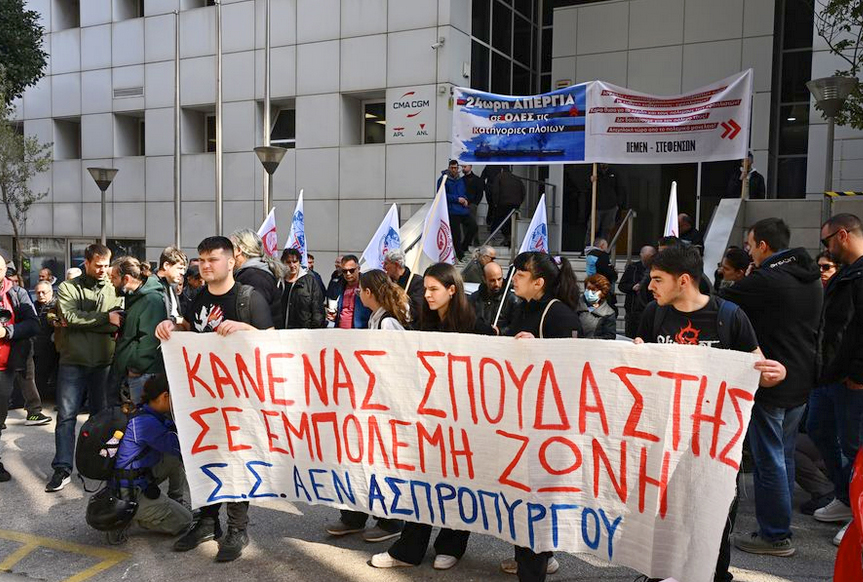
Following a unanimous decision by the Panhellenic Seamen’s Federation (PNO), a 24-hour nationwide strike has been at ports nationwide called to coincide with International Workers’ Day on Friday 1st May.
The Greek fleet will remain tethered to the piers, effectively halting the country’s maritime highway.
Central to the PNO’s demands is the protection of human life at sea and the guarantee of decent working conditions. The union is pushing to strengthen collective bargaining, specifically aiming to renew and sign updated Collective Labour Agreements that reflect the current economic climate.
The PNO is demanding that maritime education remain public and free, but with a necessary caveat: it must be upgraded. As the shipping industry undergoes rapid technological shifts, the PNO argues that the training of seafarers must evolve to keep pace with high-tech maritime developments.
The PNO said in a statement: ‘We the PNO are honouring the struggles of workers and seafarers and on the occasion of the celebrations for May 1st, unanimously decided to declare a 24-hour nationwide strike in all categories of ships, which begins at 00.01 on Friday, May 1, 2026 and ends at 24.00 on the same day.
‘The Panhellenic Maritime Federation, with the protection of human life at sea and dignity at work as its main objective, continues and intensifies its struggle, having high on the agenda the institution of collective bargaining, the renewal and signing of Collective Labour Agreements and the protection and expansion of trade union rights.
‘The preservation and upgrading of the public character and free maritime education is the spearhead of the demands of our Federation, which has submitted specific positions and proposals that respond to the rapid international technological developments as they have taken shape.
‘The need to upgrade the free provision of public health and education is imperative, as is the restoration of the unfair cuts that our fellow seafarers have suffered.
‘The union has held several strikes over the last period including a 24-hour strike in March and a 48-hour strike in March.’
Meanwhile, Germany’s Lufthansa, Europe’s largest airline group, has announced that it will cancel 20,000 ‘uneconomic short-haul flights’ from its European summer schedule, as jet fuel prices have surged since the start of the US-Israeli war of aggressionon on Iran.
The first 120 cancellations were implemented on Tuesday, effective until the end of May. By late April or early May, broader reductions through to the end of the summer scheduling season will be unveiled.
Since the start of the aggression, Lufthansa has taken some of the most drastic steps among global airlines, at the same time that there have been strikes by pilots and cabin crew.
Last week, the airline announced the shutdown of its Cityline regional unit and the grounding of 27 older, fuel-guzzling aircraft.
European Union Energy Commissioner Dan Jorgensen said on Tuesday that the coming summer will be difficult for Europe due to fuel shortages caused by the aggression against Iran and the ensuing closure of the Strait of Hormuz.
He added that the EU is preparing measures to curb the impact the war is having on jet fuel supply.
‘If needed, we may redistribute and share jet fuel resources we have,’ Jorgensen told reporters in Madrid, as nearly 75 per cent of Europe’s jet fuel supply comes from West Asia.
On 17th April, Iran had declared the Strait of Hormuz was open to commercial shipping, weeks after it was shut down to vessels associated with the US, Israel and their allies following the launch of an unprovoked war of aggression against the Islamic Republic on 28th February.
However, the Iranian Revolutionary Guards Corps (IRGC) Navy said the following day that the Strait was closed again after the United States refused to lift its blockade of Iranian ports in violation of the 8th April ceasefire.
The German government has officially halved its economic growth forecast for 2026, citing the severe impact of ‘energy shocks stemming from the Iran war’.
This revision reflects a significant slump for Europe’s largest economy.
On Wednesday, German Economic Affairs and Energy Minister Katherina Reiche announced a sharp reduction in projected Gross Domestic Product (GDP), lowering the 2026 growth target to 0.5 per cent.
Officials in Berlin noted that the downward revision was unavoidable and that the primary catalyst for this economic contraction is the ongoing Iran war, which triggered a massive energy shock across the continent.
Germany, as a major industrial hub, is particularly sensitive to fluctuations in the cost of oil and natural gas, both of which have seen prices surge since the outbreak of hostilities.
Government reports state that the ‘Iran war fallout’ has disrupted supply chains and increased the cost of raw materials, making it difficult for German exporters to remain competitive on the global stage.
The uncertainty surrounding the war has also led to a visible ‘wait and see’ approach among private investors.
Many firms have chosen to put major expansion projects on hold, fearing that a wider regional escalation could lead to further market volatility.
This lack of investment, combined with higher household energy bills that reduce domestic consumption, has created a pincer movement on the German economy.
Germany is not the only major European countryforced to recalibrate its expectations, as the Italian government has also moved to slash its economic outlook on Wednesday.
Italy has trimmed its 2026 GDP growth estimate to 0.6 per cent, down from a previous forecast of 0.7 per cent.
The Italian authorities noted that the ‘Iran war weighs heavily’ on their fiscal planning, particularly as the nation remains highly susceptible to the volatility in energy prices.
Italian Economy Minister Giancarlo Giorgetti, referring to the Iran war, said: ‘We’re not faced by normal circumstances but totally exceptional ones.
‘Unfortunately in coming weeks the numbers will probably need to be reviewed, adjusted and updated.
Earlier on Wednesday, the Italian national statistics bureau confirmed that Italy posted a budget deficit of 3.1 per cent of GDP in 2025, dashing Rome’s hopes of exiting an EU disciplinary procedure this year for its ‘excessive’ deficit.
Elsewhere, Spain, Slovenia and Ireland have urged the European Union to debate suspending its association agreement with Israel due to violations and crimes the regime has committed in Gaza, occupied West Bank and Lebanon.
Speaking before a meeting of EU foreign ministers in Luxembourg on Tuesday, Spanish Foreign Minister Jose Manuel Albares said the three states had formally requested that the issue be placed on the agenda.
He stated: ‘Spain, along with Slovenia and Ireland, has requested that the suspension of the Association Agreement between the European Union and Israel be discussed and debated today.’
The top Spanish diplomat appealed to European countries to uphold the existing international humanitarian laws and norms.
‘I expect every European country to uphold what the International Court of Justice and the UN say on human rights and the defence of international law. Anything different would be a defeat for the European Union.
Last week, in a joint letter sent to EU foreign policy chief Kaja Kallas, the three governments said Israel had taken a series of measures that ‘contravene human rights and violate international law and international humanitarian law’.
They stated that Israel breached the 1995 agreement that outlines political, economic and trade relations between the EU and the Israeli entity.