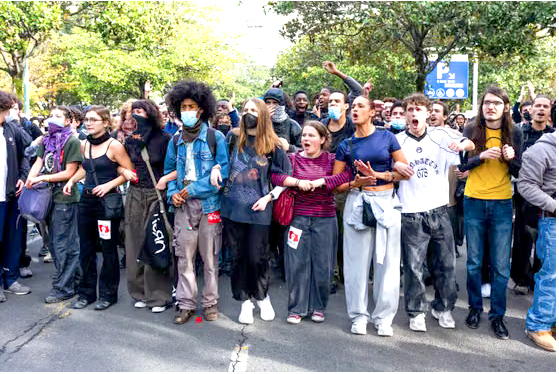
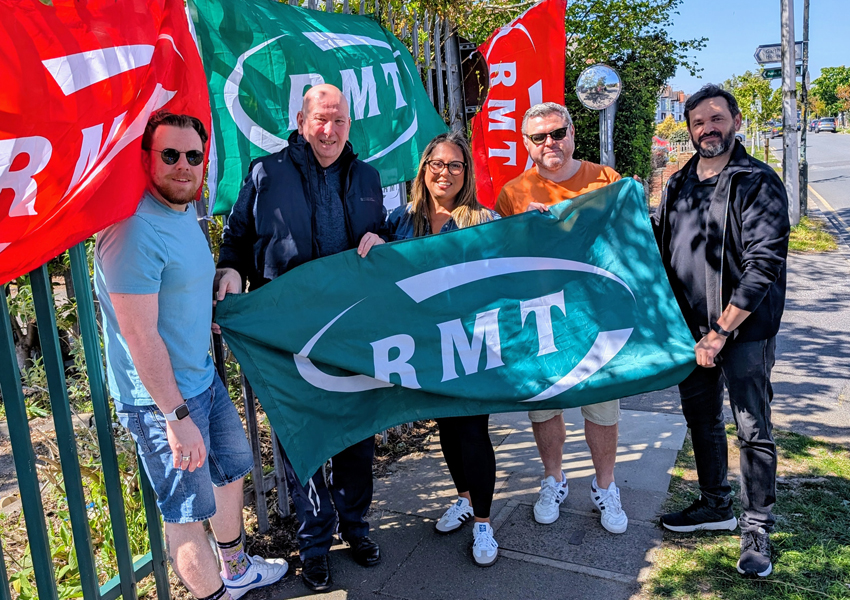
Picket lines were mounted at depots and stations across London yesterday as RMT members walked out for the second time this week in their fight against Transport for London’s (TfL) plans to impose a compressed four-day working week on Tube drivers.
On the Northern Line, drivers with decades of experience outlined their objections.
At the Morden picket Matt, an RMT member for 21 years and a driver for 19, told News Line: ‘I am opposed to the imposition of this version of the four-day week.
‘There are too many agreements we’d have to change. In principle, a four-day week is a good idea.
‘The other union, ASLEF, say let’s take it now and deal with it later. But one of the key issues is rest-day working. Management need to sit down and talk properly.
‘They say it’s voluntary, and they’ve been negotiating this for a year, but without giving us proper details.’
Keith, another driver on the line, said: ‘Management are using this to get rid of all the terms and conditions we’ve accumulated over the years.
‘They talk about work-life balance, but they’re making it worse by adding more pressure and fatigue.
‘Even ASLEF colleagues say there are things they’re not happy about, even though their union leaders agreed to it.’
William Ross said: ‘The four-day week is rubbish. There are too many strings attached, including losing two weeks’ holiday.
‘Instead of eight hours a day, they want ten.
‘There are drivers in a pool who used to get their schedule for the whole week.
‘Now they’d only get 24 hours’ notice, and even that could change in either direction for up to 2 hours.’
Sheila Maonga said: ‘I am on strike because the union called it.
‘I trust the union, it looks out for me.
‘I’ve taken time to read the proposals the company has put forward, and who in their right mind will accept this?
‘The fact that management was so keen to promote it made me dubious, because nothing is given freely.
‘Every benefit we’ve got, we’ve fought for.
‘I’m calling on people to join the RMT.’
A manager, who asked not to be named, also joined one of the picket lines in a show of solidarity.
‘RMT is strong in the management here,’ she said.
‘We won’t cover the driving during the strike.’
Support came from ASLEF train drivers who visited picket lines.
Federico, an ASLEF member, told News Line: ‘I’m here in solidarity. Everyone should come out and support this.’
Avid Astarita, an RMT rep, hailed: ‘A fantastic two days of action for our comrades on the Underground, disrupting services for four days and showing TfL and Sadiq Khan that we won’t tolerate our hard-won conditions being attacked.’
The walkouts on April 21-22nd and April 23-24th are the first of six rounds of 24-hour strikes planned across April, May and June.
Further action is scheduled for May 21-22nd and June 16-19th.
Strikes that had originally been called for late March were suspended after progress in talks, but the RMT says TfL then reneged on promises to negotiate in good faith.
According to the union, TfL initially offered to negotiate on all elements of the proposals but then informed the RMT that the plans, which were rejected by a majority of drivers in two separate referendums, would simply be imposed.
RMT General Secretary Eddie Dempsey said: ‘We have approached negotiations with TfL in good faith throughout this entire process.
‘But despite our best efforts, TfL seem unwilling to make any concessions in a bid to avert strike action.
‘This is extremely disappointing and has baffled our negotiators.
‘The approach of TfL is not one which leads to industrial peace and will infuriate our members who want to see a negotiated settlement to this avoidable dispute.’
The Piccadilly and Circle lines were completely shut during the strikes, with no service on sections of the Central and Metropolitan lines.
Reduced services ran on most other lines, though the impact was less severe than walkouts last September as ASLEF members and non-driving RMT staff continued to work.
The Elizabeth Line, DLR, Overground and buses were unaffected, though services were significantly busier than usual.