ATTACKS on civilian infrastructure and schools during the US military campaign against Iran constitute clear war crimes under the Geneva Conventions, an international law professor says, adding that Iran has the legal right to seek reparations.
Davoud Aqaei, a professor of international law at the University of Tehran, said on Tuesday that countries hosting US military bases used for launching attacks on Iran have exposed themselves to legal liability and may themselves be considered parties to the conflict under international law.
‘In the framework of international law and the law of war, not only aggressor states, but also states that violate the principle of neutrality may face the legal consequences of that situation,’ Aqaei said.
‘If a state places its territory, military bases, or logistical facilities at the disposal of a belligerent party, or in any way enhances that party’s military capacity and enables an attack on another state, it effectively becomes a party to the conflict and may be considered a legitimate target by the opposing side,’ he said.
The professor noted that the United States has no military bases in the air or space, and therefore relies either on its naval vessels or on bases it has pre-positioned in countries such as Kuwait, Bahrain, the United Arab Emirates, and Jordan.
‘Accordingly, these facilities and territories, when used for military purposes by an aggressor party, may be regarded as legitimate targets for Iran,’ he said.
On whether Iran could seek reparations for damage to civilian sites, Aqaei drew a sharp distinction between legal theory and practical reality.
‘We must distinguish between field realities and the rules and norms of international law that exist on paper,’ he said.
‘From a theoretical standpoint, legal criteria exist; documentation can be collected, compiled, and prepared for submission to international judicial bodies, including the International Criminal Court or any other international authority agreed upon by the parties; this is legally provided for,’ Aqaei said.
‘However, as I noted, in the field and in the historical experience of the international system, major powers, particularly the United States, as the hegemonic power, exert influence over institutions and mechanisms within their sphere of influence and use these tools to advance their goals,’ he added.
He said that even when their conduct violates international law, such powers rely on allies and self-constructed regimes to justify their behaviour and obstruct the realisation of justice.
Aqaei said Iran nonetheless has an obligation to document what has been done to it.
‘It is necessary for the country’s officials to collect and document the evidence, take the necessary legal steps, identify competent judicial authorities, and present the cases to those bodies,’ he said.
‘But at the same time, I see no clear prospect of obtaining reparations or compensation from the United States or regional countries under current conditions,’ he added.
He said Iran’s entitlement under international law was not in question.
‘This is our natural right and international law grants us this right and this permission, because we have been subjected to aggression,’ Aqaei said.
‘Aggressor states that attack the territory of another state through or with the assistance of their armed forces are held responsible, because they have violated the principle of the prohibition on the use of force and the principle of non-aggression and are considered culpable from that standpoint,’ he said.
‘Therefore, from the perspective of international law, we are in the right, but the reality is that in international politics, because power prevails over international law, I see no clear prospect for receiving compensation for the damages inflicted on our country, and such an outcome is not foreseeable under current conditions,’ Aqaei said.
On the specific question of whether attacks on hospitals, schools, and civilian infrastructure constitute war crimes, Aqaei said the legal framework was unambiguous.
‘Yes. We have a legal framework. The 1949 Geneva Conventions explicitly enumerate the instances of violations of the laws of war and the commission of war crimes,’ he said.
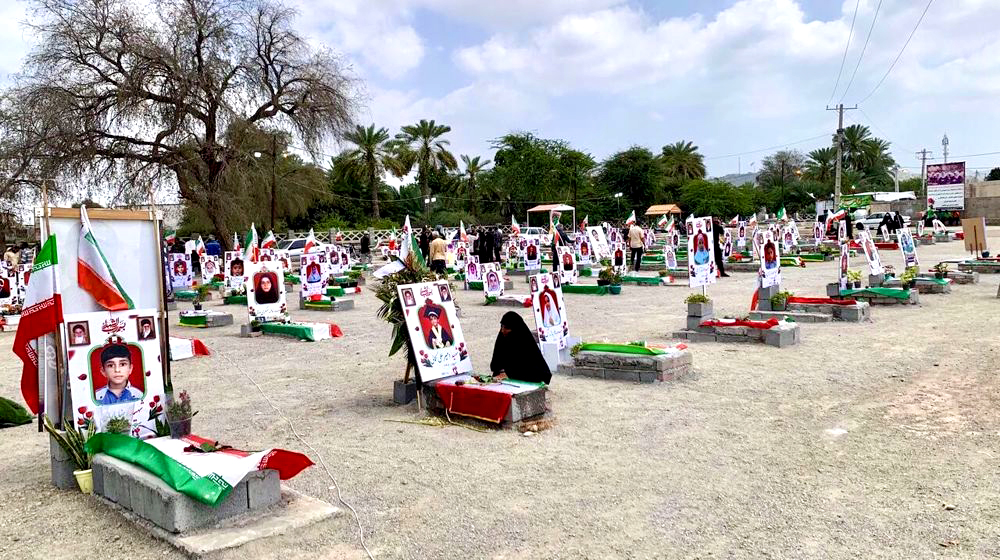
‘Therefore, if any of the parties to the conflict violates those principles, rules, and norms, including by attacking civilians, as was done at the Shajare Tayyebeh school in Minab, where they committed a grave war crime and killed 168 of our innocent students, that is a clear war crime,’ Aqaei said.
He said attacks on other civilian centres and infrastructure fall under the same legal definition.
‘Clearly, any state that attacks these centres and areas has committed a war crime, and these actions are legally actionable,’ he said.
Earlier in the day, Foreign Ministry spokesperson Esmaeil Baqaei said Washington had effectively acknowledged its disregard for humanitarian law from the outset of its military campaign.
‘The Americans officially admitted they would not abide by any of the rules of international humanitarian law,’ Baqaei said at his Monday news conference.
‘The US secretary of war, in the very first days of the military aggression against Iran, announced that they would not be bound by these foolish rules of combat,’ he said.
The 1949 Geneva Conventions and their 1977 Additional Protocols obligate all parties to an armed conflict to distinguish at all times between military and civilian targets, one of the most fundamental rules governing armed conflict.
Attacks on civilian centres, including hospitals, schools, public service infrastructure, and vital installations, are prohibited under those rules and may constitute both human rights violations and war crimes under the Rome Statute of the International Criminal Court.
Tehran has said it is documenting attacks on civilian infrastructure and intends to pursue the matter through legal and international channels.
- Foreign Minister Abbas Araghchi has stressed the importance of expanding cooperation with Mexico across multiple sectors, calling for greater use of existing capacities to strengthen bilateral ties.
During a meeting on Tuesday with Iran’s Ambassador to Mexico Abolfazl Pasandideh, the envoy presented a report on the latest state of relations between the two countries and outlined the embassy’s efforts to deepen cooperation and broaden ties in various fields.
Araghchi highlighted the significance of developing Iran-Mexico relations and thanked the Mexican government and people for hosting Iran’s national football team during the 2026 FIFA World Cup, describing the hospitality as a reflection of the friendly relations, goodwill and mutual respect between the two nations.
The foreign minister also called for active use of existing opportunities to expand bilateral cooperation and for continued follow-up on the two countries’ shared agenda.
The Iranian Interior Minister Eskandar Momeni visited the ‘Islamabad Capital Territory Police’ headquarters, alongside Pakistan Minister of State for Interior Talal Chaudhry, where he received a warm welcome.
The Iranian interior minister was honoured with a ceremonial parade during his visit to the police headquarters.
The Iranian official is also scheduled to visit the headquarters of Pakistan’s Anti-Narcotics Force (ANF).
Earlier in the day, Momeni met with Pakistan’s Chief of Army Staff General Asim Munir and Prime Minister Shehbaz Sharif. He is also scheduled to hold a meeting with his Pakistani counterpart, Syed Mohsin Raza Naqvi.
Interior Minister Eskandar Momeni and Pakistan’s army chief Field Marshal Asim Munir have agreed to strengthen coordination and cooperation to safeguard regional security during talks in Rawalpindi, Pakistan’s military said.
Interior Minister Eskandar Momeni and Pakistan’s army chief Field Marshal Asim Munir have agreed to strengthen coordination and cooperation to safeguard regional security during talks in Rawalpindi, Pakistan’s military said.
According to a statement issued by the Pakistan Army’s media wing on Tuesday, Momeni met Munir at the General Headquarters (GHQ), where the two sides reviewed bilateral cooperation and discussed issues of mutual interest, including regional and bilateral security as well as effective border management.
The Pakistani military said the Iranian minister commended Pakistan’s continued efforts and diplomatic role in easing regional tensions, promoting de-escalation and supporting peace initiatives.
The meeting concluded with both sides reaffirming their commitment to closer coordination and enhanced cooperation mechanisms aimed at preserving regional security and promoting mutual prosperity, the statement said.
- Iran is set to begin issuing motorcycle licences to women in the coming weeks, the vice president for women and family affairs has announced, stressing that there are no religious or legal restrictions preventing women from obtaining such licences.
Speaking to reporters on Tuesday, Zahra Behrouz Azar said women should have motorcycle licences to avoid additional harm resulting from being unable to obtain insurance coverage due to not having a valid license.
She said the government had taken action on the issue with Parliament’s support, while religious scholars and clerics had also stated that issuing motorcycle licences to women was not religiously prohibited.
Behrouz Azar said the necessary steps had been taken and that, according to her latest discussions with traffic police officials, a prototype motorcycle licence for women had alreiran 2ady been printed.
She said the issuance of the licences had been delayed due to the outbreak of the recent US-Israeli war, adding that a ceremony to unveil the first motorcycle licence for women had initially been planned for July.