The commander of the Iranian Army’s Ground Force says all units remain in a state of ‘full combat readiness’ and will respond decisively to any threat against the country.
Brigadier General Ali Jahanshahi made the remarks on Sunday in a meeting with Army commanders and personnel following a visit to units of the Ground Force deployed in southeastern Iran and along the Makran coast.
‘Units of the Army Ground Force, with constant monitoring of movements and precise tracking of threats, are in full combat readiness and will strongly protect the borders of the Islamic Republic of Iran,’ he said.
He added that recent developments have exposed the enemy’s ‘true capacity and capability’.
‘The enemy has been brought to its knees before the determination of the armed forces and the Iranian nation,’ he said, reiterating that the readiness of Iran’s Armed Forces and the nation’s support for fighters on various fronts have strengthened national cohesion and defeated the adversaries’ plans.
Jahanshahi further stressed the importance of enhancing specialised and combat training, particularly in ground warfare, noting that the Army has spent years conducting continuous and specialised exercises to counter a wide range of threats.
‘In case of any action by the enemy, we will give a decisive and deterrent response. If any American military presence sets foot in Iran, we will cut it off.’
The Ground Force commander also emphasised that in addition to defence capabilities, the Iranian people’s determination and endurance are key components of the country’s power.
He noted that the Iranian nation, ‘with a firm will and tireless spirit, has consistently stood beside the armed forces and supported them and prevented adversaries from achieving their objectives.’
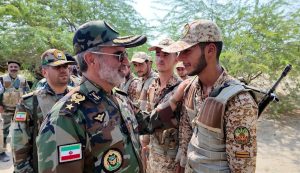
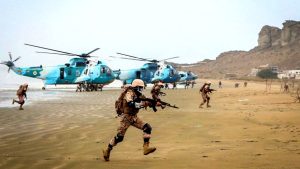
Jahanshahi also stressed that the effective presence of rapid-response units, special forces, drones, artillery and armoured formations in border areas has contributed to countering threats, protecting Iran’s frontiers and ensuring sustainable security.
Despite major challenges, including two US-Israeli-imposed wars, Iran has always emphasised self-reliance in its defence strategy, with military officials frequently highlighting the importance of domestic expertise in rebuilding damaged systems and developing new technologies.
The Iranian Army’s focus on maintaining high combat readiness comes amid ongoing US threats against Iran following its failure to achieve war objectives.
Spokesman for the Iranian Army, Brigadier General Mohammad Akraminia, also said that the Army remains in a state of readiness despite two recent wars and is continuously working to enhance its combat capabilities to counter future threats.
‘Today, despite the two previous wars, the Islamic Republic of Iran’s Army is in a very appropriate state of readiness and, with an eye on the threats ahead, is continuously working to enhance its combat capabilities,’ he added.
Following two wars imposed by the US and Israel on the Islamic Republic, he added, the military continues to constantly pursue operational and defensive improvements by modernising damaged or worn-out systems and relying on domestic capabilities.
He emphasised that maintaining combat readiness is not solely a matter of acquiring equipment.
‘The improvement of the Army’s defence capability in recent years has been based on a series of simultaneous measures, from the reconstruction and upgrading of existing systems to the introduction of new equipment, the development of domestic capacities, and the strengthening of personnel motivation and morale.’
And an important part of combat capability, particularly under current circumstances, depends on modernising and restoring damaged or ageing systems.
Akraminia said the Army is relying on its engineering and technical expertise to rebuild and upgrade equipment.
‘This process is not merely a technical operation but is part of the country’s broader defence strategy to maintain its deterrence and enhance rapid response capabilities.’
He said the introduction of new equipment has enabled the Army to reorganise its combat equipment in line with modern operational requirements.
Akraminia noted that the Iranian Army has repeatedly proved throughout past wars its ability to carry out missions under various conditions through reliance on domestic capabilities and precise planning and its focus is on maintaining high combat readiness under ongoing United States’ threats following its failure to achieve its war objectives.
Back in July, Akraminia said Iran has already developed comprehensive defence scenarios and operational plans to counter any attempted enemy incursion into the country’s territory.
- US Senator Chris Murphy has delivered a scathing assessment of the ongoing war on Iran, declaring that President Donald Trump ‘has lost this war’ and warning that every day the fighting continues, the United States grows weaker while Iran grows stronger.
In an interview on NBC News, the Democratic senator from Connecticut argued that the administration is facing a dire strategic reality, and urged an immediate end to the hostilities even if it means accepting highly unfavourable terms.
Murphy pointed out that the cost of reopening the Strait of Hormuz increases daily, and a proposed deal currently on the table would effectively pay Iran $100 billion a year to reopen the critical waterway.
‘What a victory for Iran,’ Murphy remarked.
‘At the end of this war, they get paid to reopen the Strait, they get paid to rebuild their military, they get paid to rebuild their support for proxies in the region.’
Acknowledging the unfavourable terms, the senator stated he is willing to accept a flawed agreement simply to stop the bleeding.
‘I am prepared to support a bad deal to end this war and reopen the Strait, because the only deal that is available at this point in time is a terrible, bad deal,’ he said.
The senator stressed the severe domestic economic consequences of the conflict, pointing out that ordinary Americans are bearing the brunt of the administration’s military adventurism.
‘People here in the United States get screwed, as prices go up, and up, and up,’ Murphy said.
He noted that seven-in-ten Americans want the war to end – ‘Families are being bankrupted, as we speak.’
Highlighting the immediate impact on daily life, Murphy pointed out that as children return to school, ‘filling up lunchboxes this year is going to cost them $4,000 more than it did last year. That is mostly because of this war.’
Beyond the economic fallout, Murphy warned of the severe toll the war has taken on US military readiness.
The prolonged engagement has drastically depleted America’s defensive capabilities, leaving the country vulnerable to other global adversaries.
‘We have used up almost all of our interceptors, the majority of our Tomahawks,’ he revealed.
He cautioned that this depletion has ‘put the United States in a dangerous position,’ arguing that the military’s over-extension has ‘allowed Russia and China to imagine things that they couldn’t have imagined early on because of our inability to defend ourselves and our allies.’
While Democrats have repeatedly attempted to curb Trump’s war powers – efforts that have been consistently blocked by Republican majorities in Congress – Murphy drew a strict line on future military funding.
‘I am not going to support funding to keep this war going,’ he declared, adding that he does not expect his Democratic colleagues to fund ‘a continuation of a war that is destroying American credibility and destroying American families.’
However, the senator offered a conditional path forward for post-war military recovery.
‘If the war comes to an end, if the president ends this war, then, yes, of course, I and my colleagues will be ready to provide the funding to replenish the stores of munitions that have been spent – But the priority is ending this war.’