Argentina’s university teachers began a five-day national strike yesterday (Tuesday) marking 300 days since Congress sanctioned the University Financing Law that right-wing President Javier Milei’s government has still not applied.
The stoppage, called by the Conadu Histórica union federation, follows a 24-hour national strike on Wednesday 12 August by teaching and non-teaching staff, and comes together with a day of commemoration called by the National Universities Union Front for the 300-day anniversary of the law which increases salaries and funding.
Conadu is relaunching its ‘Tents for the University and Sovereignty’ outside the Palacio Pizzurno in Buenos Aires between 18 and 21 August, and has called a further 48-hour strike on 27 and 28 August. A wage negotiation meeting has been set by the Ministry of Human Capital for 1st September.
Law No. 27,795 was passed by Congress in 2025, vetoed by Milei, but then ratified when the legislature overturned the veto.
But the executive has refused to implement it.
The National Interuniversity Council, which represents university rectors, went to court, and on 26 June the Supreme Court left standing a precautionary measure ordering the state to comply with the law.
The unions say the government has neither obeyed the injunction on salaries and fellowships, nor transferred the 20 per cent increase in operating funds nor the 50 billion pesos, around 34 million US dollars, agreed in June for university hospitals.
The Ministry of Human Capital, which oversees the Undersecretariat of University Policies, issued a statement calling the 12 August strike ‘illegitimate’ and claiming that the government is meeting its budgetary and salary commitments to the university system.
Union officials say the funds transferred correspond only to what was already allocated in the budget law and exclude the agreed increase.
Teaching salaries have accumulated a loss of 28 percent, according to Conadu Histórica, which is demanding recognition of the 2023 losses and retroactive payment from October 2025, when the law took effect.
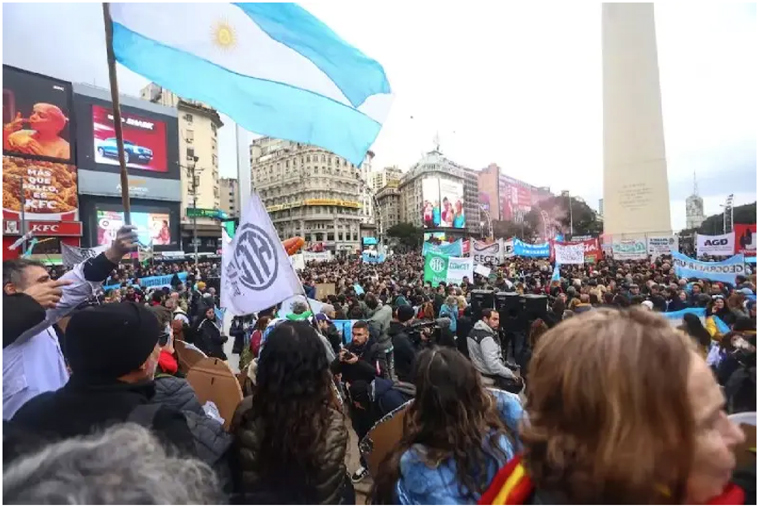
Scientists and researchers mobilised at the Obelisk in Buenos Aires on 12 August under the slogan: ‘I wear the science jersey’, with parallel actions in squares, universities and research centres across the country. The protest was called by the Federal Roundtable for Science and Technology to demonstrate ‘the dismantling of the scientific system’.
Since December 2023, an average of seven jobs a day have been lost in areas linked to research. Projected state investment in science for 2026 has fallen to 0.14 percent of GDP, the lowest figure since 1972.
Gonzalo, a researcher at the National Council for Scientific and Technical Research, Conicet, warned of a ‘general emptying process’ and said the agency has lost 2,400 posts.
He said a loss of salary purchasing power of close to 50 per cent in recent years is forcing many researchers to take second and third jobs.
The immediate trigger was Conicet’s decision not to extend the internal postdoctoral fellowships of 379 researchers, whose contracts expired on 31 July.
Rocío, one of those affected, said: ‘A few days ago we were fired because we were not granted the extension. This generates a discontinuity in our careers, loss of research lines, and the absence of science in this government.’
The fellows had applied to enter the Scientific and Technological Researcher Career, but the results of the 2025 competition are not expected until August 2027, with actual appointments estimated for mid-2028. In 2023 the Conicet board halved the number of posts it had announced for that intake, from 800 to 400, and no new call was opened for two years.
Conicet management has acknowledged that a gap of more than a year may fall between the end of the fellowships and entry into the career, but says extending all postdoctoral fellowships would cost hundreds of billions of pesos the agency does not have.
Deputies Néstor Pitrola, Romina Del Plá, Myriam Bregman and Nicolás del Caño of the Left and Workers’ Front have tabled a bill, registered as file 3579-D-2026, to extend the 379 fellowships by law until the competition results are published.
The fellows’ campaign has drawn support from more than a hundred universities, institutes and scientific associations and from over 2,200 researchers internationally, including 28 Nobel laureates.
The escalation in the universities follows the police operation against a demonstration outside Congress on Thursday 6th August, called against the government’s Inviolability of Private Property bill, under the slogan ‘The land must not be sold, or burned, or evicted!’
The Provincial Commission for Memory has filed a criminal complaint against the Buenos Aires City Police and federal forces, alleging violations of fundamental rights and physical attacks on journalists and demonstrators.
The complaint, signed by Nobel Peace Prize laureate Adolfo Pérez Esquivel, the academic Dora Barrancos and Roberto Cipriano García, was accepted by Federal Court No. 10 at the Comodoro Py complex.
The signatories state they witnessed repeated use of force and mass, arbitrary arrests carried out beyond legal and constitutional limits.
The commission’s report documented the firing of more than 100 tear gas and pepper gas grenades and rubber bullets that struck more than 40 people, along with injuries from chemical irritants, shield and baton blows and security forces raids into areas occupied by demonstrators.
It recorded 28 arrests, 21 by federal forces and seven by the city police, and counted around 1,500 injured, including its own members and personnel of the Evacuation and First Aid Corps.
A photojournalist covering the demonstration at the corner of Lima and Avenida de Mayo was attacked by officers at about 7.50pm and suffered a fracture to the base of the skull and damage to her left ear. Her identity has not been disclosed.
The operation was mounted under the government’s anti-picket protocol, with some 820 federal and city officers deployed.
The Milei administration responded with a counter-complaint asking the courts to investigate an alleged ‘attack against the constitutional order’, with charges of aggravated damage, attack against democratic life and resistance to authority.
Victoria Darraidou of the Centre for Legal and Social Studies warned this is a move to criminalise all protest.
The Senate passed the property bill in the early hours of Friday 7th August by 37 votes to 33, after the ruling La Libertad Avanza bloc withdrew the chapter easing rural land purchases by foreigners, having first sought to scrap the existing 15 per cent cap and then to raise it to 25 per cent, and after dropping the chapter amending the Fire Management Law.
The text retains reforms to evictions, expropriations and the property registry, and now goes to the Chamber of Deputies.
The same period has seen the government end free medical care for non-resident foreigners in national public hospitals under Health Ministry Resolution 1066/2025, which requires payment of tariffs or proof of international insurance for routine treatment.
The Milei government has also issued a decree of necessity and urgency ordering the expulsion of any foreigner who ‘directs or incites messages of hate, discrimination and/or violence against the Argentine people’ or who outrages national symbols.
Underlying all of this is a falling labour market.
The national statistics agency Indec put unemployment at 7.8 per cent in the first quarter. However, using microdata from the Permanent Household Survey, the Institute of Thought and Public Policies, led by the economist Claudio Lozano, found that 23.7 per cent of the economically active population is under pressure in the labour market once underemployment and those seeking another job are included, rising to 29.4 percent when workers who want more hours but are not actively searching are counted.
Off the books self employed unemployment stood at 44.2 per cent.
Three in ten unemployed people had been looking for work for more than a year. Unemployment among those aged 18 to 24 reached 19.5 per cent.