IRAN has strongly condemned Washington’s ‘ridiculous’ attempt to justify aggression against the Islamic Republic by drafting a resolution to be submitted to the Board of Governors of the International Atomic Energy Agency (IAEA).
Iran’s permanent mission to the United Nations in Vienna posted a statement on X on Tuesday, saying it was ‘ridiculous for the US, the aggressor, to submit a draft resolution to the Board of Governors on Iran’s peaceful nuclear activities.’
The resolution demands that Iran provide information on its enriched uranium stockpile and give the UN nuclear agency access to its nuclear sites.
The draft is expected to be submitted for a vote this week to the Board of Governors, which started meeting on Monday.
To be passed, the draft resolution needs to be approved by the 35-member IAEA Board of Governors.
‘They are shedding crocodile tears for the problems created by themselves; imputing “non-cooperation” where their aggression has rendered materially, logically and legally impossible to implement safeguards in the so-called “obliterated facilities”,’ the statement read.
‘The aggression and continuous threats that gave rise to the current exceptional circumstances have not ceased. Indeed, as recently as 7 June 2026, the very day on which the draft resolution was informally circulated in Vienna, the US President publicly threatened to attack Iran’s nuclear sites again,’ the statement said.
Iran’s mission warned that the United States is ‘begging for adoption of an unnecessary, provocative resolution by the Board, including for verification of the scope of destruction caused by their own aggression.
‘This looks like a pattern of justification for another aggression, as in June and November 2025.’
The United States and Israel launched the illegal, unprovoked war on Iran on February 28, assassinating the Leader of the Islamic Revolution and striking military and civilians sites, including nuclear facilities, schools and hospitals.
Despite a tentative Pakistan-brokered ceasefire in place since early April, Washington has maintained a naval blockade and continued threats.
Tehran has declared that it will not accept any IAEA resolution that ignores the destruction caused by the US-Israeli aggression.
On June 6, Iran denounced the IAEA for a report which, Tehran said, was a ‘tool of political pressure’ through concerns over lack of access to Iranian nuclear sites.
The mission noted that the US-Israeli war of aggression against Iran, which began on February 28, has destroyed or severely damaged several Iranian nuclear sites, making IAEA access and verification impossible. Yet Washington now accuses Tehran of non-cooperation.
- The Lebanese resistance movement Hezbollah says Iran’s response to Israeli aggression demonstrates its moral, political, and operational commitment to Lebanon, urging Lebanese officials to seize the opportunity and improve mutually beneficial relations with Tehran.
In a statement released on Tuesday, Hezbollah said Iran’s response came in a context where regional stability depends on full efforts to protect agreements and hold the ‘Zionist enemy’ accountable for violating them.
It emphasised that Iran’s support for Lebanon’s legitimate rights, as well as its willingness to bear the material and political costs of that support, once again demonstrates that it is Tehran that supports and backs Lebanon, not the opposite.
Hezbollah also urged Lebanese officials to benefit from Iran’s support to achieve their goals.
‘Lebanese officials should appreciate Iran’s supportive positions, rather than responding with ingratitude and deliberate insults in response to foreign dictates,’ it said.
The group hastened to add that such foreign dictates will never affect Iran’s stance or loyalty during an era when interests have come to dominate principles.
It roundly dismissed the false accusations made by some parties against Iran’s ‘honourable’ role in stopping Israeli aggressions.
The statement clarified that Iran’s response, carried out alongside support from Yemen’s Ansarullah resistance movement, aimed to make the United States understand that supporting aggressions would destroy all agreements.
Iran insists on the inclusion of a ceasefire on all fronts, especially in Lebanon, in any agreement, added the statement.
The group further stated that the regional umbrella and the power of resistance give Lebanon the ability to force the enemy, through indirect negotiations, to retreat, thereby paving the way for the return of displaced persons and the reconstruction of the country.
On Sunday, Iran launched missile strikes on the occupied territories in retaliation for Israel’s Sunday attacks on the Lebanese capital, Beirut.
Prior to this latest round of aggression, a Pakistan-brokered ceasefire had been in place since early April, following a full-scale US-Israeli war of aggression against Iran that began on February 28.
Iranian officials have also insisted that any ceasefire must include a halt to Israeli attacks on Lebanon.
A senior Iranian lawmaker has said the United States lacks a ‘serious will’ to reach an implementable framework, adding that Lebanon remains an inseparable part of any agreement for the Islamic Republic.
In an interview with CNN, Ebrahim Azizi was asked whether an agreement between Iran and America is within reach, as US President Donald Trump has claimed, to which he said: ‘We don’t think that he is honest.
‘But we have said many times that we accept negotiation as a continuation of the battlefield. We consider negotiations part of the battle,’ he said.
He added that Iran would have no problem with negotiating if it could be convinced that there is sincerity from the Americans, especially from the US president, and if Iran could reach confidence that they are people of negotiation who submit to the rules of negotiation.
The MP stated that Iran does not see a ‘serious will’ from the US side to reach a framework that could actually be implemented. He described Iran’s blocked assets as ‘a very clear and prominent example’ of this lack of will.
Regarding enriched uranium materials, enrichment itself, and nuclear issues, he said: ‘We are not currently negotiating on those matters. There is no discussion of them because it is not intended that we should have negotiations on those issues at this stage.’
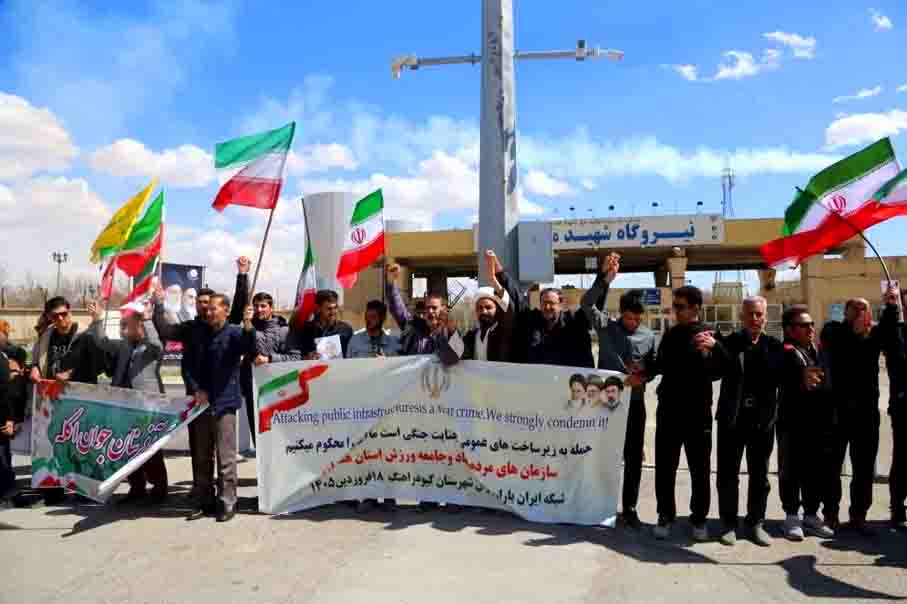
Iranian civilians formed human chains around the country’s power plants in early April after the US threatened to bomb them.