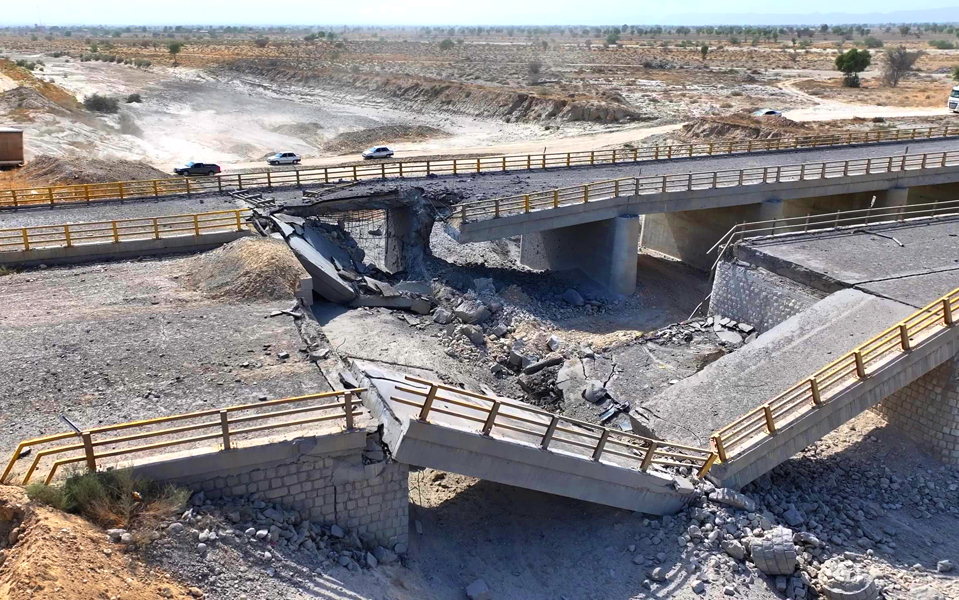
Iranian Foreign Ministry spokesman Esmaeil Baghaei says for an administration that once portrayed itself as the standard-bearer for the global order, liberalism and the fight against terrorism, displaying images of the destruction of bridges and civilian infrastructure is apparently the highest achievement the USA can now boast about.
In a post on his X account, Baghaei wrote that the Chabahar Maritime Surveillance Tower – a civilian facility dedicated to maritime safety and navigation – was deliberately targeted by the United States on 16 June as part of its ongoing aggression that began on 28 February.
He said that the US Secretary of War proudly released footage of the tower’s collapse and, had he been able to, would have broadcast the lethal missile attack on the Minab school and the massacre of civilians in Lamerd with the same chilling pride.
Baghaei said that on Saturday night, the US also attacked power facilities and desalination pumps at the Bunji village pier in Jask, leaving more than 10,000 people without access to drinking water.
‘For a State that once cast itself as the global champion of order, liberalism, and the war on terrorism, proudly displaying images of destroyed bridges and civilian infrastructure has become its only remaining victory.’
Baghaei pointed out that with the collapse of every bridge, every tower, and every civilian facility, it is not merely steel and concrete that is being reduced to rubble, it is America’s moral standing – along with the entire architecture of international law and the claims of the ‘civilised’ West – that is crumbling before the world’s eyes.
The question that must now be asked of America and its allies is stark and simple: What is the difference between what they have done in Chabahar, Minab, Lamerd, and Jask, and the very acts of terrorism they once invoked to justify their wars and occupations?
Baghaei also pointed out that confusing and often contradictory statements from American officials – including President Donald Trump – expose deep divisions and competing factions within the US administration, each pursuing its own agenda and interests.
In an interview with Ahmad Solomon, a social media activist, on Saturday, Foreign Minister Baghaei also addressed a number of regional and international developments – particularly the warmongering of the US and the Israeli regime in West Asia in violation of international law, as well as their non-compliance with agreements.
Referring to the shifting statements of American officials following the launch of the unprovoked and illegal aggression against Iran, Baghaei said that different forces and interests are active behind the decisions in Washington, leading to confusion and contradiction on various issues.
In response to a question on the Islamabad Memorandum of Understanding (MoU), he noted that Iran had never initiated any breach; rather, it was the US that violated the agreement from the very first days by renewing military aggressions.
Pointing to the MoU, which specifically addressed the management of the Strait of Hormuz and the release of frozen Iranian assets, Baghaei pointed out that there was no clause in the memorandum that allowed the United States to create an independent parallel route through the waterway off Iran’s southern coast.
Whether it was the JCPOA nuclear agreement or the recent MoU, US non-compliance forced Iran to take retaliatory measures. ‘We had made it clear that we would adhere to our commitments as long as the US fulfils its obligations.’
The text of the MoU is transparent and unambiguous he said, and a 30-day period was envisaged to ensure the return of normal ship traffic through the Strait of Hormuz.
However, the United States launched a military aggression in defiance of all the clauses, even though Iran had taken all necessary measures to ensure the safe passage of ships.
As one of the littoral states of this waterway, Iran has both the authority and the right, under international law, to take any necessary measure to prevent aggressors from abusing the Strait in order to attack Iran and threaten its national security – and this is the reason behind the closure of the maritime route.
Baghaei also said that the US failure to stop the Israeli war on Lebanon and to call on the regime to pull its forces out, was yet another example of the other side’s dishonesty regarding the agreement.
He added that there seem to be a number of factions and lobbies working behind the scenes in Washington against the implementation of the MoU.
Referring to outrageous and illogical messages on social media platforms from Washington, Baghaei said the US can no longer claim to have a coherent, efficient, and effective system of governance; rather, it is impossible to interact with such a fragmented administration.
In response to a question on Israeli warmongering, the Iranian Foreign Ministry spokesman said the regime could not survive without war, because since Israel’s creation, the region has been mired in war and instability due to the joint actions of the United States and the Israeli regime.
‘If you look at the past eight decades, you will see that the only regime that has consistently reproduced war, violence, and conflict has been the Israeli regime.’
Condemning the renewed US war on Iran and the ensuing bloodshed and destruction, Baghaei said that the US has admitted its intention to commit genocide against Iranians as part of its campaign over the past 47 years.
According to him, the entire structure of unilateral sanctions was designed to punish ordinary Iranians, and now with the US’s military campaign, they have followed the same method—directly and deliberately targeting civilians, whether in Minab school, in Lamerd, or elsewhere in Iran.
Stating that the war clearly violates the United Nations Charter as it was launched on an illegal basis, Baghaei said the US-Israeli military attack is not just a matter for Iran or even the region – it affects the entire international community.
He also highlighted US deception. Iran had never left the negotiating table, whether during the current US administration or in the past. However, he added, one cannot expect a nation that has been attacked twice in one year while negotiating in good faith to underestimate the level of sham on the other side.
The Foreign Ministry spokesman also underscored the country’s deterrence doctrine, emphasising that the Iranian Armed Forces have shown their capabilities so far and remain in combat readiness to deal with those who have imposed an unjust and illegal war on the Iranian nation and the entire region without any justifiable reason.
- A Hezbollah lawmaker says that Lebanon will never become a US protectorate or part of Israeli settlements, denouncing a US-brokered framework agreement between Lebanon and Israel, and warning that the group’s armed resistance remains essential to defending the country’s sovereignty.
Hassan Ezzeddine, a member of Hezbollah’s Loyalty to the Resistance parliamentary bloc, described the framework agreement as an ‘agreement of humiliation and disgrace’.
He said the accord ignored Israel’s crimes and failed to require a full Israeli withdrawal from occupied Lebanese territory.
Ezzeddine said the Lebanese government is making concessions by engaging in direct negotiations with Israel which amounts to a conspiracy against Lebanon’s people, sovereignty and independence and would ultimately damage the country’s national interests.
Israel says it would only withdraw from ‘disputed areas’ on the condition that Hezbollah disarms, – an objective Israel had failed to achieve through military operations in previous wars.
Ezzeddine said no one has the right to strip the Lebanese people of the resistance’s weapons.
- The Islamic Revolution Guards Corps (IRGC) Navy says two vessels were involved in accidents after attempting to transit the Strait of Hormuz through an ‘unsafe route’ and ignoring warnings issued by the Iranian authorities.
In a statement on Sunday, the IRGC Navy said four ‘offending vessels’, backed by ‘American terrorists’, switched off their navigation systems and sought to disrupt traffic by attempting to exit the Strait of Hormuz via an unsafe passage.
The force said two of the ships ‘suffered accidents and came to a halt in their locations’, while the other two abandoned the route after receiving warnings from the IRGC Navy’s Hormuz Strait control base.
The statement reaffirmed the IRGC Navy’s ‘complete control’ over the Strait of Hormuz, and that the only safe passage is the designated route announced by the force.
‘Not a drop of oil, gas, or fertiliser will pass through the Strait of Hormuz without coordination and permission,’ it added, reiterating previous warnings.
The IRGC also sternly warned that vessels influenced by ‘the American enemy’ and entering unsafe routes ‘will certainly suffer accidents’.
The developments come amid escalating tensions following repeated US violations of the Pakistan-brokered memorandum of understanding between Tehran and Washington signed on June 17.
Iran has prevented all unauthorised vessel movements through the Strait of Hormuz that are in violation of the MoU.