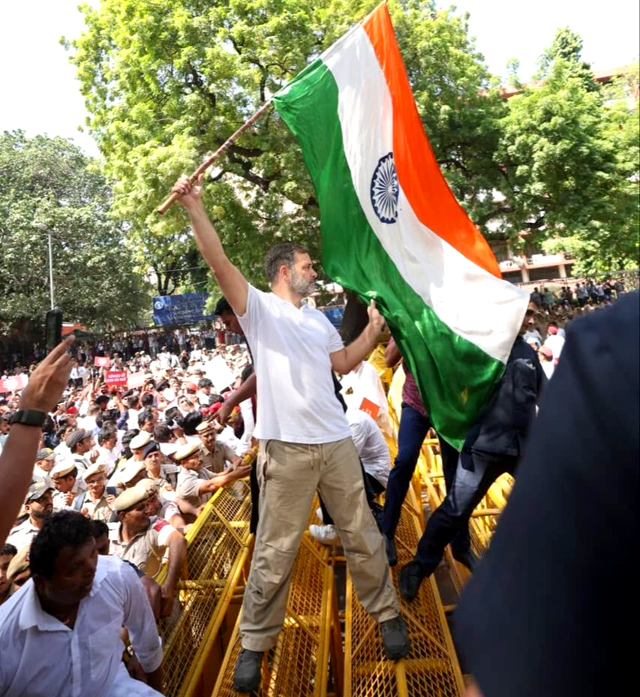
NEW DELHI – Rahul Gandhi, India’s leader of the opposition, stood on a police barricade on Parliament Street on Tuesday 6 October, waving the national flag, before he, Priyanka Gandhi Vadra and other opposition MPs marching on the Election Commission were detained.
This week, the supreme court demanded answers over 130 million deleted voters, the same court rebuffed the government over the forests of Great Nicobar, opposition parties called a statewide shutdown in mineral-rich Odisha and Delhi’s government banned striking bus drivers from protesting.
On each front the state has met resistance with barricades, detentions or emergency law.
‘A puppet in the hands of the government’
The INDIA bloc march from Parliament demanded the resignation of Chief Election Commissioner Gyanesh Kumar over the special intensive revision (SIR) of the electoral rolls, which has removed 130 million names.
MPs from Congress, the Trinamool Congress, Shiv Sena (UBT) and other parties joined it.
‘The election commission is a puppet in the hands of the government,’ Congress president Mallikarjun Kharge said as it set off.
Police said the MPs were detained after trying to breach the barricades, and released them soon afterwards.
A day earlier, on Monday 5 October, the supreme court issued notices to Narendra Modi’s government, the commission and Kumar himself, saying it expected all of them ‘to respond in a clear, transparent manner’.
Two petitions argue that the commission’s credibility is now in question and seek an independent inquiry into Kumar’s handling of the revision.
‘Deletions of voters have been made in the largest democracy,’ said lawyer Menaka Guruswamy. Another advocate warned the judges that unless the rolls were kept fair, ‘this country will burn’.
The court is due to hear the cases again the following week.
The commission says it is clearing duplicate, dead and ineligible names along with ‘illegal infiltrators’, and has called Gandhi’s allegations misleading.
Large numbers of people in Delhi, Bihar and West Bengal say they have been wrongly struck off and have struggled to get their vote back.
Critics say the exercise has particularly targeted Muslims, who do not traditionally vote for Modi’s Bharatiya Janata Party (BJP).
Kumar was chosen for his post by a panel headed by Modi. Public anger erupted after the Indian Express newspaper reported irregularities in the process that had been flagged in more than a dozen internal objections.
The Cockroach Janta Party (CJP) has led the movement on the streets.
The youth movement took its satirical name from a remark by Chief Justice Surya Kant in May, and its protests over the summer forced the resignation of Modi’s education minister.
Its founder, Abhijeet Dipke, has called Kumar ‘the biggest threat to India’s democracy’.
After Kumar ignored his deadline to resign, the CJP launched a nationwide protest on Friday 2 October, when thousands marched in Mumbai.
In Delhi the same day, police detained Neha Bora, national president of the All India Students’ Association.
Hundreds more young people were forced on to police buses in the capital over the weekend of 3 and 4 October.
Officers are accused of sexually assaulting three journalists at those protests, and Delhi police say they are investigating.
Great Nicobar Island project
Also on Monday 5 October, a bench of Chief Justice Surya Kant and Justices Joymalya Bagchi and V. Mohana threw out the government’s attempt to halt litigation against the 92,000 crore rupees Great Nicobar Island project.
The scheme would place a transshipment port, a greenfield airport, a power plant and new townships across 166 square kilometres of an island that is home to the Shompen and Nicobarese.
Both peoples are recognised as Particularly Vulnerable Tribal Groups.
The petitioner, Meena Gupta, is a retired civil servant who served as secretary in both the environment and tribal affairs ministries and helped draft the Forest Rights Act.
She argues that the consent of local village assemblies to the diversion of forest land was obtained in breach of that law.
In May, the Calcutta High Court rejected the government’s objection that she had no standing to bring the case. It held that there could be no ‘thumb rule’ on standing where vulnerable communities were concerned, and that a project’s national importance did not place it beyond judicial review.
Before the supreme court, Attorney General R. Venkataramani argued that the project was of ‘great national importance’ and questioned whether the petitions could be heard at all.
S. Muralidhar, for Gupta, said they concerned the rights of the island’s most vulnerable tribal peoples.
From the bench, Justice Bagchi asked: ‘Do they become integrated completely with the mainstream, or do we keep them with their unique identity and the identity of their culture?’
He added: ‘Preservation of culture is a constitutionally protected fundamental right.’
The High Court will now hear the case on 25 and 26 November. Congress general secretary Jairam Ramesh has accused the government of ‘bulldozing through’ the project.
‘The rightful owners of Odisha’s mines’
In Odisha, the fight over land and minerals has turned into a fight for the streets.
On Tuesday 29 September, INDIA bloc parties held a mass rally at Lower PMG Square in Bhubaneswar and marched on the residence of chief minister Mohan Charan Majhi, where police detained senior leaders and party workers.
Congress, the CPI(M), the CPI, CPI(ML) Liberation and the Samajwadi party were among those taking part.
The parties called a statewide bandh (general strike) for Thursday 8 October.
Their demands are to repeal of the Mines and Minerals (Development and Regulation) Amendment Act 2026, the resignation of state education minister Nityananda Gond, and the resignation and arrest of Gyanesh Kumar.
State Congress president Bhakta Charan Das accused the BJP state government of adjourning the assembly indefinitely to escape the protest, although it had been due to sit until 3 October.
‘So, the agitation will intensify further, and Odisha, from the capital Bhubaneswar to every village, will remain shut down on October 8,’ he said.
‘Thousands of workers of all the INDIA bloc political parties will court arrest.’
The mining law passed the Lok Sabha in August with almost no debate. Opposition parties in mineral-rich states say it strips them of control over mineral-bearing land and of mining revenue they are owed.
The Biju Janata Dal (BJD) says Odisha stands to lose around 1 lakh crore rupees in arrears.
The mines ministry says states will keep around 90 per cent of mining-related payments.
Former chief minister Naveen Patnaik, now leader of the opposition in the state assembly, has said: ‘The people of Odisha are the rightful owners of Odisha’s mines and Odisha’s land.’
A day after the rally, on Wednesday 30 September, farmer and student organisations held a separate 12-hour bandh (general strike), backed by the BJD, Congress and the left.
It was called over government school textbooks that campaigners say contain more than 1,600 errors, and it also demanded Gond’s resignation.
Bus drivers stripped of the right to strike
In the capital, drivers and conductors at the Delhi Transport Corporation (DTC) have been on strike since Tuesday 15 September. Contract drivers say they earn as little as 862 rupees (around 6.7 pounds) a day. They want a minimum of 2,000 rupees, paid public holidays, an annual bonus and social security.
The DTC Karamchari Ekta Union is also demanding a long-delayed revision of the dearness allowance and the absorption of drivers employed by private operators on to the corporation’s payroll.
On Wednesday 23 September, the Delhi High Court asked Chief Minister Rekha Gupta’s government why it had not invoked the Essential Services Maintenance Act against the strikers.
Counsel for the corporation claimed that the drivers had no union and accused strikers of vandalising buses.
A week later, on Wednesday 30 September, the government invoked the Haryana Essential Services Maintenance Act as extended to Delhi.
The order declared DTC and cluster bus services essential and banned strikes and protests by their workers for six months. The drivers were reported to be continuing their action on Friday 2 October.
Low pay drove protests beyond the capital too. In Bhopal on 28 and 29 September, outsourced and temporary workers in Madhya Pradesh government departments, among them school cooks, sanitation workers and security guards, demanded statutory minimum wages and permanent jobs.
Some said they had been paid 2,000 to 5,000 rupees a month for more than 20 years.