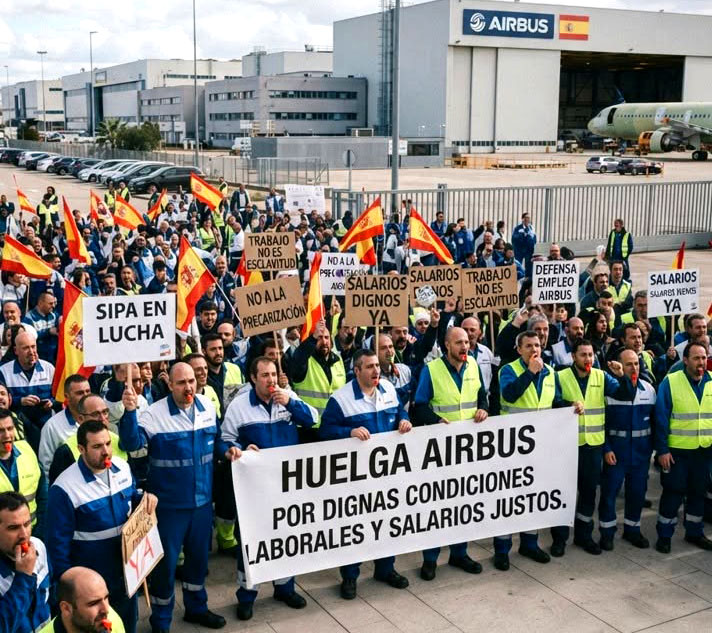
AIRBUS workers in the centres of Getafe (Madrid), San Pablo and Tablada (Sevilla) have decided to maintain the indefinite strike that began last week, after the assemblies held on Monday rejected suspending the mobilisations.
According to the Independent Union of Aeronautical Professionals union SIPA sources cited by Europa Press, 81.2 per cent of the workers voted in favour of continuing the strike, compared to 16.4 per cent who positioned themselves in favour of suspending it.
The remaining 2.4 per cent corresponded to abstentions.
The decision contrasts with that adopted last Friday in Illescas (Toledo), where the staff voted in favour of pausing the mobilisation.
The workers of Albacete and Cádiz, who did not hold a vote on Monday, have communicated that they will adhere to the majority result of the group of centres.
The continuation of the strike occurs while the last proposal presented by Airbus to try to reach an agreement with the unions remains on the table.
The company proposes in its offer to link salary increases to the real CPI and recover 7.6 per cent of purchasing power, among other measures.
However, Airbus has formally conditioned the application of the proposal to the union organisations proceeding with the immediate cancellation or suspension of the strike.
The company had already warned last week about the impact that the continuation of the strikes was having.
Airbus described the situation as ‘critical’ for its business and assured that it had received messages of ‘concern’ from clients and other stakeholders demanding ‘business continuity and reliability’.
The management has reiterated, at the same time, its willingness to reach an agreement with the representation of the workers.
The conflict had a new appointment on Tuesday. Airbus and the legal representatives of the staff will participate in a formal mediation meeting before the SIMA arbitration court.
In this meeting, the company was expected to maintain its position that the definitive agreement must be reached in a prior scenario without strikes or mobilisations.
The voting on Monday therefore keeps the strike open while both parties seek a negotiated solution to the labour conflict.
- Meanwhile, three civil service trade union organisations affiliated to the left wing CGTP confederation in Portugal have called a strike involving all civil service grades for 2nd October, to demand better pay for professionals who are ‘the lowest-paid in the civil service’, the trade union federation announced on Tuesday.
The National Federation of Public and Social Service Workers’ Unions (FNSTFPS), the National Union of Local and Regional Government, Public Enterprises, Concessionaires and Related Sectors Workers (STAL) and the Lisbon City Council Workers’ Union (STML) have jointly organised the strike.
The strike covers around 350,000 workers in general roles within central, direct and indirect, local and regional public administration, said Joaquim Ribeiro, a leader of the national federation, at a press conference in Lisbon on behalf of the three organisations.
The trade unions are demanding an immediate improvement in the career prospects of these professionals, recognition of the specific nature of their professions, and the immediate start of pay negotiations without waiting until next year.
The strike serves to send ‘an urgent warning to the government’, to show that ‘we cannot wait until 2027 to begin negotiations, and workers will demonstrate precisely that’.
In addition to the nationwide strike, the trade unions have organised a demonstration in Lisbon for the same day at 11am.
Alluding to the situation of the ‘lowest paid workers in the civil service’, Ribeiro accused Luís Montenegro’s government (PSD/CDS-PP) of ‘always leaving general service workers until last’.
He said: ‘Workers in general service roles are no more, but neither are they any less, than any other professional group.’
He also highlighted that at stake are ‘the workers who face the worst conditions amongst public sector staff’, who are close to the minimum wage and who have seen ‘their pay scale squeezed’.
Citing as examples workers in Social Security, urban sanitation, refuse collection, schools and universities, registry and notary services, and the justice system Ribeiro said: ‘Many workers, particularly operational assistants, have even been pushed down to the national minimum wage
‘These are the workers who keep public services running’ and who ‘put themselves on the line every day’ when dealing with the public, said Ribeiro.
Asked about expectations regarding participation in the strike, the leader said the unions expect ‘very strong’ participation and noted that this will be ‘an opportunity to put pressure on the government’ in the run-up to the presentation of the draft State Budget for 2027, which has to be submitted to parliament by 10th October.
Ribeiro added: ‘We are certain it will be a major public sector strike, with thousands of public services closed, thousands of schools closed, and disruption to refuse collection.’
He acknowledged that trade unions are aware that the strike ‘will cause disruption to the public’, but what they are telling the public ‘is that workers are also going on strike so that public services can be delivered more effectively’.
He continued: ‘With the wage stagnation we’ve experienced, the pay levels of technical assistants and senior technicians have fallen to within 200 euros of the national minimum wage, and we need to start negotiations in mid-2027 so that we can see the effects of this in 2028.’
He stressed that ‘pay rises of recent years are insufficient to keep up with the cost of living and, at the moment, what the trade unions are hearing in the workplace is that the month is getting longer and the pay is getting smaller’.
Of the 353,000 general-category staff, 170,000 are operational assistants, 92,000 are technical assistants, and 88,000 are senior technicians, according to the trade unions.
- Elsewhere, Georgia has declined to accept the European Union’s new sanctions against Iran.
In response to a question about why Georgia had not joined the new EU sanctions against Iran, Engiz Sharmanashvili – a representative of Georgia’s ruling Georgian Dream Party in the parliament of Georgia – said: ‘Tbilisi’s accession to any resolution or the adoption of any action in the field of international policy is determined solely based on one criterion: Does it serve Georgia’s interests at that particular time?
‘If a decision conflicts with Georgia’s interests, it simply does not matter to us whose interests it serves,’ he added.
Sharmanashvili also referred to Turkey and Serbia, noting that these two countries, despite their EU candidate status, have also not joined the new sanctions against Iran.
Recently, Georgia’s government has been trying to maintain an independent approach, making decisions based on national interests rather than sacrificing its ties with other countries just to gain EU membership.
- Meanwhile, the Serbian government, the Municipality of Indjija and Chinese battery maker Jiangsu Reliance Energy Tech signed a 100.5 million-euro (£86.11 million) framework agreement on Monday to build the company’s first overseas factory in the northern Serbian city of Indjija.
The plant, to be built in Indjija’s high-tech zone, will produce batteries for drones, humanoid robots, unmanned vehicles, advanced power tools and household appliances.
The agreement was signed at the Palace of Serbia in Belgrade by Serbian Economy Minister Adrijana Mesarovic, Indjija Municipality President Marko Gasic and Reliance co-founder and Chief Operating Officer Xu Fenlan.
Serbian President Aleksandar Vucic met with company representatives before the signing ceremony and said the investment will support Serbia’s efforts to develop a domestic supply chain for robots, drones and batteries, while reducing its reliance on imported components.