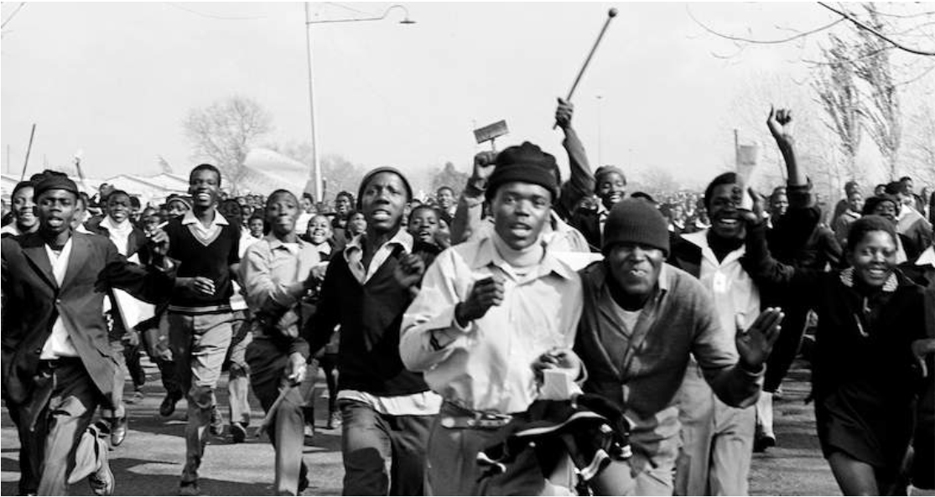
The South African Federation of Trade Unions (SAFTU) said on Tuesday that it joins millions of South Africans in commemorating the 50th anniversary of the Soweto Uprising of 16th June 1976.
SAFTU stated: ‘Today we honour the courage, sacrifice and revolutionary spirit of the young people who rose against the racist and oppressive Bantu Education system of apartheid.
‘We remember the thousands of students who marched in defiance of a regime that sought to condemn black people to permanent subordination, cheap labour and ignorance.
‘We pay tribute to the many who paid the ultimate price, including Hector Pieterson, Hastings Ndlovu and countless others whose names history may not have recorded but whose sacrifice helped to ignite a nationwide uprising that fundamentally altered the course of our struggle for freedom.
‘The youth of 1976 understood that education is never neutral.
‘They understood that the classroom can either be an instrument of liberation or an instrument of oppression.
‘Their struggle was not merely against Afrikaans as a medium of instruction.
‘It was a struggle against an entire system designed to reproduce racial inequality and economic exploitation.
‘As we mark this historic anniversary, SAFTU believes it is important to present a balanced assessment of where we stand fifty years later.
‘There have been undeniable advances since the end of apartheid.
‘Millions more children now have access to schooling than under apartheid. Racial barriers to education have been formally abolished. School nutrition programmes reach millions of learners every day.
‘No-fee schools have expanded access for poor communities. Access to universities, TVET colleges and other post-school institutions has increased significantly.
‘Learners now enjoy constitutional rights that were denied to the generation of 1976.
‘The democratic state has invested substantial resources in expanding educational opportunities and improving access to basic education.
‘The matric pass rate has improved substantially compared to the apartheid era, and many young people from working-class and rural communities have become the first in their families to access higher education.
‘These gains should not be dismissed or minimised.
‘They represent important victories won through decades of struggle by workers, students, communities and liberation movements.
‘Yet it would be a betrayal of the legacy of 1976 if we celebrated these gains without confronting the harsh reality facing millions of learners today.
‘Equal Education, teachers’ organisations, school governing bodies and many other stakeholders have consistently highlighted the deep crisis that continues to plague the education system.
‘Fifty years after Soweto, a child’s chances in life are still largely determined by where they are born, the income of their parents and the community in which they grow up.
‘The majority of working-class children continue to attend schools with overcrowded classrooms, inadequate infrastructure, poor sanitation, unsafe environments, insufficient learning materials and severe shortages of support services.
‘Recent monitoring reports continue to reveal major inequalities in school infrastructure, safety, scholar transport and access to quality education.
‘Many schools continue to face chronic shortages of teachers, support staff, librarians, psychologists, social workers and administrative personnel.
‘Austerity measures and budget cuts have undermined the state’s ability to provide quality education and have placed increasing pressure on educators and learners alike.
‘Perhaps the greatest tragedy confronting today’s youth is what happens after school.
‘Millions of young people leave the education system only to enter a labour market characterised by mass unemployment, precarious work and hopelessness.
‘The reality that millions of young South Africans are neither in employment, education nor training represents one of the greatest failures of our democratic transition.
‘Many learners who overcome enormous obstacles to complete matric find that there are insufficient places in universities, colleges and training institutions.
‘Even those who obtain qualifications often confront an economy incapable of creating sufficient decent jobs.
‘Government itself has acknowledged the gap between the number of learners qualifying for higher education and the number of available university places.
‘SAFTU has consistently argued that the educational crisis cannot be separated from the broader economic policies that have dominated South Africa for decades.
‘The continued implementation of austerity budgets has weakened state capacity, undermined public education and delayed the eradication of infrastructure backlogs.
‘While billions are found to service debt and provide incentives to corporations, schools are expected to do more with fewer resources.
‘The result is a deeply unequal system where educational outcomes continue to mirror the inequalities of our society.
‘The generation of 1976 fought against racial exclusion.
‘Today’s generation confronts the combined effects of class inequality, unemployment, poverty, hunger, violence and inadequate public services.
‘The 50th anniversary of the Soweto Uprising should not be reduced to ceremonies and speeches.
‘The most fitting tribute to the youth of 1976 would be a national commitment to:
‘
- End austerity and increase investment in public education;
- Fill all vacant teaching and support staff posts;
‘
- Eradicate school infrastructure backlogs;
‘
- Expand access to Early Childhood Development;
‘
- Ensure safe schools
‘
- Provide adequate learner support services including psychologists and social workers;
‘
- Expand access to universities, TVET colleges and vocational training;
‘
- Create decent jobs for young people through a comprehensive programme of industrialisation and public investment;
‘
- Guarantee that no child is denied quality education because of poverty.
‘The youth of 1976 taught us that injustice must never be accepted as normal.
‘Their courage helped to defeat apartheid.
‘Our responsibility is to ensure that political freedom is matched by social and economic justice.
‘As SAFTU, we reaffirm our commitment to the struggle for a quality, free, decolonised and adequately funded public education system that serves the needs of working-class communities.
‘Fifty years after Soweto, the cry of the youth remains the same: Education for liberation, not exclusion.
‘Education for human development, not profit. Education as a right, not a privilege.’
Seth Mazibuko who took part in the uprising said: ‘They struggled with the tear gas because when they threw it our way, the wind would blow the gas back to them, so it was also affecting them.
‘They then started sending the police dogs to us, we used stones to chase the dogs back to them.’
Oupa Moloto, then a 19-year-old pupil remembered police dogs being released to attack marchers.
Moloto said: ‘Now, women students were panicking, and then we took stones to retaliate.
‘And then the firing started.
‘Helicopters were hovering over, shooting tear gas from up in the sky.
‘Students were panicking, running in different directions.’