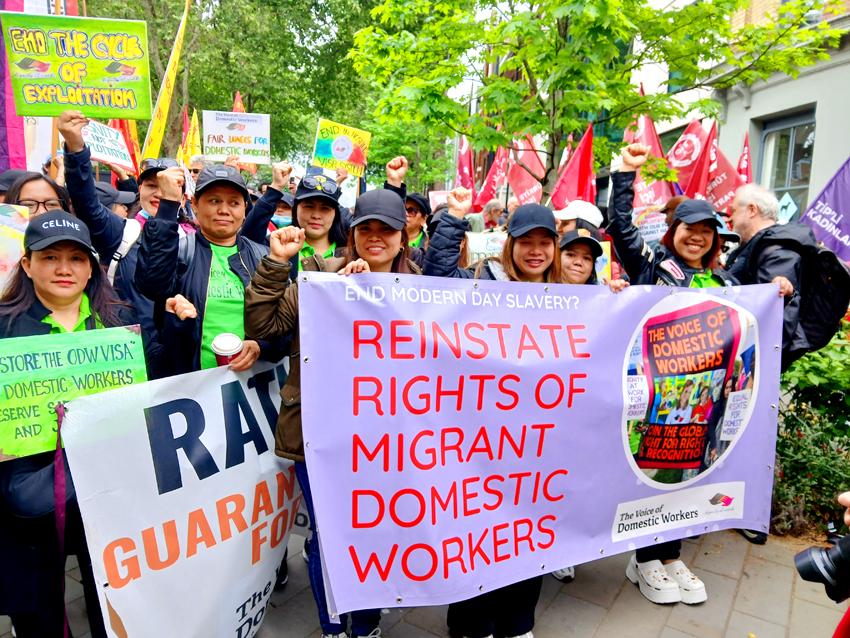
MIGRANT hospitality workers in the capital have compared life on zero hours contracts to conditions in Britain during the Industrial Revolution, as the government consultation that will decide how far the promised crackdown actually goes enters its final fortnight.
The United Voices of the World union (UVW), which organises cleaners, security guards, chefs and other low-paid and largely migrant workers across London, said the long hours, the fines levied by employers and the low wages endured by its members are very similar to those of the 1700s.
Eraldo Strumiello, a chef in a central London restaurant and a member of the union’s executive committee, said that because so many migrant workers have to renew their visas they are ‘at the mercy of their bosses’, and therefore do not refuse the hours they are given however many are piled on.
Apart from child labour, he said, the situation facing migrant workers today remains much the same as it was then.
That link between immigration control and the shift rota is the part of the problem the consultation does not touch.
A worker whose right to remain depends on continued sponsorship by the employer is in no position to turn down a shift, query a deduction from wages or complain about a cancellation.
UNISON, campaigning on the treatment of migrant care workers, has argued for a common sponsorship model precisely because tying a visa to a single employer produces a workforce too frightened of deportation to enforce the rights it already has on paper.
Neither the Employment Rights Act 2025 nor the regulations now being drafted alter that relationship.
The consultation, published by the government on 2 June under the title ‘Make Work Pay: ending one-sided flexibility’, closes at 11.59pm on 25 August.
It covers three rights created by the Act which have not yet taken effect.
The first is a right to be offered a guaranteed hours contract reflecting the hours a qualifying worker has actually worked across a reference period.
The second is a right to reasonable notice of shifts and of changes to them, including changes to start and finish times.
The third is a right to payment when a shift is cancelled, cut short or moved at short notice.
Agency workers are covered too, with the hirer responsible in most cases for making the offer.
Almost everything that will determine whether those rights bite has been left to regulations, and that is what is being consulted on now.
The government is asking where to set the threshold for a low hours contract, offering options running from eight hours a week up to 48, and has signalled a preference for somewhere between eight and 20.
It is asking how long the reference period should be, how long subsequent reference periods should run, and whether there should be a gap between them.
It is also asking which workers should be excluded altogether and what the maximum award should be where an employer fails to comply.
It has proposed that on-call firefighters and others be called out at very short notice to deal with emergencies should they fall outside the guaranteed hours duty.
The regime is expected to commence in 2027, with no date yet fixed.
Two features of the scheme are already fixed by the Act and are unlikely to reassure anyone working a variable rota in a kitchen.
A worker who is offered guaranteed hours can turn the offer down and stay on a zero hours contract, though the employer must repeat the offer after each subsequent reference period.
And the right to guaranteed hours can be disapplied entirely by collective agreement.
The manifesto commitment was to end one-sided flexibility and to give every job a baseline of security and predictability.
What Labour originally promised, before the wording was changed ahead of the 2024 manifesto, was to ban zero hours contracts outright.
What remains is a duty to offer a contract matching hours already worked, which leaves the underlying arrangement lawful.
Since Andy Burnham succeeded Keir Starmer, the shape of the final regulations remains open, and the responses filed by employers and unions this month will do much to set it.
The numbers moving in the meantime are going the wrong way.
Research by Lancaster University’s Work Foundation, commissioned by the TUC and published on 9 August, found a record number of people relying on zero hours contracts, an increase of 207,000 since Labour took office in July 2024.
The TUC has called for workers to be given at least 28 days’ notice of shifts, for full pay where shifts are cancelled late, and for ‘strong enforcement behind the new reforms’.
The gap between 28 days and what the government is contemplating is where the argument now sits.
Under a zero hours contract a worker has no guarantee of any shifts at all and is called on when wanted, frequently at very short notice, so that earnings cannot be predicted from one month to the next.
Shifts cancelled at the last minute carry no compensation, even where the worker has already paid for travel and childcare to be there.
For workers whose contracted hours are low but whose real hours are long and unpredictable, the effect is the same.
Employers’ organisations have been advised for months to audit their casual and seasonal arrangements, review their systems for tracking hours, scheduling and cancellations, and respond to the consultation while there is still time to shape it.
The hospitality industry, which employs a large share of the workers UVW represents, has warned that a crackdown would damage the sector.
Nothing comparable has been organised on the other side of the argument, which is why a union of a few thousand low-paid members putting the comparison with the 1700s on the record matters more than its size suggests.
UVW has shown what organising in these workplaces can achieve when it is done.
Security guards at the Science Museum have won pay rises totalling 30 per cent in under two years.
More than 300 workers at St Helier and Epsom hospitals voted to strike last year over what they described as second-class treatment by comparison with directly employed staff.
In each case the workforce was outsourced, low paid and heavily migrant, and in each case the gains came from industrial action rather than from consultation responses.