JORDAN DEVLIN, one of six ‘Filton 24’ activists, retried by the Labour government for damaging a weapons factory run by Israeli company Elbit Systems, who was acquitted along with Zoe Rogers, has called for the release of Samuel Corner, Charlotte Head, Leona Kamio and Fatema Rajwani who were to be sentenced as terrorists.
They were convicted of ‘criminal damage’, not of any terror offence, but have still be told they will be prosecuted on terrorism charges.
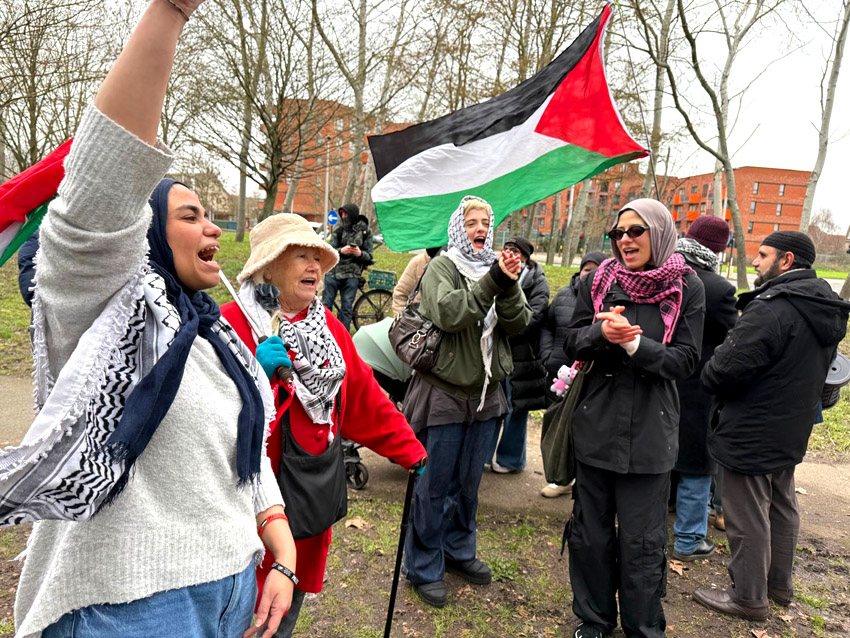
Devlin is asking supporters to attend their sentencing on 12th June at Woolwich Crown Court to show support for the Filton 24.
Devlin made the call after reporting restrictions on the so-called ‘terrorism connection’ in the Filton trial were lifted on Monday.
The facts and sentencing plans were not only hidden from the public, they were hidden from the jury in the trial, too!

- No defences permitted;
- Defendants could not mention motives, Israel, weapons, Elbit, genocide, Jury Equity, etc;
- Conviction would secretly lead to ‘terrorism’ sentencing.
This is the first time that any person convicted of an offence for protest will be sentenced as a terrorist, meaning:
- Aggravated sentences;
- They’ll serve full sentence or ‘reform’ and rescind ‘beliefs’;
- No parole until they’ve served at least 2/3rd sentence;
- Licence for up to 15 years (including requirement to register tech and relationships with police).
Meanwhile, Rajiv Menon KC a leading human rights barrister who represented Palestine Action defendants in the UK has won an appeal against a contempt of court case.
He was accused of breaching the judge’s directions in a closing speech he delivered at the conclusion of the first trial at Woolwich Crown Court involving six of the Filton 24 defendants accused of causing criminal damage to weapons at an Elbit factory outside Bristol.
The defendants were subsequently cleared of charges of aggravated burglary.
They were then retried, with four of them convicted of criminal damage last week.
The proceedings against Menon are thought to be unprecedented in English legal history.
During the trial, the presiding judge, Justice Johnson, directed lawyers that their closing speeches could not invite the jury to disregard the court’s ruling or law, and barred them from reminding the jury of its right to acquit on conscience – known as the principle of ‘jury equity’.
In his closing remarks, Menon, who has 30 years of experience and who represented defendant Charlotte Head in both trials, read out an inscription on a plaque at the Old Bailey commemorating Bushell’s Case of 1670, which first ‘established the right of juries to give their verdicts according to their convictions’.
Menon told jurors that the defendants had been ‘restricted’ when giving evidence about their knowledge of Israeli arms company Elbit Systems’ role in Israel’s war on Gaza, and that it would be ‘ridiculous’ for jurors to ignore that wider context and its impact on the defendants.
He also told the jury that the judge could not direct them to convict.
Justice Johnson said that the effect of Menon’s speech ‘was to invite the jury to disregard my directions that they should put views of the Middle East and the war in Gaza, and emotion, to one side’, and referred him to the administrative court.
Menon’s lawyers launched an appeal on the grounds that the High Court lacked jurisdiction to handle the case against him without an intervention from the attorney general.
On Monday, the Court of Appeal agreed with Menon’s team, finding that Justice Johnson wrongly initiated proceedings and should have either dealt with the issue himself at the time or referred the matter to the attorney general.
Menon’s solicitor, Jenny Wiltshire, from Hickman & Rose, said that Menon ‘is delighted that the Court of Appeal has found in his favour’, adding that he ‘hopes that this is now an end to the matter’.
The case is referred back to the trial judge. It will be halted unless he refers it to the attorney general, Lord Hermer.
Meanwhile, after almost a week of deliberations on Monday, the jury in the trial of community activist and humanitarian aid worker Majid Freeman has failed to reach a verdict, resulting in a hung jury at Birmingham Crown Court.
This follows a three week trial whereby Freeman asserted his defence and support for the Palestinian’s right to resist – as well as stating that support includes armed resistance but does not equate to direct support of Hamas, yet despite all of this a jury was still not convinced that any wrongdoing occurred.
The judge has discharged the jury and a retrial has been ordered with a provisional date of 20th September 2027 for 4 weeks.
Despite the state exhausting considerable resources in an attempt to prove that Majid Freeman was a terrorist, ten members of the British public, after days of careful deliberation, were unable to agree that he was guilty of any of the offences charged.
This outcome reflects the strength of public feeling about Palestine.
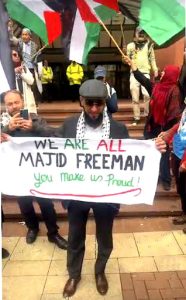
When a jury is asked to sit with the reality of a genocide and decide whether standing against it constitutes terrorism, the state is relying on fear and legal complexity to override what every decent human instinct is telling them.
The jury sat through weeks of evidence about a genocide unfolding in real time, about a man who had visited Gaza, who knew people being killed, and actively reported on their resistance to genocide, to make sure the world could not look away.
They deliberated for almost a week and could not agree that what he did was terrorism.
A retrial presents a fresh opportunity. The evidence of Israel’s brutality in Gaza, the scale of the genocide, the systematic destruction of civilian life, hospitals, schools and entire communities, will once again be placed before a jury.
Once again, the public will be asked to sit with that reality and decide whether supporting the right to resist it constitutes a criminal act, and we welcome that opportunity.
Anas Mustapha, Head of Public Advocacy at CAGE, said: ‘The state threw everything it had at Majid Freeman and a jury of his peers still could not agree he was guilty.
‘That is a profound indication of where the British public stands on the criminalisation of solidarity with Palestine.’
Of the outcome, Majid Freeman said: ‘The state exhausted considerable resources trying to prosecute me based on posts online.
‘And after almost a week of deliberation, the jury could not agree that I was guilty. They could not agree.
‘That is not nothing. I welcome the opportunity of a retrial, because it means the evidence of what Israel has done to Gaza, the brutality, the systematic destruction of an entire people, will once again be placed before a jury of the British public.
‘Let them see it again. Let the world be reminded again.’