CLOSE to 700,000 Palestinian children have now been deprived of formal in-person schooling for a third year running, according to UNICEF, as the education system destroyed by Israel’s genocidal war remains almost entirely in ruins.
Nearly 98 per cent of school buildings in Gaza have been damaged, and 526 of the strip’s 564 schools, over 93 per cent, require major rehabilitation or full reconstruction before they can function again.
Those classrooms that remain usable have been turned into shelters for displaced families.
Some 20,000 school-age children and more than 530 teachers have been killed by Israel over the course of the war, according to Monir Abu Zaiter, the director of education in east Gaza.
Tens of thousands more children have been wounded, many with life-changing injuries.
A further 19,500 students have left Gaza since October 2023.
The so-called ceasefire that came into effect on 10th October 2025 has not stopped the killing.
At least 300 children have been killed by Israel since the agreement began, an average of one child every day.
Before the genocide, Palestinians in Gaza and the West Bank had one of the highest literacy rates in the world, exceeding 97 per cent in 2020, achieved under a brutal occupation and a blockade that had already been in place for over a decade and a half.
‘Beyond missed school days, the crisis is driving severe learning loss: Without regular instruction and practice, children’s foundational literacy and numeracy skills are eroding, making it harder to re-enter schooling and progress at age-appropriate levels,’ UNICEF said in a report in April.
Researchers at Cambridge University have estimated that children in Gaza will have lost the equivalent of five years of education because of repeated school closures since 2020, first through Covid-19 and then through the war.
Higher education has been destroyed alongside it.
Around 88,000 university students were enrolled in Gaza’s institutions before October 2023.
Of 206 university buildings assessed by the Friends of Palestinian Universities, 195 were destroyed or severely damaged, with UNESCO putting the cost of the destruction at $373 million.
More than 1,372 university students and more than 246 academics and university staff have been killed.
As early as April 2024, United Nations experts said that the scale of the attacks on schools, universities, teachers and students raised the question of whether there was an intentional effort to comprehensively destroy the Palestinian education system, which they termed ‘scholasticide’.
The Ministry of Education in Gaza has attempted to promote remote learning, with lessons uploaded by teachers and made available through mobile applications.
But the targeting of telecommunications towers by Israel, frequent electricity cuts, and a severe shortage of smartphones and computers caused by the blockade have left large parts of the student population unable to reach online lessons.
Only 14 per cent of students are currently enrolled in online education, according to Abu Zaiter.
In the absence of a functioning system, parents, teachers and volunteers have built their own.
Mosques, community centres and public libraries have opened their doors as temporary educational centres over the past several months, sustained almost entirely by hundreds of teachers giving their time for nothing.
Fundraising campaigns have been launched to buy the basics, and some initiatives have managed to obtain desks, tables and blackboards.
Community and government-led projects now provide ‘temporary schools’ for some 400,000 children, according to Abu Zaiter.
Nearly 130,000 children, a fifth of all students, remain outside the education process altogether.
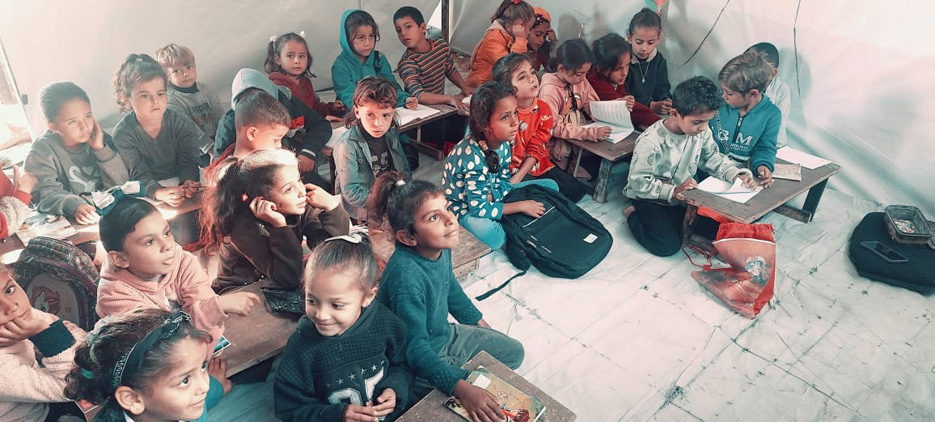
One of these initiatives is the Al-Karama School in the Sheikh Radwan neighbourhood of northern Gaza City, where classes are held under sheets of tarpaulin strung up among olive trees on a plot of farmland.
It accommodates 200 boys and girls aged from four to 17 years.
Students sit on the ground in one of two tents or in the open air, without notebooks, desks or a blackboard.
On Saturday, 13-year-old Saida Abdullah stood in front of several dozen classmates to lead the morning chants.
‘Long live a free and Arab Palestine!’ she cried out. ‘Glory and eternity to our righteous martyrs.’
The children repeated the slogans after her and the school day began.
The school’s director, Ghadeer Odeh, was forced out of her home in Gaza City soon after Israel launched its assault in October 2023.
She and her family were displaced 13 times as they fled between different parts of the strip under bombardment.
She returned to Gaza City after the ceasefire and founded the school a month later, she said, ‘to fight the ignorance that has come to threaten a new generation of Palestinians in Gaza’.
Al-Karama teaches four subjects only, Arabic, English, mathematics and science.
Physical education, arts, technology and civics, all studied in Gaza before the war, have been dropped.
Like other initiatives across the strip, the school places heavy emphasis on children’s mental health and on coping with the trauma of nearly three years of bombardment, forced displacement and engineered starvation.
This past weekend it organised a summer camp at which children sang and danced among the olive groves and were given space to talk about what they had witnessed.
Thirteen-year-old Mais Fayad addressed the other students.
Fayad said: ‘The war killed what remained of our dreams and destroyed our homes and schools. This war is painful.
‘It tore our hearts apart with fear and terror.
‘What heart could possibly hold all of this, oh God? You feel that your happiness is a betrayal, your comfort is a betrayal, and the roof over your head is a betrayal.
‘You feel ashamed to be happy so that you do not betray their grief, and you suppress the pain of your helplessness, apologising to them for remaining alive.’
Aseel Shaher, whose 12-year-old son Mohammed attends the school, was displaced with her family more than seven times during the war.
Her husband lost his clothing store and the family were driven into poverty, sending Mohammed out to work in the street markets to help feed the household.
She said: ‘I was never happy about my child working, but there was nothing we could do.’
She added: ‘Now what I had been hoping for has happened: My child has stopped working in the market and returned to learning.’
‘Schools like Al-Karama,’ she said: ‘Gave us hope that life could return to Gaza again.’
Mohammed Al-Koumi, a volunteer Arabic-language teacher, said: ‘Popular educational initiatives provide students with instruction in core subjects, alongside recreational activities and programmes to ease the burden of the war on students and compensate them, to some extent, for the education and schooling they have lost.
‘Children in Palestine have the right to learn, play, and achieve the hopes and ambitions that the war has killed.’
He added that the war has slowed but has not ended, and that parents continue to fear sending their children out to be bombed, shelled or shot by the Israeli military.
Abu Zaiter warned that initiatives like Al-Karama ‘remain temporary solutions that cannot be relied upon for many years’.
He said Israel must open the crossings into Gaza to allow in construction materials, equipment and resources, including notebooks and pencils, before the rehabilitation of school infrastructure can begin at all.
Local and international institutions, including UNICEF, have provided support, but the scale of it remains far below what is needed.
Speaking to the other children at Al-Karama, Fayad put it more directly: ‘We are the broken children of Gaza, whose hearts have been shattered by the war, deprived of their dreams and ambitions and their schools.
‘Don’t we have the right to learn? Don’t we have the right to live in a safe place, achieve our dreams, and sleep in peace and tranquillity?’