THE health and humanitarian sectors in the Gaza Strip are heading for collapse, with international and humanitarian institutions reducing some of their services at a time when the Strip is no longer able to bear the loss of any additional health facility or relief service.
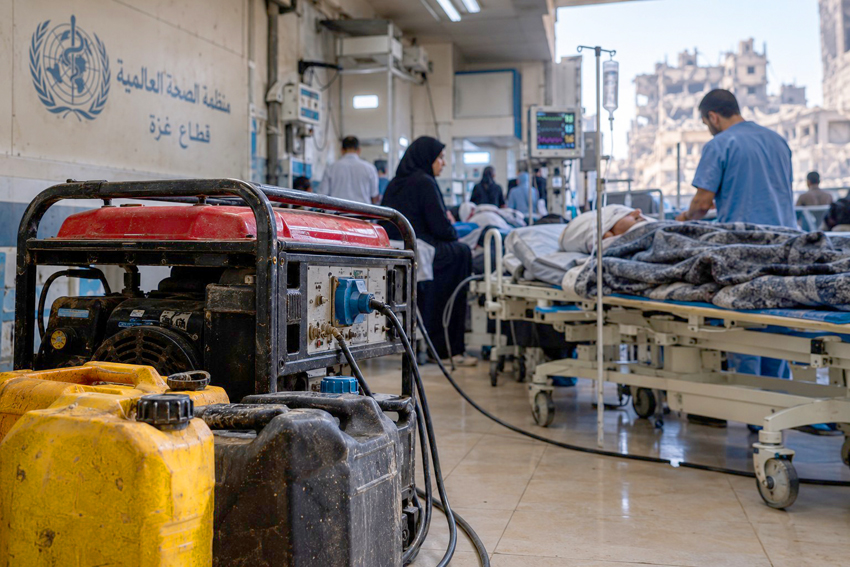
A number of non-governmental and community health centres in Gaza have received notices warning that fuel supplies provided to them by the World Health Organisation after September 19 may be cut.
According to Director of the Medical Relief Society in the Strip, Mohammed Abu Afash, this decision, if carried out, could stop or disrupt services in about seven health centres.
He explained that some institutions have already received official notices and that the reduction may extend to additional facilities, including the Medical Relief Society.
The matter, according to Abu Afash, does not relate to government and public hospitals, but rather to community and non-governmental health centres, hospitals, and institutions.
However, that does not lessen the seriousness of the repercussions, given that these facilities play an essential role in supporting public hospitals that are already operating under massive pressure and with limited capabilities.
Community and private health institutions receive thousands of patients, offering specialised services, surgical operations, examinations, and treatments that contribute to alleviating the burden on government hospitals, therefore, the loss of any new centre from service means pushing additional numbers of patients towards public facilities that are already struggling.
Abu Afash warns that the loss of these centres will not merely be a loss of individual services, but will lead to more pressure on central hospitals, and the postponement of surgical operations, diagnostic tests, and treatments needed urgently by patients.
The health system in Gaza has been operating since the war with extremely low capabilities compared to what it was before it.
There has been widespread destruction of medical facilities and departments, and there is a shortage of equipment, medicines, consumables, and personnel, which will make any new reduction in health services have a multiplied negative effect on patients.
Abu Afash points out that central hospitals, including Al-Shifa Medical Complex and Nasser Complex, already bear burdens exceeding their operational capacity, especially after the European Hospital went out of service, which makes supporting health institutions an indispensable part of the medical care network in the Strip.
The danger of the fuel crisis is not limited to operating ambulances or transporting patients, as health facilities rely primarily on generators to provide the electricity necessary to operate operating rooms, intensive care equipment, laboratories, refrigerators for preserving medicines and vaccines, and other vital services.
Therefore, reducing fuel practically means reducing the capacity to provide care, even in facilities whose buildings and equipment are still able to function.
The United Nations indicates in its latest reports that the shortage of engine oil and spare parts, alongside restrictions on their entry, threatens services that rely on generators, including hospitals, primary care centres, and blood banks, in addition to water wells, desalination plants, and sanitation.
Since March 1st, only 13,445 litres of engine oil have been approved for entry by the Israelis, while 92,778 litres remained pending approval, including more than 22,000 litres designated for health services.
Thus, the fuel crisis transforms from a logistical problem into a factor threatening a wide series of basic services, from health, water, and sanitation to transporting aid and waste disposal.
Meanwhile, the suffering of the residents of Daraa camp for Palestinian refugees in southern Syria continues due to the deterioration of a number of basic services.
This is led by drinking water, amid growing reliance on buying water at the residents’ expense, and calls to restore the dilapidated water network and implement a project for a large tank previously proposed to secure the needs of the camp’s residents.
The camp’s residents face a compounding water crisis where infrastructure damage overlaps with pumping and electricity difficulties, increasing the living burdens on families already suffering from difficult economic conditions.
A camp resident told Palestinian Refugees Portal that the water crisis compounds the services situation that Daraa camp has suffered from for years, pointing out that the residents were forced, since the beginning of the Syrian revolution, to displace to nearby, safer areas as a result of tensions and events in the region.
He explained that a large part of the camp’s residents returned in 2018 following a relative improvement in security conditions, but the returnees found harsh living conditions and infrastructure that suffered widespread damage during the previous years of war.
The damage affected the electricity, sewerage, drinking water, and lighting networks, before some of these sectors witnessed gradual improvement as a result of interventions and support provided by international organisations and donor bodies, including the United Nations Relief and Works Agency for Palestine Refugees (UNRWA).
However, according to the residents, the water sector remained one of the most pressing service files, with continuing difficulties related to securing water and its delivery to various neighbourhoods of the camp.
The water crisis in Daraa camp does not seem separate from the general water situation in the governorate, as residents of large areas of Daraa suffer from difficulties in securing water and its sources.
According to the testimony of a camp resident, the spread of random, unregulated well digging has worsened the problem at the governorate level, pointing to a report issued by Daraa Governorate that spoke of the presence of more than 50,000 illegal wells.
Residents believe that these factors reflected negatively on the availability of water and drinking water sources, at a time when the need for more sustainable solutions to address the water crisis in the camp and surrounding areas is growing.
With the continuation of the crisis, families in the camp were forced to buy water at their own expense, which poses an additional burden on their budgets, especially given declining purchasing power and rising living costs.
Their suffering does not end with merely securing the price of water, as water transport tankers face difficulty in reaching a number of homes located inside the camp’s narrow alleys.
Residents of inner neighbourhoods are forced to extend long hoses to transfer water from the tankers’ access points to their homes, with some extending up to about 50 metres, in an attempt to bypass narrow roads and the difficulty of tankers entering various areas.
These conditions add new burdens to the residents, who find themselves facing a continuous series of difficulties that begin with securing and buying water and do not end with transporting it to homes and storing it.
The water crisis was previously raised during the Daraa Governor’s visit to the camp, and it was also discussed about a year ago with the Director General of UNRWA and the Ambassador of the Czech Republic, as part of a proposal to construct a large water tank and a network to distribute water to the camp’s residents.
However, although the site designated for erecting the tank has already been identified, the project has not moved to the implementation stage yet, while the residents’ need for a more stable water source remains.
Residents hope the project will turn from a proposal into a practical step, especially since the current water network suffers from dilapidation and damage and needs restoration and rehabilitation that would improve water delivery to the various neighbourhoods.
The water crisis is growing more complex due to insufficient coordination between water pumping schedules and electricity supply hours, according to what residents convey.
At times, the duration of water arrival at the camp does not exceed two hours, and the pumping period may coincide with power outages, preventing a number of families from pumping water to their home tanks and benefiting from the limited supply period.
In response, some residents resort to operating gasoline-powered generators to run pumps and lift water to homes, which adds a new cost to the water bill.
Thus, the crisis is not limited to water cutoffs or weak arrival, but extends to the cost of purchasing, transporting, pumping, and storing it.
Amid the ongoing crisis, residents of Daraa camp have appealed to UNRWA and relevant authorities to expedite the implementation of the water tank project previously proposed, and to work on restoring and rehabilitating the damaged water network to help guarantee more regular water delivery.
Residents also demand improving the mechanism for supplying the camp with water and enhancing coordination between pumping hours and electricity supply periods, allowing families to benefit from available supplies without being forced to bear additional costs to run generators.
For the camp’s residents, the water crisis is no longer just a passing service problem, but has transformed into part of a daily situation that forces families to search for costly alternatives to secure one of the most basic fundamental needs, while implementing the tank project and restoring the existing network remain among the top demands raised to address the crisis more sustainably.
Daraa camp for Palestinian refugees is located in Daraa Governorate in southern Syria, and for decades it has been home for thousands of Palestinian refugees, maintaining its social presence despite difficult living conditions.
With the outbreak of the Syrian war, the camp and its surroundings suffered widespread damage, and its residents were forced to relocate to nearby areas in search of safety, before a large part of them returned in 2018 following a relative improvement in security conditions.
Returnees found damaged infrastructure, including water, electricity, sewage, and lighting networks, while some sectors later witnessed improvement due to interventions by international organisations and donor bodies, including UNRWA.
Basic services continue to represent a major challenge for the camp’s residents, led by water, electricity, and sewerage, amid an ongoing need for projects to rehabilitate infrastructure and improve living conditions for the residents.