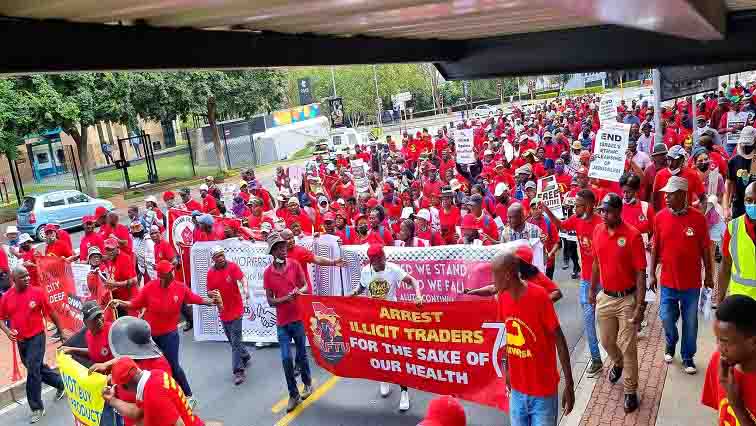
The South African Federation of Trade Unions (SAFTU) has demanded that the African National Council-led government takes action to end the education crisis in the country.
In a statement issued on Saturday they said: ‘SAFTU is alarmed by the Minister of Basic Education Siviwe Gwarube’s disclosure that there are currently 17,450 vacant teaching posts nationally out of 389,286 allocated posts, representing a national vacancy rate of approximately 4.5 per cent.
‘The provincial figures are particularly concerning:
- Western Cape: 3,535 vacancies out of 32,997 allocated posts (10.7 per cent vacancy rate);
- Northern Cape: 964 vacancies out of 9,688 allocated posts (9.9 per cent vacancy rate);
- Limpopo: 4,029 vacancies out of 53,379 allocated posts (7.5 per cent vacancy rate).
‘These figures represent thousands of classrooms where learners are being denied the full benefit of a stable and adequately staffed education system.
‘However, the real crisis extends far beyond the vacancy statistics.
‘The vacant posts must be understood within the broader reality facing public education.
‘Equal Education and other education rights organisations have repeatedly documented severe overcrowding, infrastructure backlogs, shortages of learning resources, inadequate sanitation, insufficient support staff, and the absence of libraries, laboratories and computer facilities in many schools serving working-class communities.
‘SAFTU therefore calls for:
‘1. The immediate filling of all funded vacant teaching posts.
‘2. The urgent appointment of qualified unemployed teachers.
‘3. The conversion of long-serving temporary educators into permanent positions where appropriate.
‘4. Increased funding for public education to address staffing shortages.
‘5. Accelerated investment in school libraries, laboratories, computer centres and learner support services.
‘6. Enhanced school security.’
Meanwhile, 100 workers in the embattled Tswaing Local Municipality in the North West Province have not been paid any wages since May.
In a notice to employees on 2nd June, acting municipal manager Borman Phutiyagae said the municipality had processed salaries on 29th May for employees occupying post levels six to 14.
Those still awaiting payment include general workers in levels one to five, as well as municipal and senior managers and the municipality’s 28 councillors.
This is not the first time the severely cash-strapped municipality has failed to pay staff.
In February, council workers were paid late, and during this period essential municipal services effectively came to a standstill because the municipality had no funds to purchase diesel for pumping water, delivering sanitation services or removing refuse.
Tswaing is requesting an additional grace period until 12th June.
If it cannot find the funds, Phutiyagae promised that the municipality ‘will process the outstanding salaries for May and June by 15 July’.
‘We assessed our cash flow status again and unfortunately we still do not have enough funds to process the salaries for the outstanding categories,’ he said.
He said that the municipality is also pursuing all outstanding revenue.
But members of the South African Municipal Workers Union (SAMWU) are sceptical. ‘The municipality is still expecting these employees to report for duty’ they pointed out.
SAMWU national spokesperson Papikie Mohale said: ‘What are they going to eat during their lunch breaks? How are they going to cover their children’s schooling, transport and all their financial obligations?’.
He warned that paying higher-earning employees before lower-paid workers would lower morale and create resentment.
He said: ‘The people that are actually in the forefront of service delivery are your low-paid employees. These are the workers responsible for waste collection, sewerage and all those things.’
The municipality should have approached the provincial and national governments for help when it became clear salaries would not be paid, Mohale said, ‘this highlights broader problems with municipal finances.
The cash crunch comes amid a legal battle between the municipality and the provincial government. Recently, the North West High Court in Mahikeng dismissed an urgent application by Tswaing for an interdict to block the implementation of a report that flagged widespread maladministration.
The report, ordered by North West cooperative governance MEC Gaoage Molapisi following an instruction from cooperative governance minister Velekosini Hlabisi, warned that the municipality’s administration could collapse if multiple issues were not addressed.
It flagged that the municipality prioritised salary increases and promotions over community needs, resulting in millions in losses, further criticising spending an ‘absolutely unreasonable’ R47.6-million on litigation over five years.
Molapisi subsequently directed the council to begin revoking the appointments of three senior officials, including the acting municipal manager, but the council rejected the report and launched a court application to block its implementation and challenge its findings.
While the bid for the urgent interdict was dismissed, the court is still set to adjudicate whether the investigation had been procedurally fair towards those implicated.
Meanwhile, South Africa regularly violates the rights of workers and is among the countries where violent attacks against workers have increased, according to the 2026 Global Rights Index released by the International Trade Union Confederation (ITUC).
The annual index, which ranks 151 countries based on workers’ rights protections, placed South Africa in the category of countries where government or companies regularly interfere with collective labour rights.
The index is based on 97 indicators derived from International Labour Organisation (ILO) conventions and jurisprudence.
The index found that workers suffered violence in 32 per cent of countries in 2026, up from 26 per cent in 2025, with violent attacks increasing by six per cent globally.
South Africa was listed among the countries where attacks on workers increased, alongside India, Palestine and Ukraine.
ITUC General Secretary Luc Triangle said the crisis facing workers had moved beyond isolated incidents.
‘The 2026 Global Rights Index shows that the crisis for workers’ rights is no longer confined to the margins – it is now at the heart of democracies.
‘Governments are failing to protect working people, and in many cases are actively undermining them,’ he said.
Triangle described the trend as a coordinated attack on democracy that is stripping away rights and silencing workers.
He said: ‘But workers and their unions are fighting back.
‘The struggle for workers’ rights is the fight for democracy itself – for our rights, our safety and our livelihoods. Without strong unions, there can be no real democracy.’
The ITUC said workers’ rights are deteriorating worldwide, with leading democracies increasingly contributing to what it described as a deepening global crisis.
According to the report, a record 72 per cent of countries deny workers access to justice, while half of all countries had arrested or detained workers during the reporting period.
Attacks on free speech and freedom of assembly increased by five per cent and are now reported in 50 per cent of countries.
The report identified three major trends driving the deterioration of workers’ rights globally:
The targeting of trade union leaders through arrests, violence and criminalisation;
The use of digital surveillance to monitor and discipline workers;
And governments increasingly sidelining unions when introducing or amending labour laws.
Among its key findings, the report noted that three out of four countries deny workers the right to organise, while 50 per cent of countries arrested or detained workers.
It also found that civil liberties violations increased by three per cent, with trade union leaders increasingly subjected to arrests, persecution and, in some countries, killings.
The United States was added to the ITUC Watchlist amid concerns about restrictions on collective bargaining and the use of force against workers.
France recorded its lowest-ever rating, while Argentina experienced one of the steepest declines in the index’s history, dropping from a rating of three to five in just two years.
The 10 worst countries for workers in 2026 were identified as Argentina, Belarus, Ecuador, Egypt, Eswatini, Myanmar, Nigeria, Panama, Tunisia and Turkey.