WORKERS at seven state-run universities and colleges in Plateau State in Nigeria held the third day of a strike on Wednesday, disrupting academic and administrative activities across the affected schools.
The industrial action is being coordinated by the Joint Union of Plateau State Tertiary Institutions (JUPTI), which is protesting against the state government’s failure to implement agreed salary increases and address other long-standing welfare demands.
The institutions affected by the strike are the College of Nursing Sciences, Vom; College of Health Technology, Zawan; Plateau State Polytechnic, Barkin Ladi; College of Arts, Science and Technology, Kurgwi; College of Agriculture, Garkawa; College of Health Technology, Pankshin and the College of Education, Gindiri.
The chairperson of JUPTI, Cirfat Yaknan, said the strike would escalate the action to an indefinite strike if the government failed to take concrete steps to meet its demands.
He stated: ‘If nothing is done to address our concerns, we will have no option but to proceed on an indefinite strike.’
He said the dispute centres on the failure to implement a 25 to 35 per cent salary increment for workers in state-owned tertiary institutions, in line with the Consolidated Tertiary Institutions Salary Structure (CONTISS) and the Consolidated Polytechnic and Colleges of Education Academic Staff Salary Structure (CONPCASS).
JUPTI had engaged the Ministry of Education and the Office of the Head of Service in a series of meetings, during which the state government reportedly offered a lump sum of 100 million niara (£54 million) monthly as a salary increment for the total workforce across all state-owned tertiary institutions.
Yaknan said the union rejected the proposal, describing it as inadequate and inconsistent with the agreed salary structures.
He added that government officials had earlier informed the union that implementing a 25 to 30 per cent increment would cost more than 246 million niara (£133 million) per month, while full implementation of JUPTI’s demands would require over 371 million niara (£146 million) per month.
He added: ‘The issue of salary increment has been pending since January 2023. We have written several letters and issued ultimatums, but nothing concrete has been done,’ he said.
He also said that the union shelved a planned strike on 15th March, after senior government officials appealed for more time, citing the governor’s official trip to the United Kingdom with President Bola Tinubu.
Yakhan continued: ‘Since the governor returned, nothing has changed. That is why we are left with no option than to resume industrial action.’
- In South Africa, the National Union of Mineworkers (NUM) General Secretary, Mpho Phakedi, on Tuesday addressed more than a thousand workers currently on a protracted strike at Impala Platinum Triple M.
The strike, which commenced in the early hours of Friday, April 24, 2026, is a direct result of management’s continued bad faith and the deliberate obstruction of workers’ organisational rights.
NUM members at Triple M remain resolute and will intensify their industrial action until these hard-won organisational rights are fully recognised and granted.
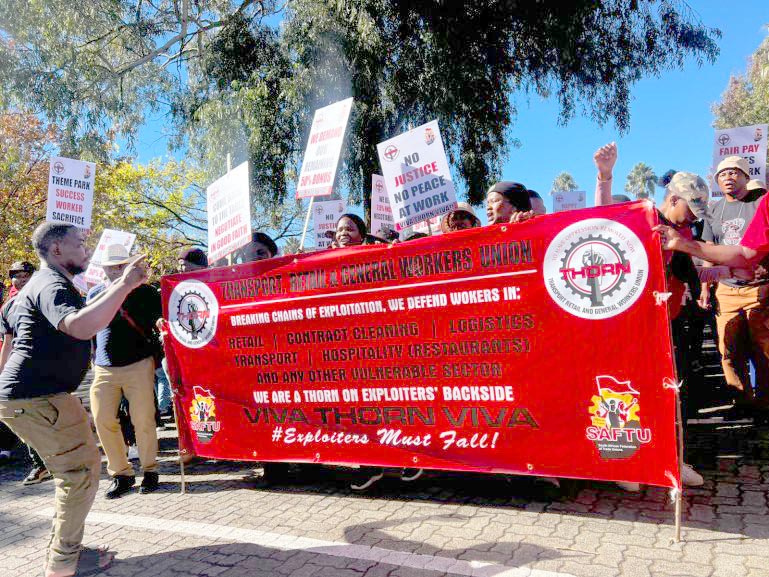
- Workers at Gold Reef City Casino and Theme Park say they won’t back down until their demands are met. They have held peaceful protests outside the casino, calling for a minimum 7.5 per cent salary increase.
The workers began their protest on Saturday 25th April, 2026, and continued their action on Monday saying they won’t back down.
Union organiser Lindokuhle Khanyi from the Transport, Retail and General Workers’ Union said workers had followed all legal processes before embarking on the strike.
Khanyi said: ‘We had salary negotiations with Gold Reef City and then we reached a deadlock.
‘We tried to move from the 12 per cent that we initially submitted to them. We moved to 7.5 per cent across the board. Still, they didn’t want to reciprocate the fairness that we brought to the table.’
According to Khanyi, management instead offered what he described as ‘a ridiculous amount’, a 4 per cent increase linked to inflation, which he claims effectively leaves workers with only about a 0.9 per cent pay increase.
He added: ‘Obviously, the workers took that as an insult and hence we are here today. Workers are also demanding the payment of outstanding bonuses.’
Khanyi claimed employees who’ve worked for more than 36 months are contractually entitled to a 100 per cent bonus but only received 50 per cent or less in December.
Khanyi concluded: ‘What they’re saying now is that it must go back to 7.5% so that whenever they retire, they can withdraw a significant amount. This 4% is not making any meaningful difference.’
- The South African Democratic Teachers’ Union (SADTU) has condemned the arrest, harassment, intimidation and reported abduction of Lot Vilakati, General Secretary of the Swaziland National Association of Teachers (SNAT) along with other Public Sector Union leaders in Eswatini.
The incident occurred while these leaders were delivering a petition to the Prime Minister’s Office.
SADTU says this is the act that falls squarely within their legitimate democratic and trade union rights.
The action represents a serious violation of the right to peaceful assembly and freedom of association.
SADTU said in a statement: ‘SADTU strongly condemns, the arrest harassment intimidation reported abduction of Lot Vilakati the general secretary SNAT and his colleagues who were allegedly abducted threatened and ill treated by the police.
‘This act, if confirmed, constitutes a grave violation of human rights and is an attack on the trade union movement.
‘Such actions represent a dangerous escalation of repression against workers and their representatives.
‘They undermine the fundamental principles of freedom of association, freedom of expression, and the right to organise.
‘These rights are enshrined in international labour movement conventions and human rights frameworks.
‘The Monarch in Eswatini has long been associated with the harassment of professionals particularly educators.
‘SADTU calls on the government of Eswatini to immediately cease all forms of intimidation, harassment and violence against trade union leaders and workers. Guarantee the safety of Lot Vilakati and all affected union leaders.
‘Respect and uphold the legitimate rights of workers to organise, protest and present their grievances without fear of reprisal. And engage in meaningful dialogue in good faith.
‘We call on the international community, including regional bodies and global labour organisations, to intervene and ensure that the rights of workers in Esatini are not violated.
‘SADTU stands in unwavering solidarity with SNAT and all public sector unions in Eswatini. An injury to one is an injury to all!’
- The South African Municipal Workers’ Union (SAMWU) calls on all municipal and water sector workers, their families, and the broader working class to actively participate in the May Day commemorations on 1st May 2026, organised by our federation, COSATU.
‘May Day is more than a public holiday, it is a day forged in struggle, sacrifice, and the blood of workers who fought for dignity, fair conditions, and the fundamental rights we exercise today.
‘From the historic 1886 Chicago strikes to the militant traditions of organised labour in South Africa, May Day remains a powerful symbol of working-class unity and resistance against exploitation.
‘May Day 2026 arrives as we reflect on the deepening crises within our municipalities.
‘Workers face the persistent non-payment or late payment of salaries, the collapse of service delivery, and the systematic victimisation of those who speak out against corruption and maladministration.
‘These realities are a direct assault on the dignity of workers and undermine local government’s role as a vehicle for community development.
‘We call on all workers to attend May Day rallies in massive numbers under the COSATU banner.
‘Our participation must not be merely symbolic; it must be a demonstration of collective power.
‘We must send an unmistakable message to employers and the state that the working class remains organised, militant, and ready to defend its interests,’ said SAMWU.