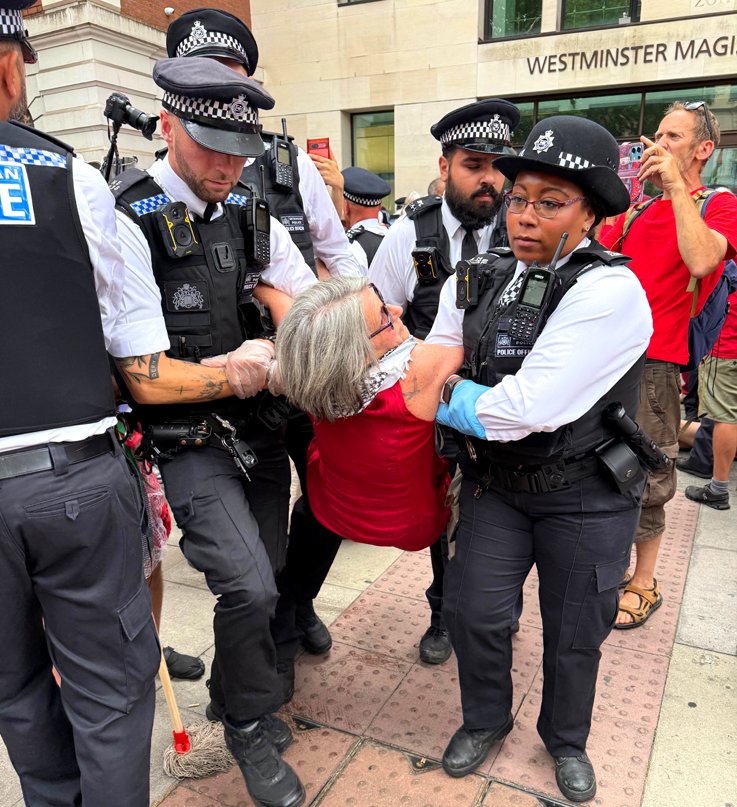
POLICE arrested demonstrators outside Westminster Magistrates’ Court yesterday, where hundreds gathered in defiance of the proscription of Palestine Action under the Terrorism Act 2000.
The demonstration, called by Defend Our Juries ‘Graduation Day’, had been timed to coincide with hearings listed for around 1,500 people arrested for holding placards reading ‘I oppose genocide. I support Palestine Action.’
Those hearings were adjourned.
The campaign said that according to the daily court listings, 1,855 people remained listed to appear in courtrooms at Westminster Magistrates’ Court on the same day, many with incorrect names or details, and in cases the court had already said were adjourned.
One prosecution notice issued to a person stated ‘Attendance required at court’, stating that the recipient must attend, and then that they should ‘not attend’, in the same document.
One arrestee said on X: ‘I’m looking forward to simultaneously appearing in Courtrooms 11 and 12 at 2pm, for a hearing that I must attend but must also not attend, which may or may not be happening, about what may or may not be a crime, on behalf of an organisation that no longer exists.’
Officers made arrests under section 13 of the Terrorism Act 2000, a summary offence of displaying an article arousing reasonable suspicion of support for a proscribed organisation, carrying a maximum of six months’ imprisonment.
Jonathon Porritt, the environmentalist and former adviser to King Charles, was arrested at the rally. As officers escorted him away he said: ‘I am a supporter of Palestine Action, trying to save lives is not terrorism, exposing this government’s complicity in genocide is not terrorism.’
Porritt was among more than 500 people arrested under section 13 in Parliament Square in August last year.
An elderly woman in a wheelchair was escorted away by police after saying: ‘I support Palestine Action and I encourage you to join.’
On 12th June, Mr Justice Jeremy Johnson ruled that four activists convicted of criminal damage at the Elbit Systems site at Filton, Bristol, had committed their offences with a terrorist connection under section 69 of the Sentencing Act 2020, as extended by the Counter-Terrorism and Sentencing Act 2021.
He sentenced them to a combined total of more than 25 years.
The jury was not told that the terrorism determination was available, and reporting restrictions concealed it until after conviction.
Their barrister, Rajiv Menon KC, told the court the ruling was of critical constitutional importance and was, he believed, the first time a terrorist connection had been invoked in a case limited to damage to property. Five more activists now face the same determination.
Johnson has twice referred Menon for contempt proceedings over his closing speech in the first trial, in which he told the jury about Bushell’s Case and the principle of jury equity.
The Court of Appeal quashed the first referral on 12 May, holding that Johnson had no jurisdiction to refer the matter to the High Court.
He referred it again on 22nd June.
Defend Our Juries has launched a campaign stream, Saving Lives Is Not Terrorism, opposing the use of the courts against ‘those who take action to save lives’.