The Yemeni resistance movement Ansarullah says Yemen’s armed forces have dealt the United States a serious setback, forcing Washington to reconsider its naval strategy in the region, along with some of its weapons, military equipment, and capabilities.
Ali al-Dailami, a member of Ansarullah’s political bureau, said that the US had ‘experience’ with Yemen, referring to Washington’s military offensive against the country alongside a Saudi-led coalition.
‘It formed a coalition against Yemen and launched military aggression against it, but achieved nothing,’ he said on Sunday, adding that the Trump administration knew Ansarullah would not compromise or submit to Washington’s will.
‘On the contrary, we struck and damaged US warships, and this was a hard lesson for the United States,’ al-Dailami added.
The Yemeni armed forces had forced Washington to reconsider its naval strategy as well as some of its weapons, military equipment and capabilities in the region.
Al-Dailami further warned Saudi Arabia that continuing its aggression against Yemen would come at a ‘very high’ cost for the kingdom, but Riyadh, he said, continued to insist on maintaining ‘a dangerous situation’.
He also called on the international community to act to stop Saudi actions and brutality against Yemeni civilians.
‘However,’ he warned, ‘when international law was suspended, and the United Nations suspended the performance of its responsibilities in the service of the Americans and the Saudi enemy, we were forced to apply and will continue to apply the equation of “siege for siege” and “military escalation for military escalation” against Saudi Arabia.”
Al-Dailami said Ansarullah would continue with the policy because the level of human suffering in Yemen remains severe.
His remarks came amid a sharp escalation between Yemeni forces and Saudi-backed forces along Yemen’s western coast.
On Saturday, the Yemeni armed forces carried out a large-scale missile and drone operation against a Saudi military base in Sharurah in southern Saudi Arabia, targeting weapons depots and command-and-control centres involved in military operations against Yemen.
Army spokesman Brigadier General Yahya Saree warned that continued Saudi attacks would trigger larger Yemeni retaliatory operations deeper inside Saudi territory.
The developments follow advances by Yemeni forces along the western coastline.
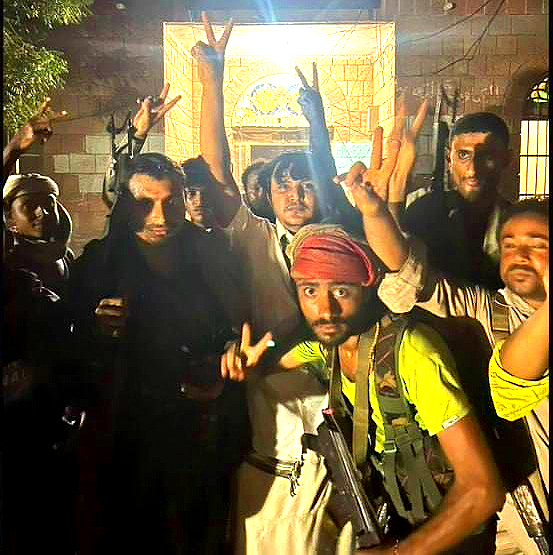
On Sunday, they captured the key port city of Mocha and the Hanish Islands and landed on the strategically located Mayyun Island at the heart of the Bab al-Mandab Strait.
A CNN report, citing sources familiar with the fighting as well as Saudi-backed Yemeni forces, described the collapse of the Saudi-backed front as ‘a major failure’ and pointed to ‘weaknesses within the coalition-backed forces’.
The Yemeni advances have strengthened Ansarullah’s position around the Bab al-Mandab Strait, a major international shipping route linking the Red Sea with the Gulf of Aden.
The developments could further disrupt shipping through another major artery for global energy and trade, with the Strait of Hormuz already severely disrupted amid the US war in Iran.
The Yemeni Armed Forces carried out a combined missile and drone strike on a major airbase in Saudi Arabia’s southern region of Asir in retaliation for the latest bout of Saudi military aggression and ongoing blockade against their homeland.
Yemeni army spokesman Brigadier General Yahya Saree, announced in a televised statement on Monday that the country’s military units had carried out a large-scale and qualitative operation against King Khalid Air Base near the Saudi city of Khamis Mushait, located some 884 kilometres south of the capital Riyadh.
He noted that dozens of domestically manufactured Yemeni ballistic missiles and combat drones hit military installations and infrastructure, aircraft hangars, radar systems, runways, arms depots, and other designated targets inside the airbase.
‘The Yemeni Armed Forces will continue their qualitative military operations deep inside Saudi Arabia as long as the open aggression against our people continues.
‘Any new aggression will be met with a decisive and more intense response.’
Saree added: ‘We will continue to uphold the siege-for-siege and escalation-for-escalation equation, and will target Saudi troop buildups until the aggression ceases and the siege on our beloved country is completely lifted.’
The recent advance by the Ansarullah-led Yemeni Armed Forces along the Red Sea coast has altered the balance of power in Yemen and marked a shift toward an offensive strategy in response to the Saudi-led aggression and siege, says a Yemeni analyst.
Professor Youssef Al-Hadhree said the rapid advance of Yemeni forces in the western coasts has shifted the balance of power.
‘Today, the balance of power at the domestic, regional and global levels is in favour of Ansarullah, given the developments that have taken place over the past few days on the western coast, and this operation demonstrates Sana’a’s offensive strategy toward the siege.’
Al-Hadhree’s remarks came after the Yemeni Armed Forces made a stunning advance along the country’s western coastline, capturing key positions overlooking the Bab al-Mandab Strait, including the coastal city of Mokha and strategic islands in and around the waterway.
The seizure of Perim, also known as Mayyun, placed the entire Strait under the control of forces operating from Sana’a, according to reports in Yemeni media.
Al-Hadhree said the developments reflect the growing military capabilities of the Ansarullah-led Yemeni Armed Forces, which he said has repeatedly used its weapons and missiles in defence of the Yemeni people, Gaza and oppressed people around the world.
‘Ansarullah has today reached a level of military power that has frightened its enemies, and the movement’s missiles have the capability to strike any point on land or at sea, and even moving targets such as ships,’ he said.
He added that Ansarullah has sufficient weapons reserves to sustain decades of war against Saudi Arabia, the United States, Israel and their allies, and weapons production is continuing.
The latest advance has given the Yemeni military greater influence over Yemen’s Red Sea coastline and the Bab al-Mandab, a vital maritime passage linking the Red Sea with the Gulf of Aden.
Al-Hadhree said the Yemeni military’s control of the Strait would establish genuine security and stability in the region, noting that waterways under the control of the United States or forces and regimes aligned with it had historically remained insecure.
He stressed, however, that Yemeni Armed Forces had previously possessed the ability to target ships in the Bab al-Mandab and the Red Sea, while all branches of Yemen’s leadership — including the Supreme Political Council, government, foreign ministry and armed forces — had emphasised the need to protect maritime trade for all ships except Saudi vessels, which had previously been declared subject to the blockade.
The analyst portrayed the latest developments as part of a broader trajectory in which Ansarullah had first resisted the Saudi-led offensive in 2015, which comprised 17 countries, and later confronted Israel in support of Gaza, and the United States when Washington sought to lift the blockade on Israel.
He said the recent fighting also thwarted a ‘Syria project’ aimed at Yemen, adding that regional and extra-regional powers and their proxies had sought to ignite a civil war and seize territory controlled by the Yemeni government and its armed forces.
The plan, he said, failed because of the readiness of Yemen’s army and people.
Al-Hadhree said Saudi Arabia’s inability to confront Sana’a was not the result of financial weakness or a shortage of weapons. Rather, he attributed it to Riyadh’s reliance on Washington.
‘Saudi Arabia has relied on America, which is a spider web and extremely weak, while we have relied on God Almighty and our internal capabilities, and God Almighty is our helper,’ he said.
He also noted that the United States is unlikely to provide direct support to Riyadh because it had already experienced confrontation with Yemen, which had ‘damaged Washington’s prestige and credibility’ in its confrontation with Ansarullah.
He pointed out that the United States is currently engaged in Donald Trump’s war against Iran and that Iran had put Washington in a difficult position.
Against that backdrop, Al-Hadhree described the Yemeni advance along the Red Sea coast as part of a strategy of ‘siege for siege’ and ‘escalation for escalation’.