ISRAEL’S Ministry of Construction and Housing has issued the first-ever tender for residential construction in E1, the colony east of occupied Jerusalem that governments have condemned for three decades as the project that would cut the West Bank in two.
The tender, published on 18 August, invites contractors to bid by 19 October to build 1,234 housing units for Israeli Jews on Palestinian land between the city and the Maaleh Adumim settlement.
It covers seven settlement complexes across roughly 12,000 dunams and takes in interconnected residential, industrial and tourism developments together with roads and infrastructure.
‘Tenders within the colonial-settlement system mark a transition from the planning stage to the stage of actual implementation,’ said Amir Dawood, head of documentation at the Palestinian Authority’s Colonisation and Wall Resistance Commission.
‘This plan is one of the most dangerous settler-colonial plans in the entire occupied West Bank.’
The tender deadline falls one week before Israel’s general election on 27 October. The Israeli organisation Peace Now said the government is trying to sign agreements with contractors before polling day so that a future government would find it harder to cancel construction.
Previous governments advanced plans for the area but stopped short of the tender phase because of American and European opposition; the current government has chosen to move toward construction as part of a declared policy of establishing facts on the ground aimed at eliminating any possibility of a Palestinian state.
On 9 September, the Jerusalem District Court refused a request from Palestinian residents and Israeli human rights groups to suspend the tender while three lawsuits against the plan are heard, Judge Nimrod Flesch ruling that construction was not yet imminent.
E1, short for East-1 and known in Hebrew as Mevaseret Adumim, was first devised in 1994 by the late prime minister Yitzhak Rabin, who instructed the Housing Ministry to begin building in the area.
The master plan was formally approved in 1999 and then frozen for over two decades under international pressure because of what it would do to the territorial basis of any Palestinian state. The Israeli government revived it in August 2025.
Finance minister and settler leader Bezalel Smotrich said at the time that the goal was to ‘bury’ the idea of a Palestinian state, and Netanyahu told a signing ceremony in Maaleh Adumim in September 2025: ‘We said: There will be no Palestinian state, and there really won’t be one. This place is ours.’
The Civil Administration approved 3,400 homes in the area that month.
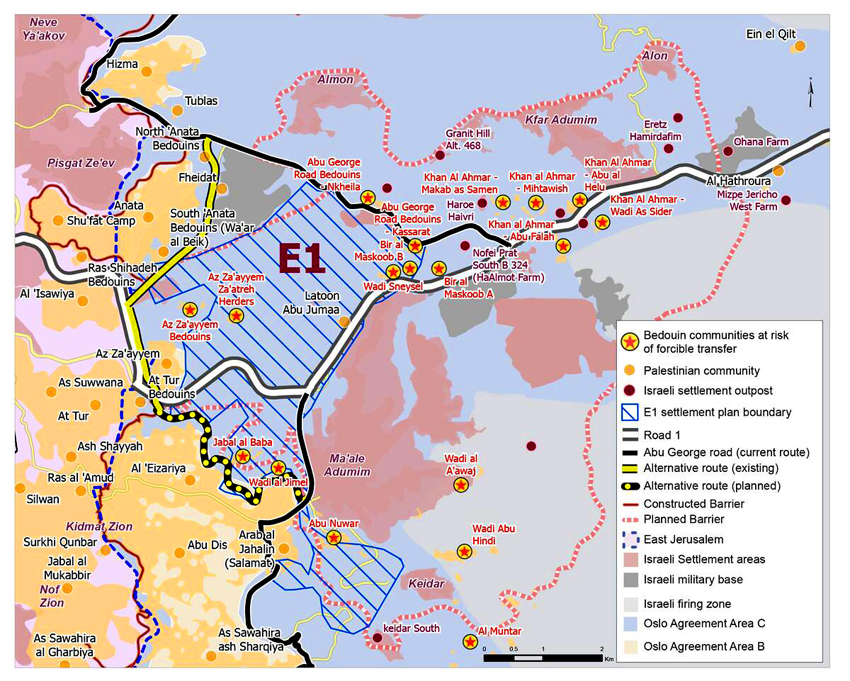
On completion, the colony will cover approximately 12 square kilometres of land taken from the Palestinian villages of Anata, al-Zaayyem, al-Eizariya, Abu Dis and al-Issawiya.
Its purpose is to create a continuous belt of settlement and easy travel between Maaleh Adumim, home to nearly 40,000 Israelis and the largest settlement in the West Bank by area, and occupied Jerusalem.
Bassam Bahar, head of the eastern Jerusalem Land Defence Committee, said some 22 villages, home to at least 7,000 Palestinians, face forced transfer, erasure and dispossession to make way for it.
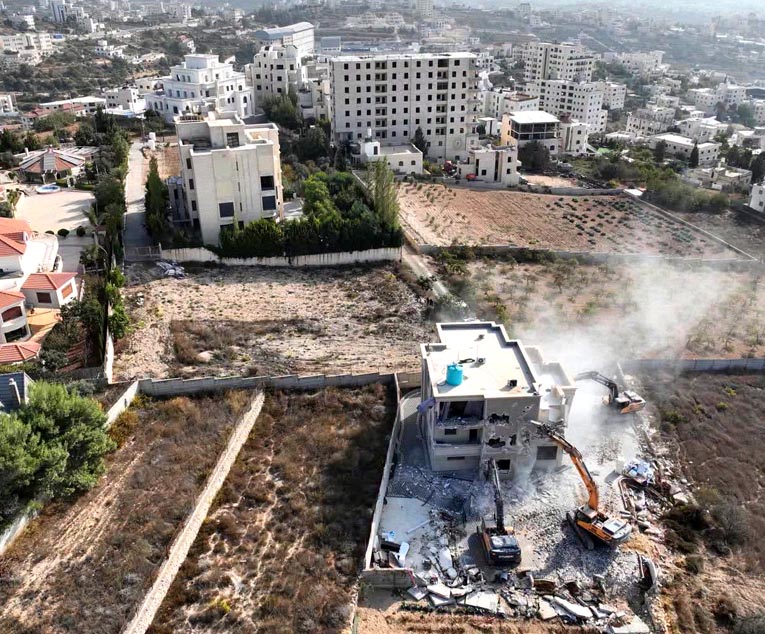
Demolitions in the E1 area have been running for years: according to the United Nations, at least 900 residents have been forcibly displaced since 2009 in more than 500 demolitions.
The location east of the city, along the historic road between Jerusalem and Jericho, is what makes the project so destructive. For Palestinians in occupied East Jerusalem, where Israel already severely restricts land for housing and urban growth, the area around E1 is one of the few remaining spaces into which the city could expand.
The colony would also complete the encirclement of Jerusalem by settlements from the north, east and south, cementing the physical separation of the city from the rest of the West Bank and cutting the daily movement of people, goods and communities between them.
Most seriously, E1 would sever the West Bank itself. Beyond linking Maaleh Adumim to Jerusalem, the new colony reinforces the settlement network stretching eastward to the Jordan Valley through one of the narrowest and most sensitive parts of the territory.
Building it would cut the most direct connection between the northern and southern West Bank and effectively split the territory in half.
Alongside the housing, Israel is building a road network under the name ‘Fabric of Life’. Its function is to reroute Palestinian traffic between the north and south of the West Bank away from the E1 and Maaleh Adumim area, allowing Israel to close the area east of Jerusalem all the way to the Jordan Valley to Palestinians while the colonies expand.
‘This new route will prevent Palestinians from travelling on the historic Jerusalem-Jericho road, and imposes a new layer of apartheid on Palestinians,’ said Dawood.The diplomatic response has been unusually broad.
On 20 August the United Kingdom, France, Germany, Italy, the Netherlands, Canada, Norway, Australia, New Zealand, Sweden, Belgium, Spain, Austria, Greece, Cyprus, Finland and the European Commission issued a joint statement saying the project would ‘further undermine Israel’s international standing’.
On 28 August some 30 Democratic US senators, several of them long-standing supporters of Israel, published a letter urging the government to ‘immediately rescind these tenders’.
On 8 September the UK, France and Canada went further. Foreign Secretary Ed Miliband told the House of Commons that Britain would introduce an import ban on goods from illegal settlements as part of a new comprehensive sanctions regime to be in place within nine months, including action against companies and individuals providing construction, infrastructure, financing or real estate services for settlement expansion.
Miliband said the action was coming now because Israel had crossed a ‘long-term red line’ with the E1 tenders, and told MPs that the British government agrees there is ethnic cleansing of Palestinians in areas of the West Bank, perpetrated by ‘settler terrorists’.
The three countries joined Ireland, Spain, Norway, Belgium and the Netherlands, which have already restricted trade in settlement goods or are in the process of doing so.
Miliband acknowledged that trade with the settlements was minimal and that the greater impact would come from the sanctions on services. Israel responded by ordering the closure of the British consulate in East Jerusalem.
For the Palestinians who live on the land, none of this has changed anything on the ground. Atallah Mazaara is spokesperson for Jabal al-Baba, a Bedouin village whose 450 residents face forcible transfer under the plan.
‘There is global inaction,’ he said. ‘We are being left to face our fate on our own.’
The plan threatens more than homes. ‘We will lose our Bedouin cultural heritage, lifestyle and legacy that we grew up in and that our forefathers protected and preserved, centred on pastoralism and livestock husbandry,’ Mazaara said.
The village’s flock has fallen from 3,500 sheep in the 1990s to 1,000 this year. Displacing the Bedouin, he said, is part of a deliberate effort to force the urbanisation of this section of Palestinian society and squeeze the population onto the smallest possible area of land, a goal Israeli ministers have stated openly.
‘I wasn’t raised to live in a city or a big village. I will live as a refugee among my own people, in my own homeland. We will be forced to live in our own society as strangers. And we will lose our entire source of income and livelihood.’
The remote locations of Bedouin and herding communities make them the easiest targets for armed settlers and soldiers.
Between January 2023 and 31 August 2026, 130 Palestinian villages across the occupied West Bank were fully or partially forcibly displaced through settler and military attacks and related restrictions on access, the great majority of them Bedouin and herding communities.
Forty-eight of those villages have been emptied completely. More than 6,400 Palestinians, including over 3,100 children, have been displaced since January 2023, and more than 2,500 of them, including 1,200 children, in 2026 alone.
The attacks have spread from the Bedouin to larger villages and farming communities across the West Bank, taking the form of mass shootings and killings, home demolitions, sieges of houses, mass seizure of farmland, the construction of colonies on private land and the destruction of crops, farm buildings and equipment.
‘We are an integral part of the Palestinian social fabric and we contribute greatly to the resilience and diversity of the Palestinian economy,’ Mazaara said.
‘This portion of society is being exterminated and wiped out. They are fighting us on everything that sustains our resilience, our livelihoods and our very presence on this land. They try to take everything from us before they have to kill us.’