THE US military boarded another tanker in the Indian Ocean carrying Venezuelan oil, the Pentagon has said, in the latest escalation of Washington’s sanctions enforcement against Caracas.
In a statement on Sunday, the Pentagon claimed the Panamanian-flagged Veronica III had tried to ‘slip away’ by sailing the vessel from the Caribbean Sea to the Indian Ocean.
‘We tracked it from the Caribbean to the Indian Ocean, closed the distance, and shut it down,’ it added.
This is the second oil tanker linked to Venezuela seized by the US military in the Indian Ocean.
Last week, the US military announced seizing the first Venezuela-linked vessel, the Aquila II, in the Indian Ocean.
The Pentagon said the move demonstrates US President Donald Trump’s determination to enforce the oil blockade on Venezuela even ‘halfway around the world’.
Since last year, nine ships have been seized by the US military in international waters.
International observers have slammed Washington’s move as ‘theft’ and ‘outright piracy’.
Venezuela had faced oil sanctions from the United States for several years. In December, however, Trump expanded the pressure campaign by ordering a quarantine of sanctioned tankers in an effort to target the government of President Nicolás Maduro.
The standoff escalated in January, when US special forces detained Maduro and his wife in Caracas and transferred them to a facility in New York.
After Maduro’s abduction, Trump announced that Venezuela’s oil would be controlled by Washington.
US Secretary of Energy Chris Wright said last Thursday that oil sales from Venezuela, controlled by Washington, have generated more than $1bn since Maduro’s capture. He said the sales in the next few months will bring in another $5bn.
Meanwhile Cuban Foreign Minister Bruno Rodríguez Parrilla on Monday met with his Spanish counterpart for talks aimed at ‘strengthening political, economic and commercial dialogue and cooperation for the benefit of both countries’, at the request of President Miguel Díaz-Canel.
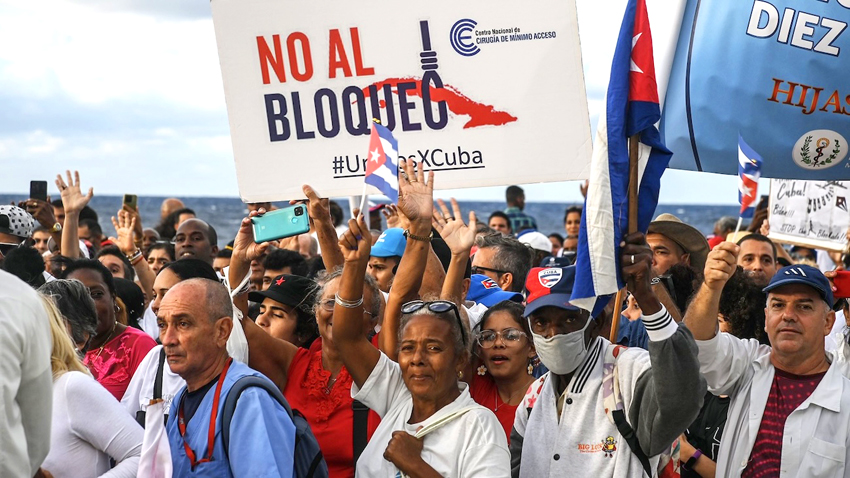
This came amid a renewed US effort to completely cut off the international oil supply to Cuba through a new tariff system.
Spanish Foreign Minister Jose Manuel Albares discussed the sending of humanitarian aid to Cuba and the situation of Spanish companies operating on the Island.
Spain will join Mexico, Chile, and Russia in sending basic supplies to Cuba, such as food and essential health products, through the Spanish Agency for International Development Cooperation (AECID, in Spanish) and the United Nations (UN).
Cuban diplomat Bruno Rodríguez Parrilla has held strategic meetings to strengthen bilateral cooperation with China, Russia, and Vietnam in the days prior.
His agenda focused on seeking international support against the unilateral coercive measures that Washington has intensified against Cuba.
US threatens Iraq with sanctions
Washington has reportedly sent a message to Iraq’s main Shia alliance, which holds a parliamentary majority, warning of potential US sanctions should the bloc proceed with the nomination of Nouri al-Maliki for the Arab country’s next prime minister.
This is according to an Iraqi adviser who spoke with Alhurra on condition of anonymity due to the sensitivity of the matter.
The adviser said on Monday that the US side threatened sanctions against the State Oil Marketing Organisation (SOMO), the Central Bank of Iraq, as well as security and diplomatic sectors, in addition to political figures and former and current officials.
The advisor suggested that the economic sanctions could involve curbs on Iraqi oil exports, constraints on the Iraqi government’s access to US dollars, or penalties on banks and financial institutions.
The measures could result in a nearly complete stop in international trade, and immense challenges in disbursing salaries for the public sector.
A member of the Coordination Framework verified the message’s authenticity, saying it was communicated to the alliance via a high-ranking Framework leader who recently met with the US chargé d’Affaires Joshua Harris.
The US Embassy revealed on Thursday that Harris met with Abdul Hussein al-Moussawi, leader of the National Path Alliance, a part of the Coordination Framework.
President Donald Trump said last Friday that the United States is paying close attention to the matter of Maliki’s nomination for the position of prime minister in Iraq.
‘We’re watching the situation regarding the prime minister. We’ll see what happens. We have some ideas about it, but in the end, everyone needs America,’ Trump said when asked whether he still objected to Maliki’s nomination.
Earlier this month, Maliki said his withdrawal of candidacy for the post would jeopardise Iraq’s sovereignty, emphasising that he would only step aside if the Coordination Framework asks him to do so.
Maliki served as Iraq’s prime minister from 2006 to 2014, and as vice president between 2014 and 2015, and again from 2016 to 2018. He currently heads the Islamic Dawa Party political movement.
He is a senior figure in Iraq’s political scene and maintains close ties with various factions, including parties linked to the Popular Mobilisation Units (PMU) that have opposed foreign interference in the Arab country’s affairs. The PMU was formed in 2014 to fight the Daesh Takfiri terrorist group and was later incorporated into Iraq’s armed forces.
Prime Minister Mohammed Shia’ al-Sudani has opted not to seek a second term.
70 groups condemn EU ICE-style reforms
NEARLY 70 groups hit out on Monday at EU reforms to migration currently under consideration by the European Parliament, comparing them to US policy under President Donald Trump and calling on officials to abandon the text.
‘This threat is real and immediate,’ the wide array of associations, including European and national rights groups, said in a letter expressing concern over police raids of public and private spaces, and racial profiling.
‘They want to oblige member states to ‘detect’ undocumented people, turning everyday spaces, public services, and community interactions into tools of ICE-style immigration enforcement,’ they warned.
The Trump administration’s raids by heavily armed, masked officers from Immigration and Customs Enforcement (ICE) and other agencies have sparked protests in Democratic-run cities, followed by violent crackdowns, including two cases where American citizens were shot dead.
‘We cannot be outraged by ICE in the United States while also supporting these practices in Europe,’ said Michele LeVoy of PICUM, an organisation that protects undocumented migrants.
The migration reform pushed by the European Commission allows the creation of centres outside the EU’s borders for rejected asylum seekers, so-called ‘return hubs’.
Under the reform, there would be harsher sanctions on those who refuse to leave European territory, including longer periods of detention and the confiscation of identity documents.
The measures have already been approved by most EU states, but are condemned by the left in the European Parliament and migrant protection groups.
The EU executive regularly rejects rights groups’ criticism, insisting its measures respect migrants’ fundamental human rights.
Brussels also says such actions are supported by a majority of citizens in Europe, where they claim political centre of gravity has shifted to the right.