
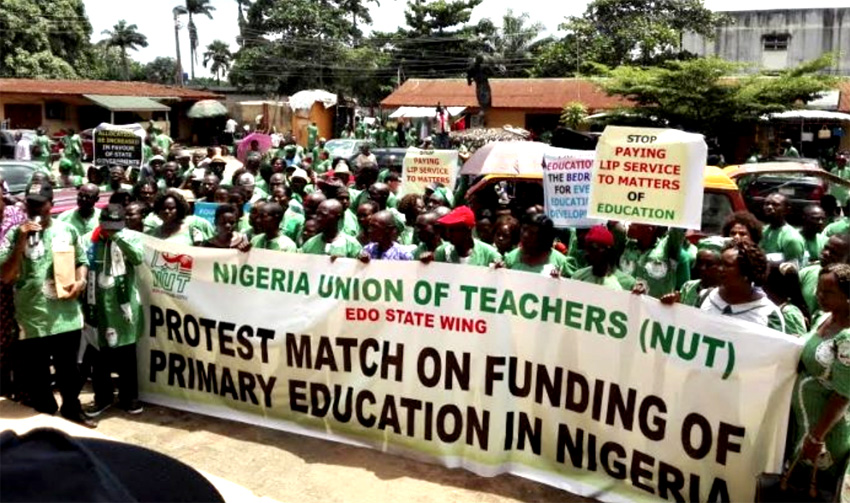
The Nigeria Union of Teachers (NUT) on Monday directed all primary and secondary school teachers in Abuja to join the ongoing strike initiated by the Joint Union Action Committee (JUAC).
The statement was issued by the NUT State Chairman, Abdullahi Shafas; State Secretary, Margaret Jethro; and Publicity Secretary, Ibukun Adekeye.
The NUT said the JUAC-led strike, necessitated a unified front.
It stated: ‘All teachers in FCT primary and secondary schools are staying away from classrooms from Monday 26th January and go on the picket lines.’
Ahead of the strike the union urged its members to remain steadfast while promising to provide updates as the situation unfolds.
Workers in the Joint Union Action Committee (JUAC) have been appealing for urgent action to resolve the welfare issues affecting their morale and productivity.
The president of JUAC, Rifkatu Iortyer, told journalists that some of the concerns raised included payment of pensions and the National Housing Fund, and non-payment of officers of the Abuja Environment Protection Board and Social Development Secretariat.
At the same time, the Academic Staff Union of Research Institutions (ASURI) has formally declared a trade dispute with the Director-General of the Administrative Staff College of Nigeria (ASCON), Dr Funke Adepoju, over what it described as gross misconduct, illegal actions, and incompetence in the administration of the institution.
In a letter addressed to the Minister of Labour and Employment, the Head of the Civil Service of the Federation, and the Chairman of the House of Representatives’ Public Service Matters Committee, ASURI accused the ASCON Director-General of violating statutory provisions and intimidating academic staff.
The union alleged that on 12th January Adepoju stormed the college premises with armed soldiers and compelled 18 academic staff to collect termination letters, citing age and years of service.
ASURI insists the action contravenes the ASCON Establishment Act, the Public Service Rules, and the Conditions of Service applicable to academic staff in research and academic institutions like universities and colleges.
Workers of the Federal Capital Territory Administration (FCTA), backed by the Nigeria Labour Congress (NLC), last Monday staged a protest at the national industrial court in Abuja over the ongoing industrial action.
The NLC said the strike was justified due to ‘persistent violations’ of workers’ rights by the FCTA management and political leadership.
Subsequently, Nyesom Wike, FCTA minister, took the Joint Unions Action Committee (JUAC) to court over the industrial action.
University workers in Abuja have also started a strike in universities and colleges.
Members of the Academic Staff Union of Research Institutions (ASURI) started their strike on Monday.
Speaking ahead of the strike last Sunday, ASURI Secretary General, professor Theophilus Ndubuaku, said: ‘We are representing the collective interest of our members and in defence of the statutory mandate of the Administrative Staff College of Nigeria (ASCON).
‘We hereby formally issue notice of a trade dispute, impending nationwide strike action and picketing in protest against the gross misconduct, illegal actions, and manifest incompetence of the management of colleges and universities.
The union’s demands include the immediate reversal of the sacking of the hundreds of academic staff and the removal of Dr Adepoju as Director-General. Failure to meet these demands, ASURI warned, will result in a nationwide strike and picketing across research and allied institutions.
It argued that undermining ASCON’s statutory framework is symptomatic of the broader neglect of research and development institutions, which has contributed to Nigeria’s insecurity, poverty, unemployment, and weak industrial capacity.
- Meanwhile in Kenya last Monday, power workers have issued a strike notice after pay talks stalled.
The Kenya Electrical Trades and Allied Workers Union (KETAWU) said employees at the state utility were under severe financial pressure and saw a better contract as a way to solve their financial problems.
KETAWU National General Secretary Ernest Nadome said rising living costs had eroded workers’ earnings.
He said: ‘We all agree that the economy and inflation are affecting everybody.
‘We have issues of affordable housing, taxation and the levies that are being imposed on us. Kenya Power employees are bearing all that.
‘Our disposable income is completely low. The contract we negotiated was meant to cushion employees from these harsh economic conditions.
‘The union has now put the government and key state agencies on notice, including the Cabinet Secretary, the Public Service Commission, the Salaries and Remuneration Commission and the Head of Civil Service.
‘We are sending a message to the government, the Cabinet Secretary, the Public Service Commission, the Salaries and Remuneration Commission (SRC) and the Head of Civil Service.
‘Come the end of February, if there is no Collective Bargaining Agreement that is going to be implemented, then prepare for a big response.
‘The eventualities will be far-reaching in this country.’
KETAWU warned that any strike would disrupt electricity supply to homes, businesses and public institutions, but said the action could still be avoided if the agreement was concluded and implemented in time.
Kenya’s sugar workers are going on strike from tomorrow. More than 30,000 employees from four major companies announced a strike over unpaid wages and benefits totalling 10.8 billion Kenyan shillings.
Workers say months of delayed payments and broken government promises have left them struggling financially, prompting the industrial action.
Kenya Union of Sugar Plantation and Allied Workers (KUSPAW) General Secretary Francis Wangara told journalists in Kisumu that the government has failed to meet its obligations, despite leasing the mills to private investors under the ongoing ‘reform’ programme.
Wangara said: ‘The government made a commitment to release a partial payment of 4 billion shillings (£23 million) before December, including 1.9 billion shillings (£11 million) in salary arrears due by the end of November, but nothing has been paid.
He criticised the Ministry of Agriculture and senior officials for making repeated assurances that have yet to materialise, leaving workers with no choice but to take industrial action.
Staff at Nzoia, Chemelil, Sony, and Muhoroni mills will stop work until the arrears are fully settled and reflected in their accounts.
The industrial action follows long-standing challenges in the sector, which include financial instability, outdated machinery and slow restructuring.
Although partial payments have been made in some instances, many arrears remain unsettled, with scheduled instalments consistently delayed, raising frustration among employees.
Under the 2025 reform programme, the government leased the four state-owned mills to private investors to attract investment and revive operations.
Part of the plan included settling salary arrears and benefits before and during the transition, but union leaders say these commitments have largely gone unmet.
The sector has also struggled with inefficiency and weak supply chain systems, with temporary mill closures in 2025 and the Sugar Development Levy exposing deeper structural problems.
Legislators and county officials have criticised the pace of arrears settlement and handling of redundancies, arguing that government pledges have not been backed by action.
Past disputes highlight the industry’s persistent wage challenges.
In 2025, Sony Sugar workers staged strikes demanding Sh350 million (£2 million) in unpaid salaries, demonstrating that payment delays have long been an issue even before the current arrears crisis.
The looming strike threatens livelihoods in sugar-producing counties across the Western and Nyanza regions, where many families rely on regular mill income for essentials such as food, school fees, and healthcare.
Union leaders warn that continued delays in addressing salary arrears could undermine confidence in the sugar sector reforms and risks social unrest.
The Ministry of Agriculture has not publicly responded to the latest strike notice, though earlier statements acknowledged arrears and outlined phased payments.
ends
pics on spreads stick
- Nigerian Teachers protest
- Nigerian march against the government in the capital Abuja
Kenyan workers march against the government
Kenya sugar workers demonstrate