CUBAN President Miguel Díaz-Canel signed a book of condolences on Monday at the Venezuelan embassy in Havana for the victims of the June 24 earthquakes in Venezuela.
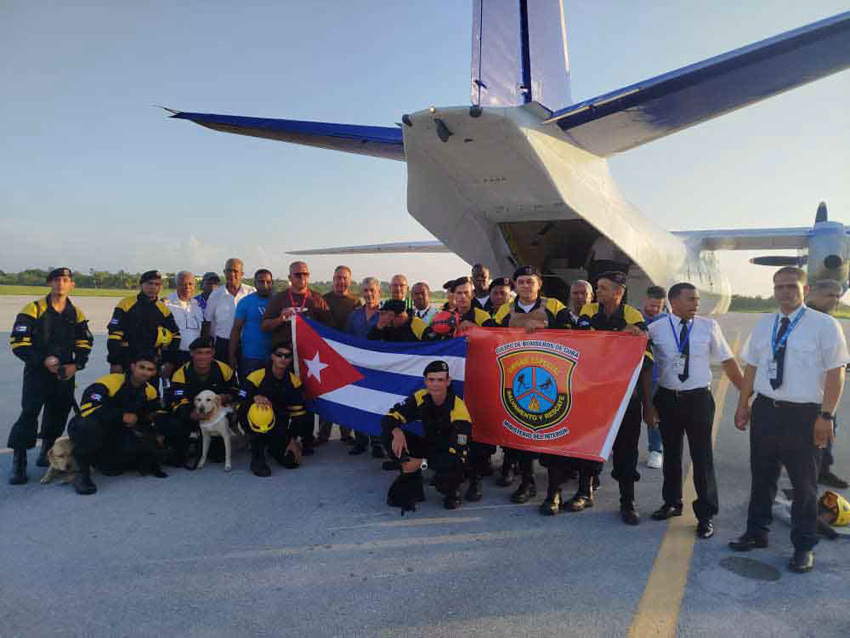
This was as Cuban rescue and medical teams continue their disaster-response work in the South American country, according to a report from the Cuban Presidency on social media.
The president also stated that Cuban health workers and rescuers would remain in Venezuela for as long as necessary.
Accompanying Díaz-Canel at the Venezuelan diplomatic mission were National Assembly President Esteban Lazo, Prime Minister Manuel Marrero, and acting Foreign Minister Gerardo Peñalver.
Rescue and salvage specialists have joined the island’s medical brigade already operating in Venezuela.
Both groups are engaged in searching for people trapped under collapsed buildings and providing care to the injured following the seismic doublet considered the deadliest earthquake event Venezuela has experienced in the past century.
A team of eight Cuban forensic doctors, consisting of five coroners, two forensic anthropologists, and a thanatology technician, has been working on identifying the deceased in La Guaira, the state that sustained the heaviest damage from the tremors.
The latest official bulletin reported that the earthquakes have killed at least 3,535 people, injured 16,740, and led to 6,462 rescues.
A total of 17,854 people lost their homes, while 190 buildings collapsed and 856 others sustained damage.
Venezuela maintains uninterrupted search, rescue and victim recovery operations 13 days after the double earthquake, defying international protocol timelines that typically recommend suspending such efforts after 5 to 7 days.
The Venezuelan government has pledged to continue the deployment as long as there remains the slightest possibility of finding survivors beneath collapsed structures.
The operations involve coordinated work between national and international rescue brigades who maintain their deployment despite the physical exhaustion inherent to the emergency.
Beyond tired muscles and the weight of passing days, rescue workers are guided by solidarity and compassion as they navigate the affected zones.
International rescue manuals, including the United Nations International Search and Rescue Advisory Group (INSARAG) Guidelines backed by General Assembly Resolution 57/150, suggest halting operations within a five to seven-day window following a disaster.
This timeframe corresponds to the estimated closure of the so-called ‘biological window’, which scientifically assesses survival probabilities for trapped individuals without access to water or food.
Crucially, the UN framework clarifies that the multilateral body does not decree the end of search operations.
Instead, it provides the technical, medical and logistical criteria for the local government to make the final decision.
Venezuelan authorities have exercised that sovereign prerogative, choosing to extend the mission beyond the conventional threshold.
On July 2nd, Acting President of Venezuela Delcy Rodríguez affirmed the state’s commitment, stating: ‘There is a mother crying, a father crying, a sister, a grandmother, a grandfather or an uncle suffering for that family member, and we will not rest.’
She added that a specialised team has been deployed to determine whether there are living persons in a given location or whether remains must be recovered before any infrastructure process begins.
- A Bolivian court ordered six months of preventive detention on Monday for peasant leader Vicente Salazar over roadblocks that the Ministry of Government says he led between May and June demanding the resignation of President Rodrigo Paz.
Prosecutor Walter Lora, part of the Public Prosecutor’s commission on the case, told media that a formal indictment was filed over the weekend after Salazar’s arrest, on alleged charges of public instigation to commit crimes, criminal association, terrorism, attack on public services, and attack on means of transport.
Lora added that the court found sufficient evidentiary grounds for the probable commission of those offences, and that the prosecution had argued procedural risks to justify preventive custody.
The blockades were spearheaded by the La Paz peasant federation and the Bolivian Workers’ Central (COB), later drawing support from groups aligned with former president Evo Morales, all pressing for Paz to step down after he assumed the Presidency last November.
The protests continued for more than 50 days across multiple regions.
Following accords with sectors including the COB, Paz decreed a state of exception on June 20 to lift the blockades, prompting police and army deployments to clear roads of obstructions.
Salazar had been arrested last Saturday by police officers while travelling in a vehicle in El Alto, the city neighbouring La Paz.
Separately, the Civic Committee of the eastern Santa Cruz region has filed another criminal complaint against Salazar, Morales, and COB leader Mario Argollo over alleged armed uprising, terrorism, and criminal association.
Elsewhere, former Peruvian presidential candidate Roberto Sanchez last Sunday declared Keiko Fujimori’s government unlawful and called for peaceful protests across the country in July, citing a lack of transparency in overseas vote counting that he says handed her a narrow victory.
Sanchez announced the creation of a patriotic front aimed at recovering democracy and urged mobilisations during the Independence Day holiday period to support party members and citizens facing criminal complaints from prior demonstrations.
The organisation pledged to provide legal and political defence for the charged leaders and social activists.
His technical team challenged the official result based on his performance within national territory, where he secured 50.08% of valid votes and won in 16 of the 24 regions.
With all tally sheets counted, Sanchez obtained 9,173,755 votes against Fujimori’s 9,223,396, a difference of 49,641 ballots.
Sanchez denounced that procedural modifications for receiving and counting overseas votes were introduced just days before the election, undermining transparency and traceability.
In response, the leader reported that they had filed a petition, a lawsuit, and a request for precautionary measures with the Inter-American Commission on Human Rights (IACHR).
He reiterated his refusal to engage in any dialogue with Fujimori while priority conditions remain unmet.
The demands include the release of former president Pedro Castillo, the repeal of congressional measures passed over the last two years – dubbed ‘pro-crime’ laws and identified by analysts as drivers of organised crime – and a call for the Executive to refrain from promulgating the police and military jurisdiction law currently on the presidential desk.
Sanchez warned that transferring the prosecution of police and armed forces personnel from civilian courts to military tribunals would create a scenario of impunity for serious legal violations.
- In June 2026, during the International Labour Organisation (ILO) Conference, Education International (EI) formally submitted a complaint on behalf of the Magisterio Panameño Unido (MPU) to the ILO Committee on Freedom of Association (CFA).
The complaint documents widespread violations of trade union rights and fundamental freedoms by the Panamanian authorities during and after the 2025 national teachers’ strike.
The MPU alleges that the government, particularly the Ministry of Education (MEDUCA) and the Controller General, systematically repressed teachers and union leaders for engaging in lawful trade union activities.
The complaint describes a sustained pattern of anti-union persecution in violation of ILO Conventions 87 and 98 and constitutional guarantees, including restrictions on freedom of association, collective bargaining, and the right to strike, as well as breaches of due process and retaliation against union members and leaders.
One year after the strike ended, 298 teachers from 23 educational institutions across five provinces remain unreinstated and without salary and benefits.
The 2025 teachers’ strike was a significant national mobilisation. Beginning 23rd April 2025, the MPU launched an indefinite nationwide strike to oppose Law 462, a reform of the social security system seen as undermining pensions, social benefits, and workers’ rights.
The movement quickly broadened, drawing support from construction workers, students, and Indigenous communities, and leading to widespread protests across the country.
From the outset on 28th April 2025, authorities responded with police violence in several provinces, including Panama City, Colón, and Veraguas.
Demonstrations were met with intimidation, arrests, detention, tear gas, and violence.
By late May, arrests and confrontations had become widespread. Around 20-27th May, protests continued amid a pattern described in the complaint as ‘persecution and judicialisation’.
The crackdown peaked in mid-June 2025. Unions report a ‘brutal and indiscriminate escalation’, including arbitrary arrests, beatings, and indiscriminate use of tear gas.
On 20th June, the government declared a state of emergency (‘estado de urgencia’), among others in the north western province of Bocas del Toro, suspending freedoms of assembly and movement and deploying large security forces under ‘Operación Omega’.
Bocas del Toro became a focal point of mobilisation, particularly among teachers, banana workers, and Indigenous communities. Its economic importance, linked to agriculture, exports, and transport routes, combined with longstanding grievances over land, poverty, and marginalisation of indigenous communities, contributed to the intensity of the protests and the forceful State response.
From 14th June 2025, MPU documented large deployments of 2,499 police officers and 341 arrests, as well as house searches, detention of minors, and continued military-style operations.
The strike ended on 14th July 2025 following an agreement with the Ministry of Education. The deal enabled a return to classes and included commitments on due process, non-retaliation, and continued dialogue. However, it fell short of union demands, notably the repeal or reform of Law 462.
While the agreement created some procedural safeguards and opened space for dialogue, key issues remained unresolved.
Many teachers received no pay for the strike period, and disciplinary and legal proceedings often continued.
The government did not reopen discussions on structural reforms, and many teachers returned to work under financial pressure.
Provisions that disciplinary measures against union leaders and teacher activists would follow administrative procedures rather than remain purely arbitrary, were not respected.
The union reports that retaliation persisted after the strike, including wage deductions, disciplinary actions, and continued tensions with the authorities. Union dues were withheld, and judicial decisions ordering reinstatement and salary payments were not implemented.