THE BRUTAL Israeli war on the Gaza Strip is not limited to destroying buildings and facilities, but extends to the health system, at a time when hospitals face an unprecedented shortage of medicines and medical supplies.
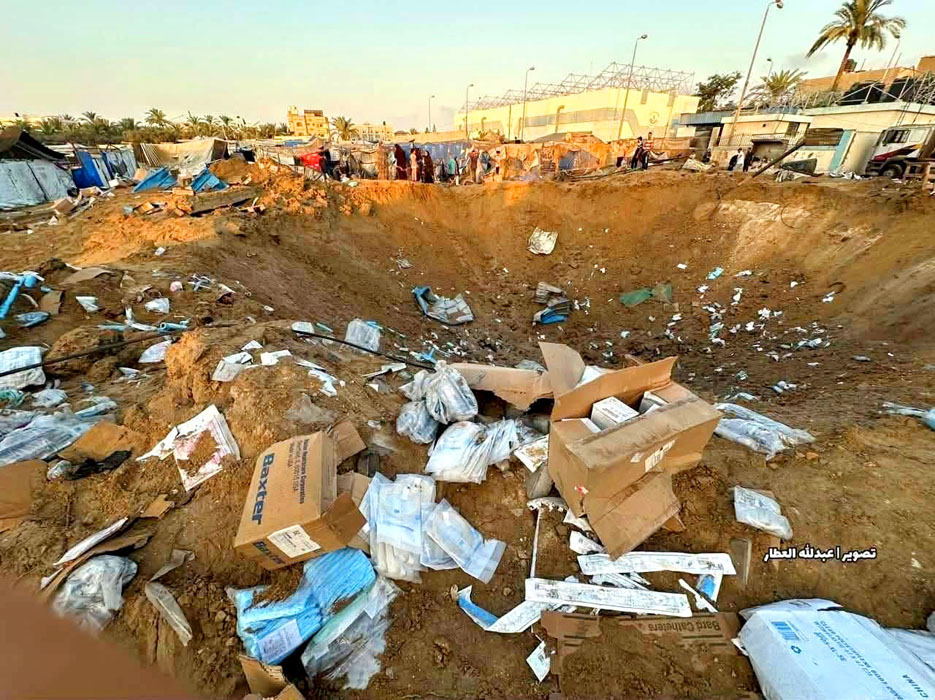
The occupation army’s bombing of medicine stores in the Al-Aqsa Martyrs Hospital in Deir al-Balah city demonstrates its fascism and criminality during the war of genocide, and its efforts to deepen the tragedy of the health sector.
It comes amid continuous warnings that basic items are running out, and as the health crisis deepens, hospitals can barely provide even the minimum level of care to the sick and wounded.
The Palestinian Ministry of Health condemned Israel’s direct and systematic targeting of medicine and medical stores in the Al-Aqsa Martyrs Hospital in the central Gaza Strip, on Saturday, describing it as a ‘complex crime’.
The ministry explained that the destructive force of the missiles used completely wiped out two stores of out of the four at the targeted site, and severely damaged the other two, causing the loss and damage of vital medicines and supplies for the sick and wounded.
It added that the bombing also caused significant damage to the outpatient clinics building adjacent to the stores, and also caused a state of panic among patients, their companions, and medical staff inside the hospital.
The ministry confirmed that Israel is not content with preventing the entry of medicines and medical supplies and depriving thousands of sick and wounded from travelling for treatment, but continues to target what remains of Gaza’s health system and destroy its limited capacities.
The ministry is demanding the international community, the United Nations and human rights organisations urgently intervene to stop the attacks and provide protection for health institutions and medical crews.
Al-Aqsa Martyrs Hospital spokesman, Khalil Al-Daqran, said that the Israeli raid destroyed a warehouse for medical supplies that included medicines and solutions designated for kidney and intensive care patients.
The bombing destroyed all the warehouse’s contents, and also damaged the hospital wall and adjacent buildings. Al Daqran warned that the destruction of medical supplies threatens the lives of patients in light of the acute shortage of medicines and supplies resulting from the Israeli siege.
Head of the Palestinian National Council, Rawhi Fattouh, described the destruction of the hospital’s medicine and medical supplies warehouse as a new war crime added to the record of crimes targeting civilians and health infrastructure, in violation of international humanitarian law and the Geneva Conventions.
He stressed that targeting health facilities comes in the context of continuous bombing of homes and residential neighbourhoods, as part of the policy of collective punishment and creating a worsening humanitarian disaster.
He also called on the United States administration and the international community to take immediate action to stop these crimes, protect civilians, and work to lift the siege imposed on the Gaza Strip.
The targeting of medicine stores came only one day after warnings issued by the Director General of the Ministry of Health in Gaza Strip, Mounir Al-Bursh, regarding the rapid deterioration in health conditions, confirming that the percentage of zero-stock medicines in hospitals and health centres exceeded 53%, amid the continued prevention of the entry of medicines, medical supplies, fuel, and oil necessary to operate electrical generators.
Al-Bursh pointed out that about 28% of widespread diseases in the Strip have become linked to contaminated water, as a result of drinking water mixing with cesspools inside shelter centres, which has spread diseases and epidemics among the displaced, warning that the deterioration of environmental and health conditions increases the risks threatening the lives of the population.
On the file of the sick and wounded, he revealed that more than 1,500 patients, who had been officially medically referred for treatment outside the Gaza Strip, had died while waiting to be allowed to leave, describing it as a ‘humanitarian tragedy’.
Medical reports and United Nations statements follow one another warning of the collapse of the health system in Gaza Strip, in light of 26 hospitals out of 38 going out of service, the deficit in basic medicines exceeding 50%, the shortage of medical consumables reaching 70%, in addition to the deficit in laboratory tests reaching more than 87%.
The World Health Organisation also estimated the damage to the health sector at about 1.4 billion dollars, pointing to the partial or complete destruction of more than 1,800 health facilities, including hospitals, primary care centres, clinics, pharmacies, and laboratories.
The targeting of medicine stores in Al-Aqsa Martyrs Hospital comes at a time when the health system in Gaza Strip already suffers from an acute shortage of medicines and medical supplies, amid the continuation of the siege and the decline in the ability of hospitals to respond to growing needs.
With the continuation of local and UN warnings of the worsening crisis, concern increases over the expanding circle of risks threatening the lives of the sick and wounded, in light of the continued damage to health facilities and the decline of their operational capabilities.
Meanwhile, the World Health Organisation (WHO), in recent reports, said that the health sector in Gaza faces one of the most dangerous drug supply crises, as stocks of basic medicines and medical disposables have reached critical levels, while hospitals suffer from an acute shortage of anaesthesia drugs, anti-biotics, intravenous solutions, and surgical supplies.
The UN organisation pointed out that the continuation of restrictions on the entry of medical supplies threatens to stop more lifesaving services, and undermines the ability of medical staff to respond to the growing needs of the sick and wounded.
For its part, the United Nations Office for the Coordination of Humanitarian Affairs, OCHA, said that the health system in Gaza Strip operates with extremely limited capacities as a result of the repeated targeting of health facilities, the chronic shortage of fuel and medical supplies, and the continuation of restrictions imposed on the entry of aid.
OCHA has confirmed, in multiple statements, that health needs in the Strip far exceed the volume of supplies that arrive, exacerbating the suffering of hundreds of thousands of patients, especially those with chronic diseases, cancer patients, dialysis, pregnant women, and children.
UN agencies clarify that medical disposables are no less important than medicines, as they include gauze, bandages, surgical sutures, catheters, intravenous solutions, injections, and sterilisation supplies, which are materials needed daily in large quantities in emergency, operation, and intensive care departments.
Running out of these seriously disrupts surgical operations and reduces treatment services even if highly trained medical cadres are available.
In conclusion, targeting the medicines and medical disposables warehouses cannot be separated from the broader scene experienced by the health system in Gaza Strip.
When hospitals are drained of their cadres, capabilities, and drug stock at the same time, their ability to respond to medical needs becomes more fragile, and every new targeting turns into a factor that multiplies the severity of the humanitarian crisis.
While warnings continue of the collapse of the health system in the Gaza Strip, targeting the warehouses of medicines and medical disposables adds a new burden to a reality described by health officials and international organisations as having reached a critical stage.
In light of the limited stock and the difficulty of compensating for what is lost, any new targeting is not limited in its impact to a facility or a warehouse, but extends to the ability of hospitals to perform their basic function at all.
And with every day medical supplies are delayed, the gap widens between needs and capabilities, leaving the lives of thousands of patients and wounded left waiting for the arrival of a medicine or a medical disposable that might make the difference between life and death.