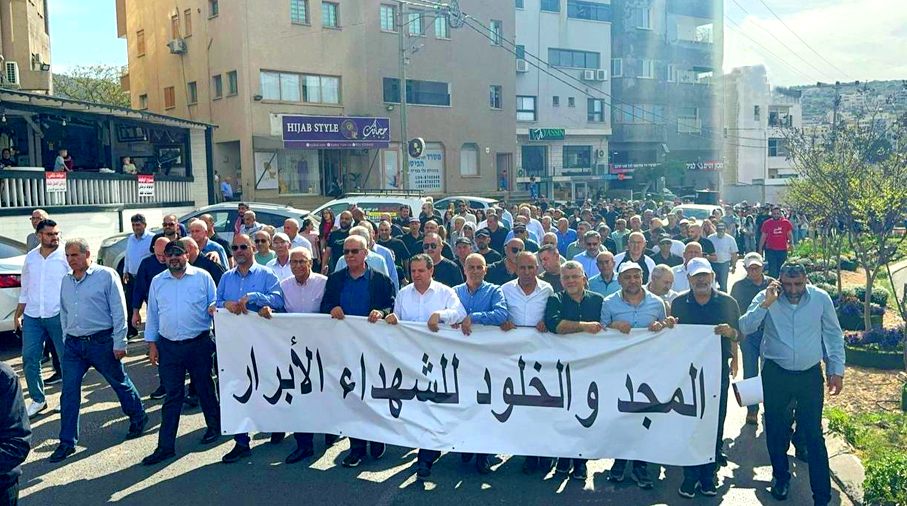
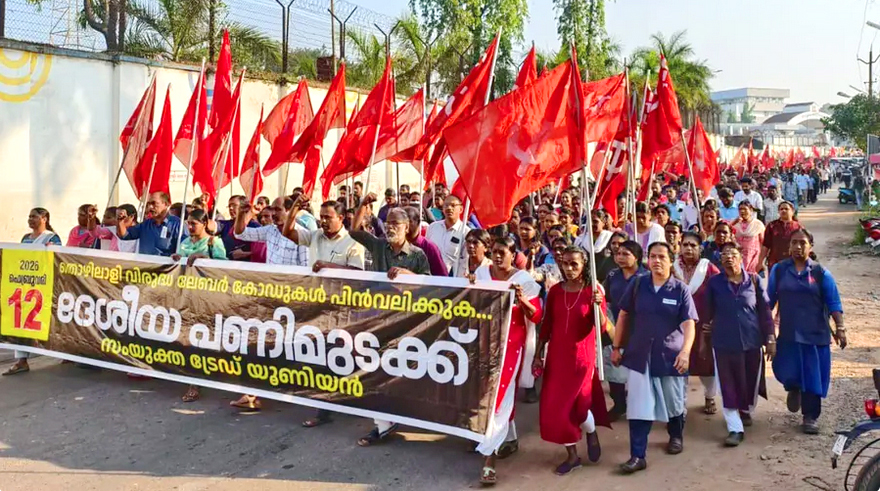
Workers across India stopped work on Thursday as part of the Bharat Bandh (general strike).
They were protesting against labour reforms and economic cuts being brought in by the right wing BNP government of President Narendra Modi.
There were road blockades and sit-ins, rallies and demonstrations around the country.
There were particularly big protests held in Chennai in Tamil Nadu state in the south, Patna in Bihar state in the northeast, Guwahati in Assam state which is also in the north-east, Ranchi in the eastern state of Jharkand, Bhubaneswar in the near by state of Odisha and Bankura in West Bengal state.
The strike had a massive effect in the southern state of Kerala. At some work places state police clashed with picketers and the Kerala state government tried to intimidate state workers by saying that if they did not work it would be declared as an unauthorised absence.
The state government said on Wednesday: ‘We are withholding the salary of all civil servants and public sector workers who take action.
‘No leave is granted to teachers and government employees except in cases of personal illness or illness of close relatives, examinations, maternity leave or other unavoidable reason.’
Apart from government offices, most shops and businesses also remained closed on Thursday, public sector and private buses remaining off the roads.
Auto-rickshaw unions also announced that they would not operate during the strike.
A clash broke out between teachers and police at the Government Mixed Upper Primary School in Puthiyangadi, Kozhikode, as the state forces tried to keep it open.
Residents and parents of the students arrived in support of the teachers, leading to a scuffle. Police intervened and dispersed the crowd, after which the teachers also left the school.
Trade unions held rallies and meetings in all districts. Elamaram Kareem, general secretary of the trade union federation the Centre of Indian Trade Unions (CITU), addressing protesters in Kochi said workers are being exploited by big businesses.
He said that, as per established norms, a worker is required to work 8 hours a day, 6 days a week, with 1 paid day off.
He added: ‘However, corporate companies are now asking why the working time should be limited to eight hours.’
In the state of Karnataka, striking workers in the city of Mangaluru held a demonstration at the old port.
The protest heavily impacted the Old Port wholesale market, halting loading and trading.
Their absence brought trading and loading operations to a near standstill, leaving the usually crowded market largely deserted.
The Indian affiliates of Public Services International (PSI) issued a statement on Thursday morning in which it stated:
‘We extend their full support and solidarity to the nationwide strike on 12th February 2026, called by the Joint Platform of Trade Unions, in defence of workers’ rights, public services, and social justice.
‘Public service workers across sectors including health, sanitation, water supply, electricity, transport, municipal services, education, social welfare schemes, and public administration are participating in the strike to oppose policies that undermine public services, weaken labour protections, and promote unchecked privatisation.
‘
- The four Labour codes, which dilute labour rights, restrict collective bargaining, and weaken social security for workers.
‘
- Privatisation and outsourcing of essential public services, threatens the accessibility, affordability, and quality of services for citizens.
‘
- We demand workers are given proper contracts to stop precarious employment and short term employment and stop job insecurity in public services.
‘
- Erosion of social security systems, including pensions, healthcare, and statutory welfare measures must be ended.
‘We oppose The Electricity (Amendment) Act/proposed amendments, which seek to introduce multiple private distribution licencees, weaken State Electricity Boards and public DISCOMs and shift the burden of electricity costs onto consumers – particularly farmers, domestic users, and small enterprises & endanger employment, safety, and service conditions of electricity workers through increased outsourcing and contractualisation.
‘Rising prices and shrinking public expenditure, disproportionately affect workers and vulnerable sections of the middle class.
‘Public service workers play a vital role in safeguarding citizens’ health, safety and basic needs.
‘Any attack on public service workers directly affects the quality and accessibility of public services for the people.’
The Indian affiliates of the Public Services International (PSI) union said that strong public services require decent work, fair wages, job security, and respect for trade union rights.
Attacks on public sector workers are ultimately attacks on the people who depend on public services.
The Telangana State Auto Union took part in the strike in the city of Hyderabad in the southern state of Telagana, demanding that the Central and state government address their concerns.
The taxi drivers have stopped running their cars on the main road in Himayath Nagar, Hyderabad, as part of the protest.
The auto drivers are demanding an increase in meter charges, separate boards for auto drivers, removal of services like Uber, Rapido, etc., operating illegally in the state, and removal of the 2019 Motor Vehicles Act introduced by the Union Government.
A taxi driver from Himayath Nagar, Hyderabad said: ‘We’re on strike today, demanding the government address our issues with Ola, Uber, and Rapido.
‘These services are causing problems for us city drivers, while district autos which are for a select group of drivers who can operate in both rural and city areas, operate freely.
‘We request that the government ban these services in the city.’
The strike ran from 6 am to 6 pm, with services stopping across the city.
A rally was held at 10 am from Sudha Riah Park to the NTR Stadium in which the concerns of workers were voiced.
App-based transport workers (those who work for companies like Uber) affiliated with the Telangana Gig and Platform Workers Union (TGPWU) and the Indian Federation of App-Based Transport Workers (IFAT) said that they received massive support as they are protesting against falling incomes and increasing exploitation in the platform transport sector.
The nationwide protest will involve drivers and delivery workers associated with major platforms, including Ola, Uber, Rapido, Porter, and other app-based transport services.
According to the unions, the agitation is being organised against the continued failure of the Central and State Governments to organise minimum base fares under the Motor Vehicle Aggregator Guidelines, 2025 which means that they receive very little money for the shortest journeys.
Despite the existence of these guidelines, aggregator companies continue to unilaterally fix fares, pushing workers into unsustainable working conditions and forcing longer working hours for declining earnings.
Shaik Salauddin, founder President of TGPWU and co-founder and National General Secretary of IFAT, said that the absence of government-notified base fares has allowed platform companies to arbitrarily lower prices while transferring all operational risks to workers.
‘However, governments have failed to act, enabling platforms to deepen exploitation.’
As part of the strike, a massive protest march and rally were organised on Thursday under the leadership of CPI and AITUC in Hyderabad.
In Visakhapatnam, Andhra Pradesh state, there was a big protest held as part of the day of strike action.