RAILWAY workers have started a week-long strike in Portugal, with the first two days of strike action having been held on Tuesday and Wednesday.
Workers are calling for higher wages and improved working conditions, with railways across the country being affected.
The issue at stake ‘is the need to improve working conditions, ensure a salary increase that takes into account the loss of purchasing power, and a guarantee that matters relating to work organisation are subject to collective bargaining, rather than unilateral company decisions.’
Workers at Metro Transportes do Sul were on ‘total strike’ this Tuesday and Wednesday, demanding a salary increase that ‘takes into account the loss of purchasing power’ and better working conditions, according to the train drivers’ union.
The strike, called by the National Union of Train Drivers of the Portuguese Railways, will take different forms between this Tuesday and 27th October.
Speaking ahead of the strike the union said: ‘A total strike is planned for Tuesday and Wednesday, and from Thursday until 27th October, the work stoppage will take place during ‘the last two hours of the work periods that begin on those days.
‘In situations where the start of the strike coincides with an ongoing train service, the stoppage will begin at the station of origin of that service, avoiding service interruption at intermediate locations.
The National Union of Train Drivers of the Portuguese Railways stated that the strike was called following the lack of concrete results in negotiations for a new Company Agreement, with the decision being taken by the workers gathered in plenary session ‘after about two and a half years of negotiations without it being possible to reach an understanding that meets their demands.’
Portuguese police arrested 55 protesters for civil disobedience, and two people were injured in the early hours of Tuesday, as security forces moved to dismantle camps of housing rights protesters in public squares in Lisbon and Porto.
In Lisbon, the public security police intervened at Praca D Pedro IV to remove tents set up by the Acampada de Lisboa movement.
The 55 arrests were made among protesters who allegedly resisted when officers cleared the site.
Debora Miranda, a 41-year-old communications consultant, said that she had joined the Lisbon protest to represent generations struggling with the rising cost of living.
‘If people don’t feel at home, in every sense of the word, they can’t move forward with their lives … enough is enough,’ she said.
Jorge Paixao, a 19-year-old history student said: ‘The housing crisis is a societal problem, arguing that younger generations needed better opportunities to establish independent lives in Portugal.
‘My generation needs the ability to live with dignity, start families and rejuvenate Portugal.’
In Porto, demonstrators vacated the square after armed police said that they would break up the camp by force.
The housing protests have been ongoing for more than 10 days in Porto and have spread across multiple Portuguese cities, with demonstrators calling for laws to curb real estate speculation and demanding government action on housing affordability.
The movement has also called for a joint Iberian general strike on November 11th in coordination with similar housing protests in Spain.
On Wednesday, there were also demonstrations by students in Lisbon.
Student representatives are contesting the intention to update tuition fees, which have not changed since 2020, for undergraduate degrees, Higher Professional Technical Courses (CTeSP), and master’s degrees essential for practising a professional activity, starting in the 2027/2028 academic year.
The measure, included in the State Budget proposal for 2027, stipulates that the maximum monthly payment will equal the 2026/2027 maximum value (697 euros), plus the average variation rate of the Consumer Price Index (CPI), excluding housing, recorded in 2026.
The government had already proposed updating monthly payments last year, but the opposition blocked the move by approving, in the specialised State Budget discussion for 2026, a Socialist Party (PS) proposal that kept the maximum at 697 euros.
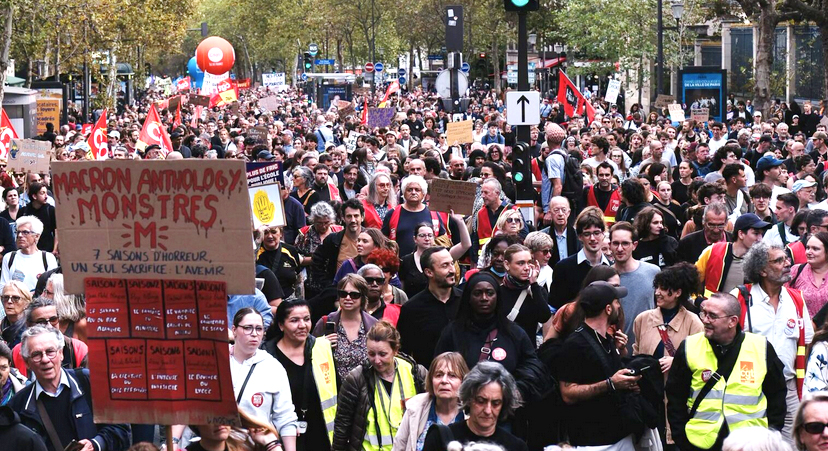
- General Confederation of Labour (CGT) leader Sophie Binet has urged Prime Minister Sebastien Lecornu to respond to the demands of workers and young protesters, warning that there was ‘legitimate and enormous anger’ in the country.
Her remarks come amid nationwide demonstrations over rising living costs, deteriorating school conditions and declining public services.
Binet made the remarks during an interview with the French media, calling on the government to address the concerns driving the protests.
Binet stated: ‘Lecornu needs to respond to the demands of unions and young protesters.
‘The movement that began among students and teachers has expanded into a broader campaign seeking better wages, improved education and stronger public services.
‘The CGT is demanding an increase in the minimum wage, salary hikes in line with inflation and adequate funding for schools and public services.’
Her remarks come as the French government tightens security ahead of fresh demonstrations scheduled for Saturday.
Lecornu has promised a ‘massive’ police deployment, while authorities have extended curfews and increased security measures following days of unrest.
The latest measures followed an admission by Interior Minister Laurent Nuñez that authorities had underestimated the unrest and lost control in some cities during Saturday’s demonstrations.
More than 2,500 people had been taken into police custody by Monday evening, Justice Minister Gérald Darmanin said.
The rioting included the burning of a historic town hall in Limoges and widespread looting and damage to businesses.
Overnight curfews have been imposed around Paris’ Place de la République and the Les Halles shopping district, with similar restrictions introduced in Lyon and other cities.
Authorities extended the measures after Paris and Lyon reported no major incidents on Monday night.
President Emmanuel Macron, in an address on Sunday, said the government would listen to protesters’ concerns while ensuring that those responsible for rioting and looting faced legal consequences.
The protests began in mid-September when high school students and teachers in Paris’ suburbs demanded action on overcrowded classrooms, deteriorating school buildings and teacher shortages.
Trade unions and Yellow Vest activists subsequently joined the movement, broadening it into a nationwide campaign against rising living costs and declining public services.
The government has announced plans to deploy more than 3,000 substitute teachers to schools most in need and authorised several hundred additional hires.
However, financial pressures and political divisions have complicated efforts to introduce wider reforms.
France’s public debt stood at nearly 3.6 trillion euros at the end of June, equivalent to 119 per cent of its annual economic output
The Macron government expects the fiscal deficit to reach 5.4 per cent of economic output this year and aims to reduce it to 5 per cent in 2027.