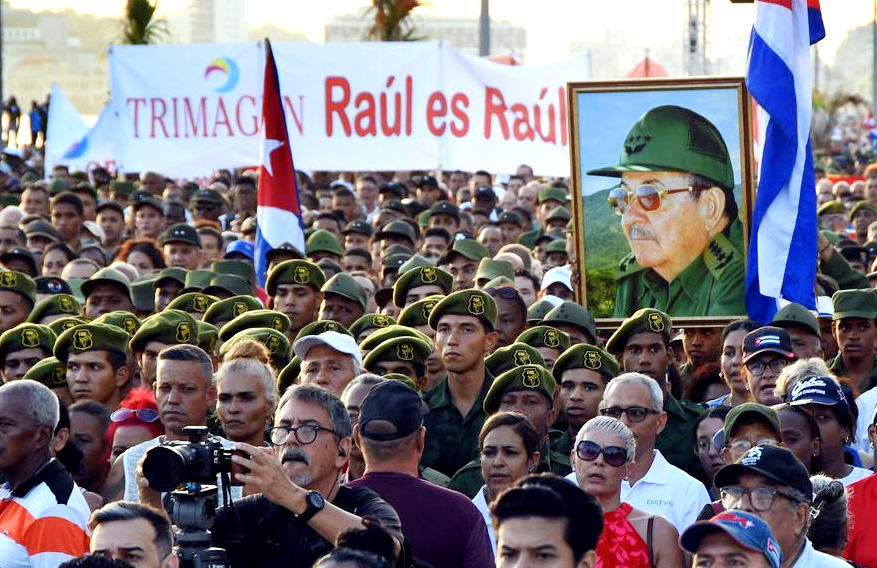
ON MONDAY, Cuban President Miguel Diaz-Canel called the Florida Court’s arrest warrant for Army General Raul Castro a ‘reprehensible action’ and a ‘pathetic Miami circus’.
He said: ‘The reprehensible action taken against the Army General this morning – a pathetic circus in Miami with an electoral agenda – lacks, and will forever lack, any legal basis, let alone any practical merit.
‘Raul is Raul, and every affront to his person will always be met with the determination of a people to defend the revolution.
‘This manoeuvre, dressed up in legal terms by anti-Cuban politicians against Raul and against Cuba, deserves our firm condemnation.
‘It is part of an aggressive agenda and reflects the difficulties they face in trying to justify the blockade and the collective punishment of our people.’
Cuban Foreign Minister Bruno Rodriguez also condemned what he called a ‘sterile manoeuvre’ driven by anti-Cuban politicians in South Florida.
Havana accuses Washington of using a disputed event at UN headquarters to divert attention from its decades-long economic blockade.
Cuba’s permanent representative to the United Nations, Ernesto Soberón Guzmán, condemned the gathering, organised by the US Mission to the UN, as a clandestine meeting unrelated to the organisation’s official agenda.
He also criticised the UN Secretariat for failing to stop the event despite repeated warnings from the Cuban delegation.
According to Soberón Guzmán, the US mission selectively invited a small group of member states to promote what he described as false claims about Cuba.
He alleged that the panelists were funded by the US State Department and had criminal records or links to organisations responsible for attacks against the Cuban people.
Soberón Guzmán said: ‘This charade is an attempt to distract attention from a simple fact: the United States is acting as an international criminal, imposing collective punishment on the Cuban people.
‘It is inflicting immense suffering on the entire population of a peaceful nation.’
Iran’s Foreign Ministry on Tuesday denounced the United States’ illegal actions against Cuba, saying Washington’s sanctions and attempts to intimidate Cuban officials and public figures violate international laws.
In the statement, the ministry noted that the sanctions, pressure, and intimidation imposed on Cuba by Washington for more than seven decades violated the United Nations Charter and ran counter to international law and human rights principles.
It cited an arrest warrant issued for former Cuban president Raúl Castro by authorities in Florida, calling it a ‘criminal and illegal act’ and urging respect for Cuba’s sovereignty, independence, and right to self-determination.
The ministry called on the US government to be held accountable for the devastating consequences of these policies for the fundamental human rights of the Cuban people.
The statement concluded by reaffirming Iran’s solidarity with Cuba and its position that the Cuban people’s right to determine their own future had to be respected.
The Chinese government has also expressed its opposition this Wednesday to the arrest warrant issued by a judge in the United States against the former president of Cuba, Raúl Castro, and has reiterated its rejection ‘of the abuse of judicial means to pressure Cuba.’
The spokesperson for the Chinese Ministry of Foreign Affairs, Mao Ning, has emphasised that ‘Raúl Castro is a highly respected leader of the Cuban Revolution’ and has highlighted that the former leader ‘has great international prestige.
- On Tuesday, Mexican President Claudia Sheinbaum said she believes the arrest warrant issued by a Florida court against former Cuban President Raul Castro is primarily politically motivated and linked to the US elections.
Sheinbaum wrote on social media: ‘It’s political, The Mexican government considers that the case also has a connection to the November elections in the United States.’
On Tuesday, Russia’s Foreign Ministry issued a statement condemning the issuance of a US arrest warrant for Castro: ‘We categorically reject and strongly condemn the issuance by a judge in Miami, United States, of an arrest warrant for Cuba’s historic leader, Army General Raul Castro.
‘Bringing baseless, contrived charges more than 30 years later can only be seen as an act of revenge by Miami’s anti-Cuban lobby — an attempt to settle scores with Raul Castro, who celebrated his 95th birthday in June.
‘We wish to emphasise that further escalating tensions around the Island of Freedom, which is already enduring extremely difficult times amid an unprecedented trade, economic, financial and energy blockade, could destabilise the entire Latin American and Caribbean region.’
The Cuban protest comes ahead of a formal debate at the UN General Assembly on a resolution calling for an end to the US economic, commercial and financial blockade against Cuba.
The assembly is scheduled to consider the issue on 27th and 28th October, and in an open and inclusive debate, marking the 34th time the body has addressed the resolution.
Soberón Guzmán accused Washington of exploiting human rights concerns to undermine Cuba’s sovereignty and right to self-determination, weaken the Cuban people’s resolve and subvert the country’s constitutional order.
He also argued that the US-organised event was intended to divert attention from the consequences of Washington’s policy of maximum economic pressure on the island.
The ambassador expressed confidence that the resolution would again receive broad international support, insisting that Cuba posed no threat to other countries.
He said: ‘The US government knows very well that the vast majority of countries will once again support our demand, because Cuba is not the threat; the blockade is,’ he said.
Soberón Guzmán rejected the prospect that US pressure would force Cuba to abandon its position, saying that efforts to break the determination and unity of the Cuban people would fail.
‘If anyone in the US government thinks they will break the determination and unity of the Cuban people, they are wasting their time, their efforts and no small amount of resources.’
He said: ‘We will never bend the knee. We will not surrender.’
On Sunday, the National Ballet of Cuba announced a special season to celebrate its 78th anniversary, the 81st anniversary of the United Nations (UN), and the 50th anniversary of the island’s Ministry of Culture.
The first gala will took on place on Wednesday at the National Theatre of Havana to honour the Ministry of Culture, coinciding with the celebrations of National Culture Day.
The programme will include a performance of Don Quixote, one of the company’s emblematic works. Contemporary Dance of Cuba and the National Folkloric Ensemble will also participate, presenting renowned pieces from their repertoires.
The performances on Saturday 24th and Sunday 25th October will be dedicated to the UN anniversary.
For this occasion, the National Ballet of Cuba will present Giselle in the stage version by the legendary ballerina Alicia Alonso.
The season will close on October 28th, commemorating the anniversary of the first performance given in 1948 by the then-Alicia Alonso Ballet, the precursor to the current national company.
During this final performance, ‘The Magic of Dance’, an anthology featuring highlights of 19th-century ballet in versions conceived by Alicia Alonso, will be presented, along with the epilogue to Gottschalk’s Symphony.
The institution explained that these performances aim to compensate for the cancellation of the Alicia Alonso International Ballet Festival of Havana, which cannot be held this year due to the country’s economic difficulties.
The Union of Writers and Artists of Cuba (UNEAC) will celebrate Cuban Culture Day, (October 20) with a national event titled ‘Art and Homeland’ (in spanish Arte y Patria), started on Monday, 19th October, to Friday, 30th October.
The programme includes panel discussions, concerts, exhibitions, exchange forums, and activities centred on artistic creation, history, and the defence of national identity.
The event draws inspiration from the National Anthem, composed by Pedro ‘Perucho’ Figueredo – a piece whose notes accompanied a decisive moment in Cuban history and remain a symbol of independence and emancipation.