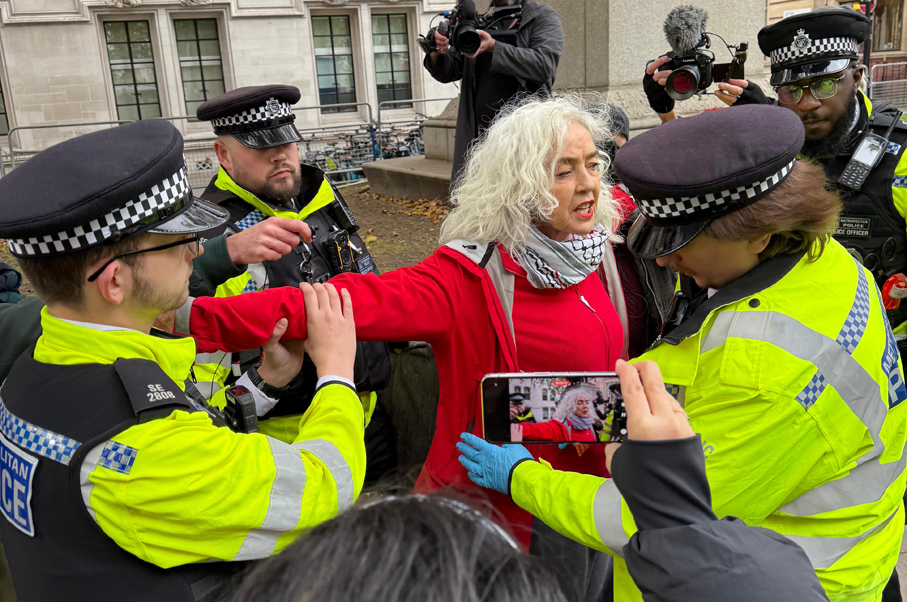
POLICE arrested 25 people outside the Supreme Court yesterday as five justices began hearing Palestine Action co-founder Huda Ammori’s challenge to the group’s proscription as a terrorist organisation.
Officers carried several demonstrators into nearby vans, some of them holding signs reading ‘I oppose genocide, I support Palestine Action’.
Other placards adapted an October post on X by the author Sarah Helm, wife of the national security adviser Jonathan Powell: ‘God help us authors who support Palestine and Palestine Action.’
The actor Alfred Enoch, holding a sign reading ‘this is democracy not terrorism’, said: ‘I think it’s part of a wider erosion of rights of protest, which is fundamental to a democracy.
‘People don’t even feel safe enough to come out and say that.’
A letter to the court yesterday from 150 academics and writers, among them the novelist Sally Rooney, said: ‘We oppose genocide, so we support Palestine Action.’
Raza Husain KC, for Ms Ammori, told the court the ban had caused ‘the total destruction of a protest group which enjoyed widespread support from across civil society’, whose objectives ‘were aligned with, rather than abhorrent to liberal democratic values’.
Only three of the group’s 385 actions over five years had been assessed as meeting the definition of terrorism, he said in written submissions.
‘This was solely on the basis that they involved “serious damage to property”.
‘In other words, the Home Secretary’s advisers assessed that less than 1% of Palestine Action’s direct action protest activities over five years fell within a definition of terrorism.’
Ms Ammori argues the ban breaches Articles 10 and 11 of the European Convention on Human Rights and ‘failed to strike a fair balance’.
More than 3,000 people have been arrested for supporting the group since the ban, the court heard.
Defend Our Juries, which organises the mass protests, said: ‘Nowhere else in the world has the regular mass arrest of elderly and disabled people as terrorists become normalised.’
Sir James Eadie KC, for the Home Office, told the court that serious damage to property could amount to terrorism without violence or intent to endanger life.
He said ‘vocal large-scale and frequent expressions of support for the pro-Palestinian cause’ continued despite the ban.
The UN Special Rapporteur on Counter-Terrorism, an intervener, has called the ban ‘out of step with comparable liberal democracies, including in Europe and various common law States’.
‘The government’s current definition of terrorism is so wide-ranging it captures behaviour most people would never consider terrorism,’ said Akiko Hart, director of Liberty, which is also intervening.
‘This case has already had a chilling effect on protest and free speech, leaving many too afraid to protest or say the wrong thing.’
Then-home secretary Yvette Cooper proscribed the group in July 2025, after activists broke into RAF Brize Norton and damaged two military aircraft.
The High Court ruled the ban unlawful in February before the Court of Appeal overturned that in June, finding it a ‘justified and proportionate’ interference with freedom of expression.
The hearing before Lords Reed, Sales, Lloyd-Jones, Briggs and Stephens is due to conclude today, with judgment expected later.