HUNDREDS of thousands of workers, students, and teachers demonstrated in Belgium last Friday against the Belgian government’s austerity measures, in a day of action leading up to a general strike at the end of November.
The protest in Brussels came amid negotiations for the federal budget, as Prime Minister Bart De Wever’s government is seeking an additional 10 billion euros to adjust public accounts.
The march was 30,000-strong, according to the police, and 50,000, according to the socialist union FGTB.
The demonstrators marched through the centre of the Belgian capital from Central Station to Midi Station, with the participation of the main trade unions and educational organisations.
The day also saw clashes between groups of demonstrators and security forces, as well as significant disruptions in transportation, including the cancellation of some 140 flights at Brussels Airport.
The mobilisations coincided with the federal government’s negotiations to finalise its budget plan, which must be presented to the European Commission before Thursday, October 15.
The five parties that make up the governing coalition, known as ‘Arizona’, must agree on how to distribute the necessary adjustments to meet fiscal targets.
Among the main union demands is maintaining the automatic indexing of wages, avoiding a VAT increase, and rejecting the introduction of annual accounting of the working day. The organisations say these measures would harm workers and beneficiaries of social benefits.
As an alternative, the unions propose a package of measures valued at about 21 billion euros, based on a higher tax contribution from capital income and large fortunes, as well as the elimination of public spending that they consider ineffective.
The president of the SETCa union, Myriam Delmée, has argued that the budgetary effort should not fall on workers or beneficiaries of social aid, but on those with greater economic resources.
She has also warned that the trade unions are willing to intensify protests if the government maintains its plans.
The FGTB has a mandate to call a general strike during the week of 23rd November if the government exceeds the red lines established by the unions.
The Christian organisation CSC, which also participated in the demonstration, prefers to wait for the outcome of the negotiations before deciding on new mobilisations.
The mobilisation also saw a significant presence of students and teachers, who are protesting against the adjustments planned by the government of the Wallonia-Brussels Federation, made up of the Reform Movement (MR) and The Committed (Les Engagés).
Among the proposed measures is a 10 per cent increase in the teachers’ workload with no corresponding salary increase, in addition to cuts affecting various educational benefits, including free meals in schools.
Another decision that has provoked the students is the increase in tuition fees for non-university higher education, which would rise from 835 to 1,194 euros for 58 per cent of the student body.
The regional Executive intends to use this measure to reduce the budget deficit of the Federation.
The protesters are demanding the withdrawal of the educational reforms and the resignation of the president of the regional Government, Élisabeth Degryse, and the Minister of Education, Valérie Glatigny.
Student groups condemn the rising cost of education and the reduction of aid for blocking access to higher studies, especially for young people with fewer economic resources.
Their demands have joined those of the unions, which are calling for a different distribution of the fiscal effort.
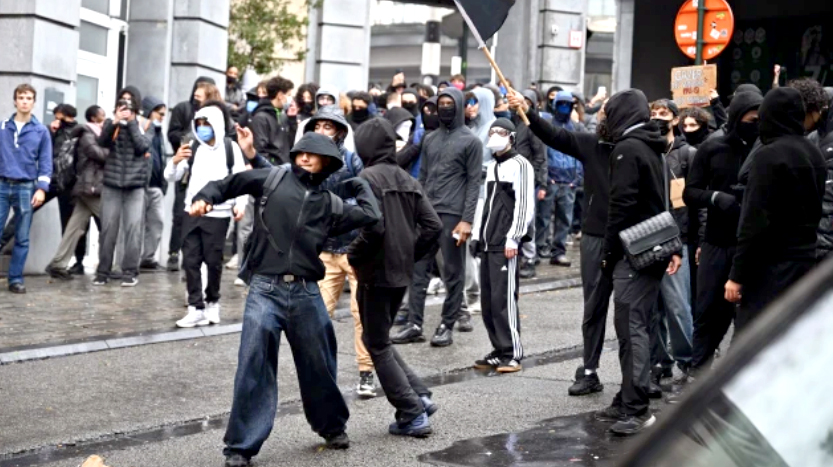
Although the demonstration began peacefully, clashes were reported between the police and groups of young people near Brussels Central Station, when some threw cobblestones, bottles, firecrackers, and fireworks, in addition to erecting barricades with bicycles and setting trash bins on fire, as the security forces ‘intervened’ to clear the area and disperse the participants using water cannons and tear gas.
However, the mass union mobilisation continued nevertheless.
The protest last Friday was the fourth national demonstration of the year against the policies of the Belgian Government and adds to other labour mobilisations held in recent months.
Protests also continued yesterday, Monday, with a railway and public services strike.
The De Wever government faces the last days of budget negotiation under growing union pressure and with the threat of a new general strike at the end of November.
Meanwhile, in Italy on Saturday there was a 24-hour public transport strike by Florence GEST tram staff which stopped services right across the city.
The CGIL union has also called a regional general strike across Tuscany tomorrow (Wednesday), covering public and private sectors for the whole working day.
For local public transport, the stoppage is limited to four hours, although each operator will set their own slot and announce it a few days before the strike.
On Friday there is a 24-hour nationwide strike which has been called by the easyJet cabin crew from 12.00am to 23:59pm. Since it is a nationwide strike, airports throughout Italy will be affected.
In France, there is also a nationwide five-day strike by cabin crew and pilots which will coincide with the start of the Toussaint school holidays. Airlines are expected to provide information about cancellations, delays or changes in schedule if they are affected by the strike.
There have been several big actions in France in the last couple of weeks.
Twenty-four investigations have been opened by French police watchdog IGPN into incidents linked to the ongoing high school protest movement, the interior ministry said.
The police response has reignited calls to scrap rubber bullets and launcher-fired riot-control weapons, long denounced by rights groups and United Nations (UN) experts as dangerous and excessive.
Fourteen-year-old Eden suffered a broken jaw and multiple smashed teeth when he was struck by a tear gas canister directed towards him at close range by a police officer last week during student protests in France, his parents and family lawyer said.
The teenager had been sitting on a wall looking at his phone metres away from the protest in Saint-Ouen-l’Aumone, the lawyer said. An officer approached him and struck him with a baton, prompting Eden to respond with a kick, according to the local prosecutor. A second officer then fired a tear gas grenade with a Cougar launcher, hitting him in the face.
Lawyer Elsa Marcel said: ‘(The officer) shot him in the mouth and left him lying on the ground, without even calling the emergency services.’
The family, who have asked for Eden’s second name to be withheld to protect their privacy, has filed a complaint for attempted murder.
The police response has renewed calls for the withdrawal of the use of rubber bullets and grenade launchers, which are not used by police in many other European countries and have been repeatedly criticised in recent years by rights groups, including Amnesty International and UN human rights experts, as dangerous and disproportionate.
It has also sparked anger among the public and fanned support for a protest movement that is the latest manifestation of deep-seated discontent with President Emmanuel Macron’s government ahead of a 2027 election.
Authorities said that 700 police officers have also been injured, schools have been burned or ransacked, and teachers and members of the public have been attacked.
The police have arrested 6,877 people, mostly minors under the age of 18.