Fighters of the Rapid Support Forces (RSF) refused to help rescue dozens of men trapped when a gold mine collapsed in Sudan’s West Kordofan state on 15th September, killing at least 82 people, survivors say.
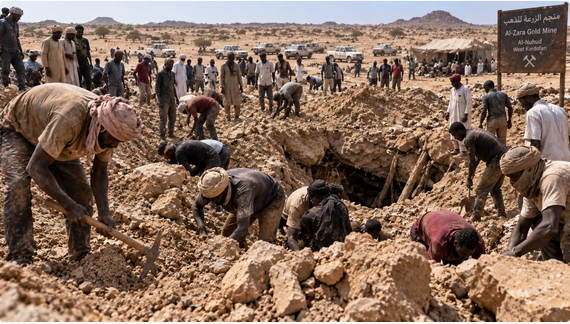
The collapse at the Al-Zaraa mine near Al-Nuhud brought six interconnected shafts down into one another.
About 50 people were injured and an unknown number remained trapped, according to a local administration official and a source within the RSF, which has controlled West Kordofan since December 2025.
Survivors gave their accounts in an investigation published on Monday by Drop Site News.
Abu Fayza al-Fadil, 32, survived because he had stepped out of the shaft minutes earlier.
‘I went out to rest for a few minutes, and suddenly the ground shook and the shaft disappeared, along with everyone inside it,’ he said. ‘There were just a few minutes between me and death.’
Mohammed al-Hassan was among the men working in one of the shafts.
‘There were about 60 of us down there when it collapsed,’ he said.
‘Twenty-five died. We pulled their bodies out ourselves.
‘Seventeen of us made it, six of them injured, and we got them out with our own hands. The others are still missing. We don’t know what happened to them.’
The survivors went for help to the RSF, which local miners say was itself a partner in running the mine.
‘We went to a Rapid Support Forces post about 15 minutes away and told them people were trapped, al-Hassan said.
They had two excavators, and they refused to help,’ he said adding: ‘No medical teams or officials arrived. Local people dug with tools brought from their homes.
Al-Tahir Issa, 30, said: ‘We locals volunteered to help.
‘We brought our tools from home like pickaxes and shovels, and began trying to rescue those trapped and give first aid to those coming out of the mine.’
He said: ‘We found the young men in a state of shock and bewilderment.
‘Some of them did not know what had happened, while others had managed to get out on their own, some with injuries and fractures,’ he said.
‘By the second day, we had recovered 25 bodies and 13 injured people. After the bodies were recovered, we performed the funeral prayer for them.’
A few days after the collapse the RSF sealed off the area, clearing out even the miners still searching for their colleagues, local sources said.
No one has been allowed near the mine since.
Among the dead were Abu Bakr Hamid al-Daqil, 27, and Mohammed al-Zaki, 26.
Al-Zaki’s sister Lamia said he had given up his studies for the mines. ‘He knew the work was hard, but he went because he wanted to establish himself and get married.
‘After a year of working in various mines, he died, leaving grief in our hearts that will never heal,’ she said.
Al-Zaraa was the fourth major gold mine collapse in Sudan this year, after Abu Jubeiha in January, where at least six miners died, Keliti in April, which killed at least seven, and Wadi Halfa in July, where 15 died.
Less than a week later, a fifth mine collapsed at Awny in Red Sea State, killing at least ten people and injuring 21.
Khaled Qarashi, a researcher with the Sudanese Environmental Conservation Society, said: ‘Informal mining relies on shallow digging without any shoring, personal protective equipment or rescue tools.
‘The authorities only take notice after major disasters have occurred, at which point they intervene to close the mines temporarily, only to reopen them later.’
More than two million people work in Sudan’s mining industry.
Many are paid on quotas, and a miner may earn a single piece of gold worth about $2,000 after three months underground, or nothing at all.
Mohammed Haroun, who manages a mining pit in Northern State, said: ‘Rampant unemployment, deteriorating living conditions and a lack of opportunities, even before the war, coupled with the war’s worsening of these conditions, have made mining the only viable option for them to provide for their families.’
The gold dug out by these workers pays for the war.
It is one of the main sources of revenue for both the Sudanese Armed Forces (SAF) and the RSF, and experts commissioned by the UN say large quantities have been smuggled out of the country to finance the RSF.
Research published in March 2025 by the London think tank Chatham House found the RSF oversees mining in Darfur and parts of Kordofan, including West Kordofan, while the army controls the gold-producing River Nile, Northern, Red Sea and South Kordofan states.
The RSF, led by Mohamed Hamdan Dagalo, known as Hemedti, seized the Jebel Amer mine in North Darfur in 2017 and channels its gold profits through about 50 affiliated companies.
Much of Darfur’s gold is smuggled through South Sudan, recast with false papers and flown on to Dubai.
The war broke out in April 2023 when the RSF and the army under General Abdel Fattah al-Burhan, former partners in the 2021 military coup, turned on each other.
More than 13 million people have been driven from their homes and 33.7 million need humanitarian aid.
The UN-backed Integrated Food Security Phase Classification has confirmed famine in parts of North Darfur and Kordofan.
Kordofan has become a main front this year.
The army launched ground offensives in North and South Kordofan in June, while the RSF has repeatedly hit El Obeid with drones.
More than 219,000 people were newly displaced in Kordofan by late June.
In Darfur the RSF has carried out genocide against the region’s non-Arab peoples.
In 2023, its fighters and allied militias killed between 10,000 and 15,000 people in El Geneina, most of them Masalit, according to UN experts.
On 26th October 2025, the RSF took El Fasher, capital of North Darfur, after an 18-month siege that cut civilians off from food, water and medical care.
The UN human rights office documented 6,000 killings in the first three days alone.
Researchers at Yale’s Humanitarian Research Lab have put the death toll above 60,000, and 150,000 residents remain unaccounted for.
In February, the UN Independent International Fact-Finding Mission for Sudan found that the atrocities in El Fasher bore the hallmarks of genocide against the Zaghawa and Fur.
It documented mass killings, widespread sexual violence, torture and enforced disappearances, and RSF statements calling for non-Arab communities to be wiped out.
In June, the UN human rights office verified 546 incidents of conflict-related sexual violence across the country against at least 838 victims, mostly women and girls, and said the figures were only the tip of the iceberg.
‘The scale, coordination, and public endorsement of the operation by senior RSF leadership demonstrate that the crimes committed in and around El Fasher were not random excesses of war,’ said the mission’s chair, Mohamed Chande Othman.
Mission member Mona Rishmawi said: ‘The RSF acted with intent to destroy, in whole or in part, the Zaghawa and Fur communities in El Fasher.’
The RSF’s principal foreign backer is the United Arab Emirates, a major destination for Sudan’s smuggled gold and a close ally of Washington and London, which sell it weapons.
In May 2025, Amnesty International identified Chinese guided bombs and howitzers re-exported by the UAE in RSF hands, in breach of the UN arms embargo on Darfur.
Abu Dhabi denies arming the RSF.
The same month, the International Court of Justice threw out Sudan’s genocide complaint against the UAE, ruling that it lacked jurisdiction because of a reservation the Emirates had entered to the Genocide Convention.
The killing goes on across the country.
More than 1,000 civilians were killed by drone strikes in the first five months of this year, and the World Health Organisation recorded at least 900 deaths in attacks on healthcare between January and August, with 37 per cent of Sudan’s medical facilities out of service.