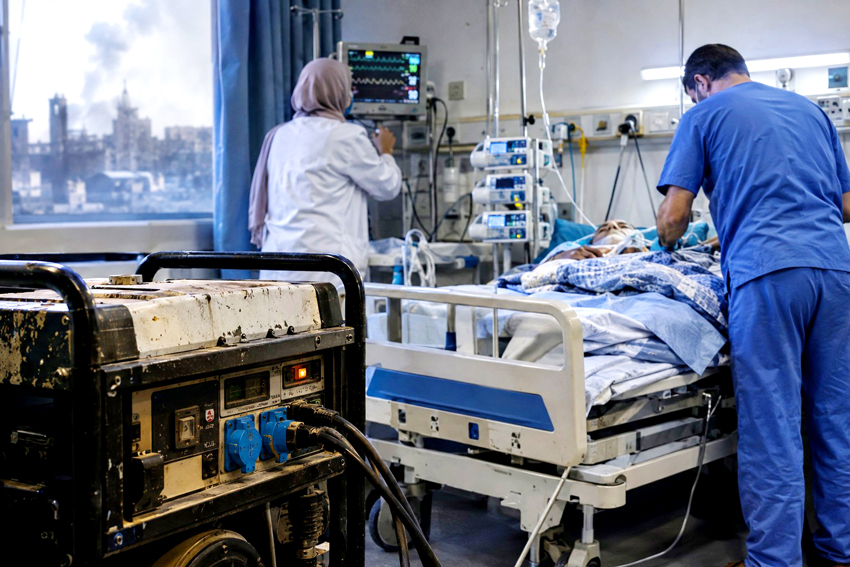

A ‘deadly mix’ of a collapse in the number of the registered nurse workforce and increasingly complex patient needs is leaving staff struggling to keep people safe – registered nurse numbers are so far below what is required there is now a ‘high risk’ of harm on shift.
In her opening speech to over 3,000 frontline nursing staff gathered in Liverpool on Monday for the Royal College of Nursing’s (RCN) annual conference, its general secretary Professor Nicola Ranger called for new and sustained investment to grow the nursing workforce to a level that meets the needs of an ageing, more sick population, and condemned the Labour government’s anti-immigration policies.
The RCN has just conducted its latest ‘Last Shift’ survey, which asked more than 13,000 nursing staff about their experiences on their most recent shift.
This found that four fifths (79%) of members say that clinical complexity has increased over the last two years alone, while just one in ten say staffing was at the right level for all patient needs to be met.
More than two thirds (69%) say the situation is now forcing them to make difficult decisions about prioritising care.
The RCN is also releasing new analysis which shows that as demand increased, growth in the registered nurse workforce collapsed in England to an eight-year low.
However, had the registered nurse workforce in NHS hospital and community settings grown at a similar level to that of doctors over the last decade, there would be 45,100 more registered nurses, equivalent to filling the number of vacancies in England’s NHS twice over.
Nursing staff across all NHS settings report care demands increasing, while registered nurse staffing remains unchanged or in some cases has fallen.
They say adults, children and those with mental ill health are all presenting with more clinical complexity which is placing unsustainable pressure on staff.
One nurse working on an acute adult ward in an NHS hospital in England, said: ‘The “care” has disappeared in nursing – now it’s just about trying to stay safe, to get through the shift without any harm being done. It’s very, very sad.’
A nurse working on an older people’s ward in an NHS hospital in England, said: ‘Managing high-risk fall patients who require 1:1 supervision is simply not achievable with current staffing levels, despite what policy suggests.
‘This gap between theoretical expectations and practical reality places both patients and staff at risk.’
Another, said: ‘There is no understanding, insight or awareness of how significantly the dependency, frailty and medical instability of our patient group has changed and increased.’
While a nurse working in an emergency department in the NHS in England, said: ‘The shift was completely unsafe, and it felt a miracle that avoidable harm was not caused. I’m 11 years into nursing and have never felt so awful about my work.’
Professor Ranger said: ‘Widespread vacancies of registered nurses are always unsafe, but the risk is being compounded by the demands of delivering ever more complex care to an ageing, sicker population, with multiple conditions. It is a deadly mix.
‘It is a government’s first priority to keep its citizens safe, but our analysis and the testimony of nursing staff show ministers are too often failing in this most basic task.
‘We need a new approach, away from the flawed “finger in the wind” workforce planning which led us here. It must be centred on new, sustained investment in the nursing workforce to the level that allows our profession to meet all patients’ needs – now and in the future. Anything else lays the ground for another patient safety disaster.’
Almost a quarter of nursing staff across both hospital (22%) and community (22%) settings said registered nurse staffing levels on their last shift were ‘well below what was needed’, with ‘care significantly compromised’ and a ‘high risk of harm to patients and staff”.
Registered nurses are highly-skilled, degree-educated professionals delivering the majority of clinical care. Their skills, knowledge and expertise are crucial in meeting the needs of patients, especially as demands and complexities increase.
In responding to the RCN’s survey, district nurses and those in other crucial community nursing roles, who typically care for older people and those with long-term conditions, consistently highlighted being unable to meet surging patient need.
A district nurse working in the NHS in England, said: ‘District nursing is going under with the complexities of care required. We cannot sustain the levels of pressures faced since Covid.’
A nurse, working in community services in the NHS in England, said: ‘I have worked in community nursing for four years. Over that time caseloads have significantly increased and patients are far more complex with social issues or medical issues. Community nursing is on its knees.’
Alongside fully costed and funded workforce plans based on robust assessments of patient need, the RCN is also calling for the introduction of mandated safe nurse staffing levels across all settings, with enforceable registered nurses-patient ratios.
The findings of the RCN’s survey also show the extent to which having too few registered nurses to meet growing demand is impacting staff wellbeing. More than three in four (76%) felt emotionally exhausted on their last shift. Reports of exhaustion were highest among those who said their shift was understaffed.
Professor Ranger said: ‘But we continue to bear the brunt of funding restrictions and budgets cuts. And that makes a hard job even harder. It means no matter how far we push ourselves beyond our limits, we can’t make up for having too few staff.
‘That can feel like our failure and we carry that pain home with us, long after our shifts have ended. It’s not our failure. It’s nursing set up to fail.’
On violence faced by nursing staff, Ranger said: ‘There’s a torrent of violence, sexual assaults, discrimination and abuse faced by nursing staff while we provide care. It’s rising. And it has to be stopped.
‘This is about respect, it’s about fairness and it’s about decency. But these problems run deep. What we see is sex, race and class being held against sections of our workforce.’
And on anti-immigration policies, Ranger said: ‘The truth of the matter is, if we don’t make nursing staff feel welcome here, we shouldn’t be surprised if they decide to leave. We cannot allow that to happen.
‘Because it only risks deepening nursing workforce issues by creating a recruitment and retention crisis of internationally educated staff. Staff who bring knowledge and skills that are so valued.’
The RCN’s ‘Last Shift’ survey’s workforce figures were based on NHS hospital and community data in England – as of 31 December 2025 there were 372,515 full-time equivalent nurses – an increase of 6,127 in a year.
This represented the lowest growth in a calendar year since 2018. Over the decade to December 2025, the nursing workforce increased by 31% compared to 47% for doctors. If nurses had seen a similar growth to doctors then there would have been 417,646, which is around 45,100 more than was the case.
Further testimony in the survey, which received 13,000 responses, includes:
- A children’s nurse working in Health and Social Care in Northern Ireland, said: ‘The pressure to manage both high acuity clinical interventions and fundamental care needs create an unsafe working environment and increase the risk of missed care, reduced patient comfort, and potential deterioration going unnoticed.’
- A nurse working in children and young people’s outpatients services in the NHS in Scotland, reported that their service was on the risk register for being understaffed, adding ‘our workload has increased significantly over the past few years, however we still have the same amount of staff as we did 10 years ago when we had approximately 90 patients on our caseload. We now have 185 patients.’
- An oncology nurse working in the NHS in England, said: ‘My days are frequently the same, high acuity, complex patients and understaffed.’
- A nurse working on a maternity ward in the NHS in England, said: ‘We are constantly working in unsafe environments in maternity due to acuity and short staffing. Often working without any breaks.’
- A nurse working on a general acute ward in the NHS in England, said: ‘I am newly qualified as and struggling massively with the patient load and acuity on the ward I work on.’
• A nurse working in an acute NHS hospital in England said expectations of nursing staff are ‘too high, considering they (patients) are all in side rooms, not visible, spaced up and down the corridor, have high needs and cannot always use or remember to use the call bell. Everything feels rushed because you can hear the buzzers going… These all pose serious risks to patient safety.’