THE 1956 Suez Crisis was a definitive political watershed that signalled the collapse of British imperial power, when Egyptian President Gamal Abdel Nasser nationalised the Suez Canal Company.
On 26th July 1956, in a speech in Alexandria, President Nasser announced the nationalisation of the canal.
He used the name Ferdinand de Lesseps, who built the canal, as a code word ordering Egyptian forces to seize control of the canal.
Egypt closed the canal (and the Straits of Tiran) to Israeli shipping, and blockaded the Gulf of Aqaba
In response, Britain, France, and Israel secretly colluded to launch a military invasion to retake the canal and depose Nasser.
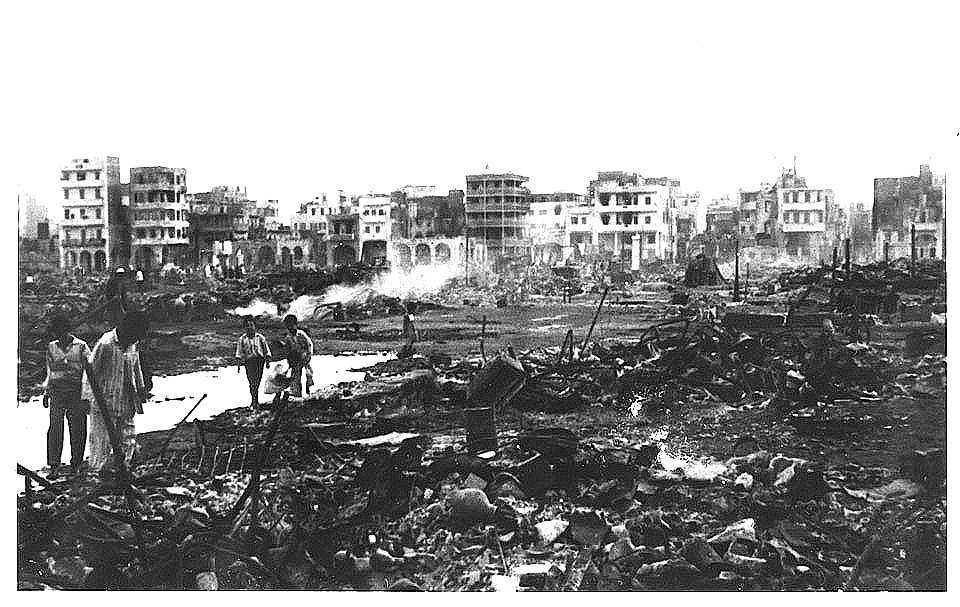
Seventy years ago, on 5th November 1956, British and French troops landed in Egypt in support of Israeli forces in an action which would be deemed by observers as a military success but a political disaster.
The Suez Crisis, as it became known, became a symbol of the death of the British Empire and the end of ‘Perfidious Albion’ as a world power.
The Suez Canal had opened in 1869 as a man-made link between the Mediterranean and the Indian Ocean.
The building of it had been financed by the two main imperialist interests in the region: The British and French governments.
They saw the canal as a strategic weapon in controlling trade providing speedy access to their military forces, both to the region itself and the Indian sub-continent beyond.
After the British invasion of 1888 the running of the canal was under British control, although French investors maintained a majority shareholding.
In 1951, the formerly tame government of Egypt cancelled the 1936 agreement by which Britain was allowed to have a huge military base at Suez.
Anti-British protests grew in cities like Cairo and the British responded with the might of the gun.
The Egyptian monarchy had proved themselves incapable of standing up to the British in any meaningful way.
On 23rd July 1952, the crony regime of King Farouk was removed in a coup by members of a left-nationalist ‘Free Officers Movement’.
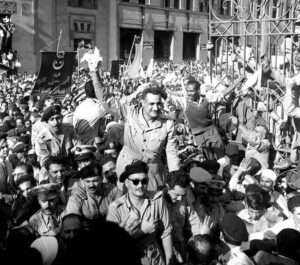
One of the movement’s leaders was Gamal Abdul Nasser, who become president of the new Egyptian republic.
In 1953, Britain agreed to quit the Sudan and carry out a ‘phased withdrawal’ of forces from Suez.
In return, the Egyptians would let the colonial powers keep the Nile Valley region, while the Suez Canal would remain under British and French ownership until at least 1968.
Nasser had sought to buy arms from America, but when they were not forthcoming, due to Egypt’s anti-Israel stance, an arms deal was struck in 1955 with Czechoslovakia, a Warsaw Pact country, with the support of Russia.
On July 26th, Egypt nationalised the Suez Canal, removing the British overlords.
The canal was immediately closed to Israeli ships along the Straits of Tiran. Egypt also blockaded the Gulf of Agaba.
Tory Prime Minister Anthony Eden and the British government were thrown into turmoil.
A special session of Parliament condemned the nationalisation, with Labour again backing the Tories, as did the British press.
Plans were immediately put in place to act.
A political and media campaign began to paint Nasser as a dictator like Hitler and Mussolini.
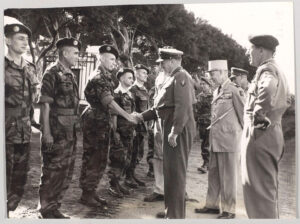
The French moved first, agreeing on July 29th to take military action with Israel.
It was confirmed to them on August 7th that Israel would indeed be ready to invade – they saw Egypt as being increasingly hostile to them given the treatment of the Palestinians.
A London conference was called in August, with representatives of Britain, France and the US in attendance, to discuss the crisis but with no clear solution.
A further conference was again held in London later that month with representatives invited from all countries who used the canal.
Egypt did not attend but were backed at the event by India and Russia. The conference demanded, by majority vote, international (i.e. imperialist) control of the canal.
Negotiations with Egypt over this proposal got nowhere.
The Americans then proposed an ‘association’ of canal users that would draw up guidelines of operation.
The US hoped that this plan would enable them to be seen as separate from Britain and France who were widely seen as the main imperialist aggressors by the Arab world.
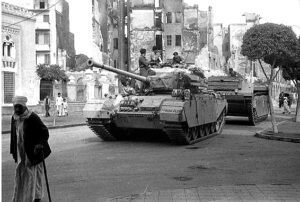
In fact, both countries went along with the US plan, but largely to buy time before taking military action.
Britain begun to assume that Washington would not object, should any such action take place.
On September 1st, France and Israel began organising the details of an invasion of Egypt.
France would use Israeli airstrips to launch bombing raids should British ones, based in Cyprus, not be available.
In October, Britain was let in on the plan and at a secret conference outside Paris, all three countries – Britain, France and Israel – agreed on the tactic they would play.
Israel would invade first, targeting Sinai, with France and Britain following on in as ‘peace-keepers’ to ‘separate’ the Israeli and Egyptian forces and in doing so re-occupy the canal and remove Nasser from power.
Britain would maintain its hold in the Middle East and both France and Britain could use the invasion to keep pressure on their African colonies.
A huge military operation was started to prepare for the invasion, set for late October.
Meanwhile, the Americans were monitoring all this through the CIA.
On October 29th, the Israeli invasion begun, with the French giving logistical support to Israeli forces.
Both French and Israeli aeroplanes engaged in bombing sorties.
On October 30th, France and Britain carried out the first part of their deal by sending ultimatums to both Egypt and Israel.
Nasser responded by sinking ships in the canal, thereby blocking it to all traffic.
On November 5th, British troops landed at the El Gamil airfield. The invasion had begun.
The next day British forces landed at Port Said. From a military point of view, the conduct of the British invasion was fairly successful with considerable advances for relatively little loss of British lives (the same could not be said of Egyptian casualties).
In Britain, huge opposition to the invasion was growing, with the Labour leadership coming under huge pressure to break with Eden, and this they reluctantly did.
A House of Commons debate nearly erupted into fistfights it was said.
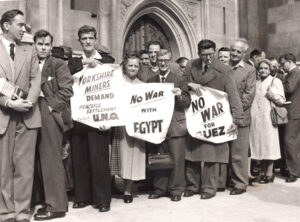
Opinion polls were showing growing opposition to the invasion and a massive anti-war protest was held in London on 4th November, the day before British troops landed in Egypt.
Eden wanted to take direct control of the BBC to direct propaganda in support of the invasion but was resisted on this.
The Americans too were worried. The UN had met on November 2nd to pass a US motion calling for peace.
Britain, France, Israel and a number of other countries allied to them either voted against or abstained.
The US continued to put pressure on France and Britain to call off the invasion and withdraw, financial pressure was put on Britain to stop this ‘adventure’.
Oil sanctions by the US seemed likely. An oil embargo was started by Saudi Arabia under direction from America. Other countries were set to join in.
Neither France nor Britain had the financial resources, still depleted from the Second World War, to withstand this.
Britain had no choice. A ceasefire was announced on 6th November by Britain without even telling the French. All advances were halted.
British and French troops were told to withdraw by December 22nd to be replaced by UN representative forces.
Some Tories were furious, seeing the military advances and demanding that the job be finished.
The question of the ownership of the Suez Canal was now made clear – it was Egyptian, not British or French.
Nasser’s position was also strengthened, with Nasserism – as it was called – becoming a dominant concept in Egypt and beyond.
A clear loser was Anthony Eden. With the invasion having been wound up in shame, with clear opposition at home and evidence that he had misled Parliament, he had to resign as Prime Minister on January 9th 1957.