ISRAELI forces carried out fresh strikes in southern Lebanon, even as US President Donald Trump renewed his criticism of Israel’s conduct and Washington and Tehran prepared to sign a deal this week meant to end the war.
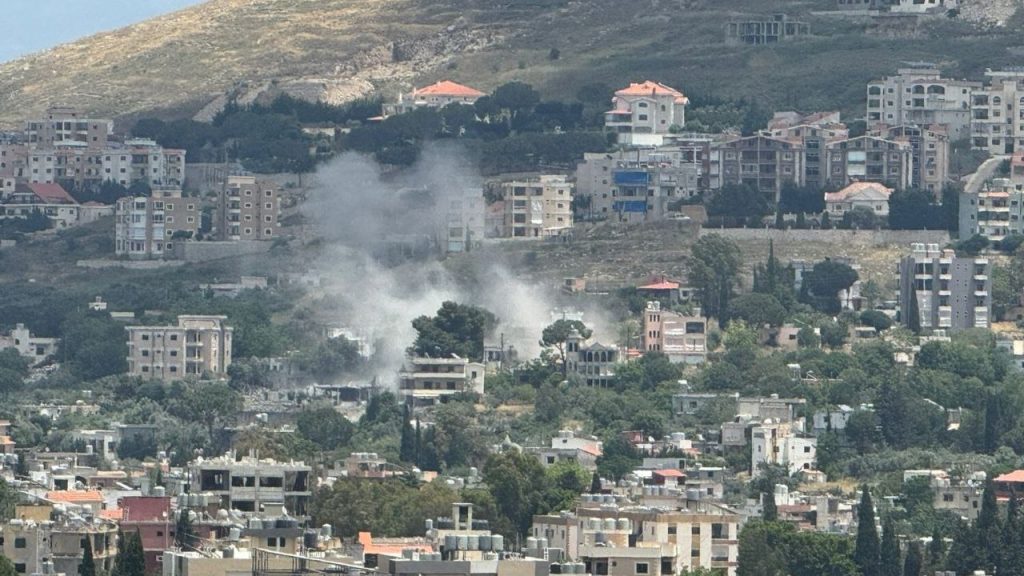
Israeli jets hit the Nabatieh al-Fawqa area and the outskirts of neighbouring Kfar Tebnit, Lebanon’s National News Agency reported, with an earlier air strike on Beirut adding to the pressure on efforts to finalise the agreement.
The Israeli military has previously claimed to be targeting Hezbollah, a claim that sits against the mounting evidence of Israeli crimes against civilians in Lebanon, including the Gaza-style obliteration of civilian infrastructure and ethnic cleansing.
Trump’s frustration with Israel spilled into the open at the G7 summit in France.
He said Israeli prime minister Benjamin Netanyahu needed ‘to be more responsible with respect to Lebanon’, and that Israel had been fighting Hezbollah for ‘too long and too many people are being killed’. He told the summit he had a ‘great relationship’ with Netanyahu but that he ‘didn’t like that he did an attack … that was too much’.
He went on: ‘Without the United States, there would be no Israel. Without me, there would be no Israel because no other president was willing to do what I did.’
Netanyahu said on Monday that Israeli forces would stay in Lebanon ‘for as long as necessary’. Iran’s foreign minister, Abbas Araghchi, warned that Tehran would treat any Israeli attack on Lebanon, or any continued Israeli military presence on Lebanese soil, as a violation of the interim agreement with the United States.
The text of that agreement, described as a memorandum of understanding, has not been officially released, though the mediator, Pakistan, says it covers Lebanon.
The two sides are due to sign it this week at the Swiss resort of Bürgenstock, according to Switzerland’s foreign ministry, and Trump said he would probably hold a news conference to read the deal out in public ‘word by word’.
In Tehran, President Masoud Pezeshkian said in a post on X on Tuesday, Iranians had learned from the martyred Leader of the Islamic Revolution, Ayatollah Seyyed Ali Khamenei, not to accept humiliation, and that the Islamic Republic had prepared itself for every scenario as it works to end the cycle set off by the latest unprovoked American-Israeli aggression.
He called the understanding ‘an important step towards stopping the war and beginning negotiations’, while cautioning that no final agreement had yet taken shape.
Iran, he said, remained ready ‘for all options’, and the government’s first concern would stay the same, serving the public, whether or not the talks produced a deal.
Araghchi said separately that negotiations on a fuller agreement would open once the signing was complete.
That sequencing carries a warning rooted in recent experience.
Both the latest round of aggression, between 28 February and 7 April, and the earlier round that began last June, came while Iran and the United States were already engaged in diplomacy meant to head off confrontation, and Iranian officials have repeatedly urged caution against an American betrayal of the process now under way.