A drone registered to the American defence contractor Shield AI was hovering 500 metres from the burning wreck of an Ecuadorian fishing boat within hours of it being bombed in the eastern Pacific, flight tracking data shows.
La Negra Francisca was struck at 1:02pm on 17 March 2026 at coordinates 1.5822°N, 87.6958°W, a position corroborated by NASA thermal imagery consistent with an explosion recorded at the same moment, at the point where the vessel’s transponder stopped broadcasting.
The V-BAT drone launched from a nearby boat seven hours later and circled the hull, switching its signal off and on and repeatedly ascending and descending in a pattern consistent with landing on a ship and taking off again.
The finding was published on 19 August by Drop Site News, the US outlet that broke the story of the boat bombings in April.
The V-BAT is marketed for intelligence, surveillance and reconnaissance but is capable of carrying a weapons payload and of switching its transponder off to avoid detection.
It matches the descriptions the surviving fishermen gave of drones circling their boats before the bombing, and carries the same red and green lights eyewitnesses reported as they photographed the explosion.
Three boats were attacked in January and March. No drugs were found aboard any of them. La Negra Francisca, the Don Maca and the Fiorella had each been searched and cleared by Ecuadorian coast guard personnel before they were hit.
The Fiorella vanished in January with all hands and has never been found. The crews of the other two vessels were taken by gunmen in US military uniforms who they say hooded, handcuffed and starved them for eight days aboard a US-flagged ship before handing them to El Salvador’s navy hundreds of miles from home.
Thirty-six fishermen were abducted. Jordi Flores, a young crewman aboard La Negra Francisca, was left with a foot injury that has stopped him working. Erik Coello, of the Don Maca, has lost 70 per cent of his vision.
Last week, both the New York Times and the Washington Post corroborated much of the original investigation, with the Post reporting that the attacks were the work of a covert CIA operation. The Times reported that a patrol plane flew from a military base in El Salvador towards each of the three boats before each attack.
The Post identified the aircraft as FENIX 701, a Cessna business jet fitted with surveillance equipment and operating out of Ilopango International Airport, which served as a hub for CIA operations during the Contra war against the Sandinista government of Nicaragua.
The plane is registered to a company with almost no digital footprint, listing its address as a mailbox inside a UPS store in Virginia. It stopped broadcasting its signal well before reaching the boats and returned to base hours before the strikes.
Shield AI, based in San Diego, builds drones and fighter aircraft piloted by artificial intelligence. It was founded in 2016 with seed funding from the Pentagon’s Defence Innovation Unit and Naval Special Warfare Command. In 2024 the US Coast Guard signed a $198 million contract for V-BAT services; in April 2026 the company announced an $800 million contract from the US Navy.
Its chief executive, Brandon Tseng, has said publicly that the Coast Guard and Navy use V-BATs to interdict and destroy drugs bound for the United States. Politico has reported that the Israeli military has used the company’s self-piloting drones in close-quarters combat, and CBS News that Ukrainian forces use V-BATs to identify Russian targets.
Vessel tracking data previously showed a Coast Guard cutter leaving a Galápagos military base a day before the bombing of La Negra Francisca.
Its signal went dark and reappeared in Central American waters 24 hours before the fishermen were placed in Salvadoran custody. Asked to account for those movements, the Coast Guard said it does not disclose cutter positions during law enforcement missions for operational security.
In June it told the Guardian that it had deployed its Bertholf cutter for a search and rescue operation after a Mayday alert, an account that contradicts Southern Command’s earlier statement that it knew of no US involvement. Eyewitness video shows the Coast Guard patrolling in the aftermath of the airstrike. The service has never acknowledged using drones in its purported rescue.
Since September 2025 the US military has carried out more than 66 strikes on vessels in the Caribbean and eastern Pacific under Operation Southern Spear, killing at least 221 people.
The Washington Office on Latin America, which documented that toll in a report published on 24 July, concluded that the strikes constitute murder under section 1111 of Title 18 of the US Code and extrajudicial executions under international human rights law, and are not war crimes only because the United States is not at war.
Its co-author Adam Isacson warned that the sheer frequency of the killings has dulled reaction: ‘The strikes have been so frequent that many Americans have grown numb to them.’
The report found the targeting intelligence turns on vague notions of affiliation and does not require commanders to know who they are killing, or that drugs are aboard.
Ben Saul, the UN special rapporteur on counter-terrorism and human rights, told an Inter-American Commission on Human Rights hearing that the killings ‘have no justification under international law and gravely violate the right to life’, and called for the prosecution of those who ordered them. Human Rights Watch’s Washington director Sarah Yager described ‘a pattern of using military force where the law does not permit it’.
Amnesty International’s Amanda Klasing said: ‘These are law enforcement operations’, and those aboard retain the right to life and to due process. Volker Türk, the UN High Commissioner for Human Rights, demanded the strikes stop last October, when the toll stood above 60.
In Ecuador the consequences have only compounded.
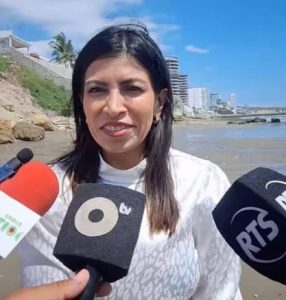
Alexandra Bravo, the prosecutor investigating the attacks, was shot dead in June in Manta, home port of all three boats.
US troops have been stationed there since December 2025, restoring a de facto base that the 2007 constitution outlawed and that 60 per cent of Ecuadorians voted to keep banned last November. President Daniel Noboa governs under a 23rd state of emergency, permitting warrantless raids and wiretapping and granting diplomatic immunity to all US forces.
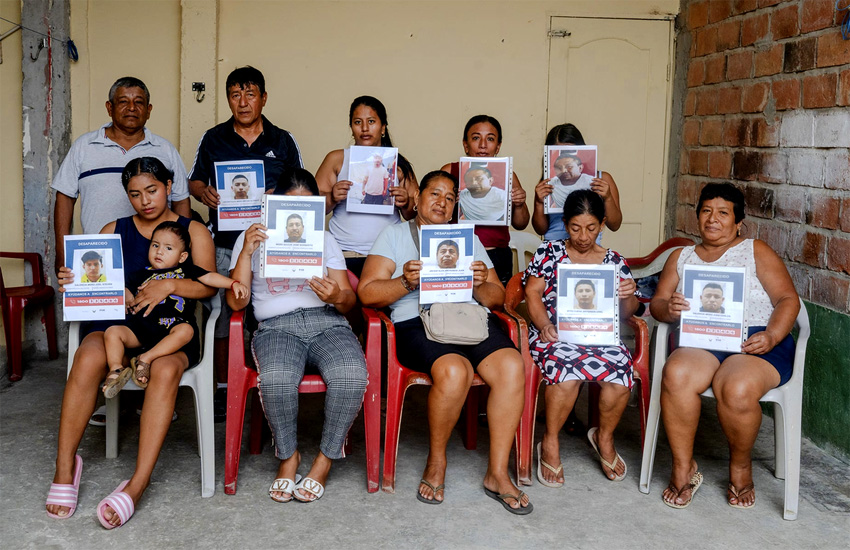
Maria Mero lost her husband, Gabriel Aladino Mero Delgado, and her brother, Jefferson Ariel Mero Cueva, aboard the Fiorella.
Her mother-in-law stopped eating and died waiting for her son. Her daughter was hospitalised with anxiety after seven months without her father.
Groceries, the electricity bill and a school uniform are now beyond the family. ‘Please, I beg you, return my husband, my brother, and all the people who are with them.’