SYRIAN President Ahmed al-Sharaa told the UN General Assembly in New York on Wednesday that Israel had carried out nearly 500 air and artillery strikes and more than 1,200 ground incursions into Syria since December 2024, and had detained around 300 people.
He demanded that Israeli troops withdraw to the lines set by the 1974 disengagement agreement.
‘We reject the permanent Israeli attempts to impose a fait accompli in Syria,’ he said, referring to Israel’s occupation of the Golan Heights and the territory it has seized beyond it.
In the occupied south west, however, residents who have taken up arms against Israeli troops say the government has left them to face the occupation alone, according to reporting by Drop Site News.
Israeli forces crossed from the occupied Golan into the UN-patrolled buffer zone within hours of Bashar al-Assad’s fall on 8th December 2024.
They then pushed deeper into Quneitra, Daraa and Rif Dimashq provinces, while hundreds of airstrikes destroyed much of Syria’s military capability.
Israel first called the deployment temporary. Defence Minister Israel Katz later declared that troops would stay on Mount Hermon indefinitely and remain in Syria for an ‘unlimited amount of time’.
Hamza Ghadban, head of Syria’s Sijil Centre, has recorded nine Israeli military bases built between Mount Hermon and the Yarmouk River since Assad’s fall.
At least 240 Syrians have been detained, 46 of whom were still held in August.
Israeli forces have killed 36 people in the south west, most during ground incursions: 13 in Beit Jinn, nine in Nawa and seven in Kuwayya.
Under what the Israeli army calls its ‘New East’ project, troops are digging a continuous barrier of earth walls and trenches four metres deep and four metres wide.
It runs from the northern Golan to the tripoint with Jordan. Night patrols, house raids, checkpoints and drone flights are near daily across the three provinces.
In Nawa, in Daraa province, residents fought back on 3rd April 2025.
Guards watching farmland spotted Israeli troops at Jubaylia, six kilometres away, and called in young men from the town.
‘Everyone was armed,’ said Abdullah al-Saqr, who is in his seventies. ‘They went out with hunting rifles, army rifles, whatever weapons they had, to stop the Israeli advance.’
Both sides called in reinforcements, and Israeli drones, helicopter gunships and artillery struck the fighters and the road to the battle.
Al-Saqr said Israeli troops positioned themselves behind those arriving to help the wounded, effectively laying a trap.
Nine men from Nawa were killed and 12 wounded, among them al-Saqr’s son Issa, a father of four. ‘He was married and had four children,’ al-Saqr said.
‘We asked the new government for help, but no help came,’ said resident Jihad Tayasni, adding: ‘They did not even allow an ambulance to reach us.
‘Civilian cars were the ones that went in and evacuated the wounded.’
The townspeople stopped the Israelis from entering Nawa or seizing Tal al-Jumoua, a strategic hilltop position.
‘Since the battle,’ al-Saqr said, ‘they have not returned’.
Kuwayya, a village above the Yarmouk River on the Jordanian border, fought off Israeli troops on 25th March 2025.
Six local men were killed as Israeli drones fired missiles into the village. ‘It was the first and last intervention,’ said a farmer who gave the pseudonym Hamada Msallam for fear of reprisals.
‘Men from the village grabbed weapons from their homes and went and stood against the Israelis,’ he said. ‘It wasn’t small arms against small arms. The moment we fired, they struck us with explosives.’
‘I, my brother, my son, will die fighting before they ever enter our homes and touch our women,’ Msallam said. ‘Our home is our dignity.’
Israeli troops have since occupied the Assad-era Al-Jazeera barracks nearby.
They have demanded that Kuwayya’s residents hand over their weapons and routinely search their homes.
‘People here genuinely believe they are left to their own fate,’ one farmer said.
Beit Jinn, a farming village near Mount Hermon, has paid the heaviest price.
On 12th June, 2025, Israeli troops killed resident Mohammed Hamada and seized seven young men in a night raid.
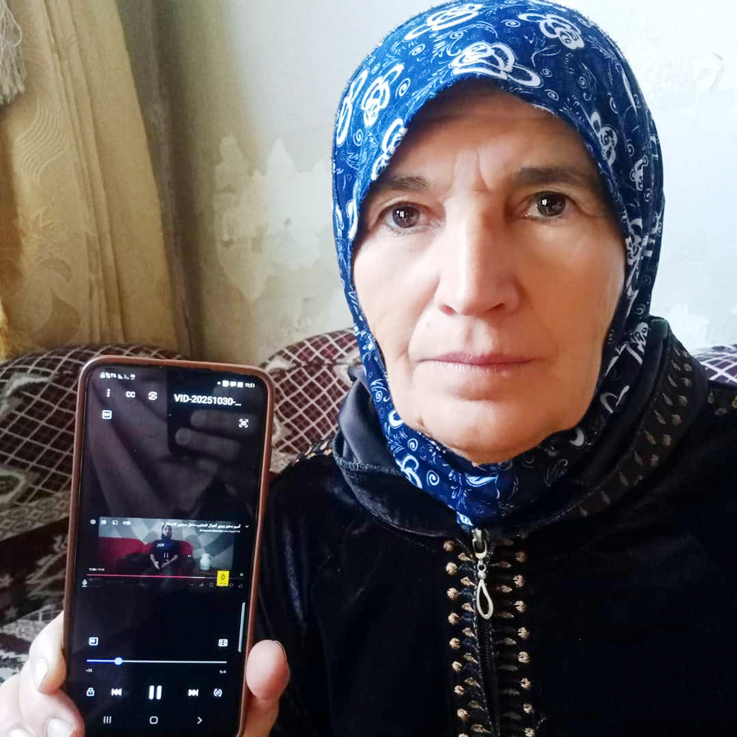
‘They let their dogs into the house and then entered themselves. They pulled young men out of their homes, beat them up, and took them in their cars,’ said Fatima Mohamed Safadi, whose two sons were taken.
The detainees were moved to Israel and accused of belonging to Hamas, which their families deny. Safadi did not know for seven months whether her sons were alive.
She learned where they were held from a video of a released prisoner naming the men detained alongside him.
When troops returned in late November, some villagers opened fire. Israel answered through the night with warplanes, artillery from Mount Hermon, tanks, drones and helicopters, and ambulances were kept out for hours.
Thirteen people were killed and up to 35 wounded, five of them from the Hamada family, including four-year-old Shahad.
The Israeli army said six soldiers were wounded. Nearly all of the village’s 2,500 residents fled, and few have returned.
Among the dead was Hassan, son of the village’s community leader, Mohammed Abderrazzaq al-Saadi. ‘It was supposed to be his wedding day,’ al-Saadi said.
‘We did not initiate any attack on them, not even a stone, we were shocked that they were attacking us,’ said Safaa Safadi, a computer engineer from the village.
Syria’s Foreign Ministry condemned ‘the criminal attack perpetrated by a patrol of the Israeli occupation forces’.
It called the bombardment of civilian homes ‘a fully fledged war crime’.
Residents who have protested outside the ministry in Damascus for the release of their relatives say they have only been told that negotiations are continuing.
An Iran-aligned group calling itself Uli al-Ba’as, formally the Islamic Resistance Front in Syria, has claimed rocket attacks on Israeli positions and a parallel campaign against Syrian government security forces.
Wail Olwan of the Jusoor Research Centre said the group’s messaging consistently outstrips attacks that can be independently verified.
Syria-based researcher Aymenn al-Tamimi said one faction’s claim that two fighters died in Abdeen appeared to be fabricated.
Unarmed resistance is spreading. On 9th December 2025, residents of Khan Arnabeh, the main town in Quneitra, confronted an Israeli patrol that had set up a checkpoint in the town.
They held their ground through warning shots and drove it out with stones.
Mohammad Debbek was shot in the leg and still walks on crutches. ‘This is my land. When you’re the owner of the land, you don’t need someone to encourage you to resist,’ he said.
By April this year, demonstrations organised over Facebook and WhatsApp had spread across Quneitra.
‘Syria cannot bear armed conflict right now,’ said Ilaf Obeid, 24, of the group Syrians for Palestine. ‘But when (the Israelis) see resistance, they think twice about advancing.’