
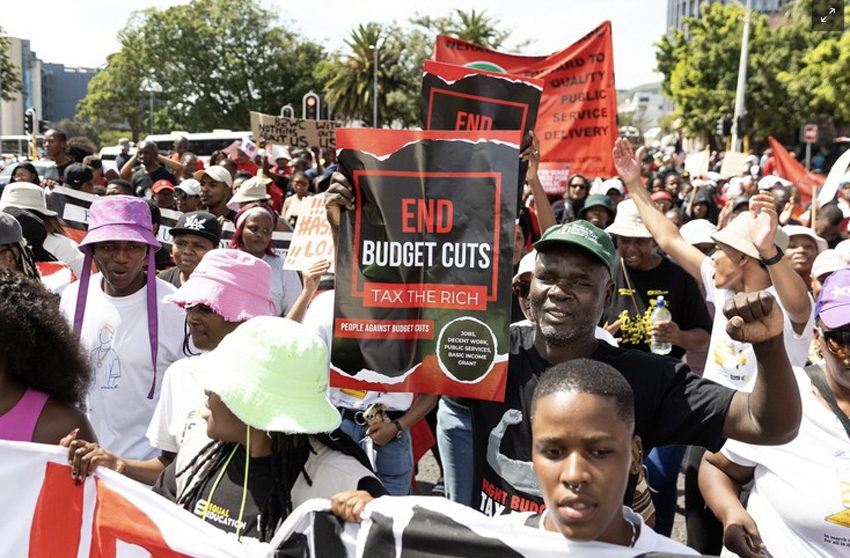
All three of South Africa’s trade union federations the Congress of South African Trade Unions (COSATU), South African Federation of Trade Unions (SAFTU), and Federation of Unions of South Africa, said on Wednesday that they rejects ANC-led government’s 2026 National Budget.
‘The Congress of South African Trade Unions (COSATU) notes with extreme disappointment the lacklustre 2026-27 Budget tabled at Parliament by government.
‘Whilst appreciating that there are some progressive and important allocations that COSATU campaigned for included in the Budget, as an overall package it fails to respond decisively to the fundamental crises facing the working class.
‘The economy, in particular a 41.1 per cent unemployment rate, economic growth far below the 3 per cent needed to create jobs, struggling public and municipal services and State-Owned Enterprises (SOEs), entrenched levels of poverty and inequality, and endemic crime and corruption.
‘Tragically, the Budget is focused on balancing the books, not at aggressively kickstarting economic growth or tackling unemployment.
‘We welcome above-inflation increases for health, education and social security as well as R18 billion (£835 million) allocations to enroll 300,000 more students; R7.8 billion for the National Health Insurance Grants plus R24 billion (£1.1 billion) for revitalising public healthcare, R92 billion (£4.27 billion) for district health programmes, and more money for the employment of doctors but this not enough, over the MTEF; plus the recruitment of 3,000 staff to digitise civic services at Home Affairs.
‘We are deeply worried that no funds appear to have been allocated to the employment of the additional 10,000 permanent labour inspectors pledged in the State of the Nation Address (SONA); these inspectors are supposed to ensure that workers can do their jobs in safe conditions.
‘Local government remains the Achilles’ heel of the state with more than 60 per cent of municipalities in financial distress and many struggling to provide basic services or pay staff.
‘The allocation of 27 billion rands (£1.25 billion rands) to improve municipalities’ abilities to provide basic services and bill correctly is critical as are plans to strengthen national government’s ability to intervene in good time and hold failing municipalities accountable.
‘Plans to connect over 320,000 houses to electricity and roll out 258,000 smart meters are welcome but highly dysfunctional municipalities, with rising debts are not being funding enough.’
SAFTU stated: ‘The budget entrenches austerity under the language of stability and credibility.
‘The government, including Finance minister Enoch Godongwana, celebrates narrowing deficits, stabilising debt ratios and rising primary surpluses.
‘But for the working class, the unemployed, and communities facing collapsing services, this budget does not represent renewal, it represents continuity of a contractionary fiscal path.
‘Government spending is a driver of demand. In a country facing mass unemployment, deindustrialisation, municipal collapse and infrastructure decay, they are suppressing demand when expansion is required.
‘Economic growth is projected at 1.6% in 2026, rising to only 2% by 2028.
‘At this pace:
- Structural unemployment will not fall meaningfully;
- Manufacturing decline will not reverse;
- Poverty reduction will stall;
- Informal work will increase.
‘South Africa requires sustained growth well above 4-5 per cent to make serious inroads into unemployment. Instead, this budget normalises stagnation and builds fiscal consolidation around it.
‘Stability without transformation entrenches
inequality.
‘Debt is projected to peak at 78.9 per cent of GDP and gradually decline. The deficit narrows steadily.
‘This is achieved through:
- Wage bill containment;
- Early retirement programmes;
- Efficiency savings.
‘The consequences are already visible:
- Unfilled nursing and medical posts while facilities are overstretched;
- Overcrowded classrooms due to educator vacancies;
- Backlogs in courts and weakened prosecutorial capacity.
‘Social grants rise modestly. Education remains the largest functional allocation.
‘Health receives additional funding for HIV/AIDS and compensation pressures.
‘The budget also fails to confront the broader crisis of tax avoidance.
‘There was no comprehensive strategy to stop private companies and the richest people in South Africa avoiding tax.
‘There was no wealth tax proposal, no solidarity tax, no corporate tax increase, and no windfall tax.
‘This model de-risks investment for private capital while the state absorbs risk.
‘Infrastructure without binding localisation, beneficiation and domestic manufacturing conditions risks reinforcing import dependence rather than building productive capacity.
‘Until fiscal policy is reoriented toward structural transformation and redistribution, stabilisation will remain an end in itself, not a pathway to social justice.
‘We must put people before profits.
‘Build the economy around jobs, not debt.’
Another trade union federation, Fedusa, was also highly critical of the budget it said: ‘The 2026 national budget focuses on reducing debt, offers some help to households and includes important reforms, but it does not do enough to create large numbers of jobs.
‘This is the view of union federation FEDUSA after finance minister Enoch Godongwana tabled the budget in parliament on Wednesday.’
FEDUSA said: ‘It steadies the books, but it does not yet ignite the economy to the degree and in the manner required to provide relief to millions of South Africans.
‘After these economic measures, unemployment will not decline meaningfully. For a country facing structural mass unemployment, jobs should dominate the budget. Instead, the dominant theme remains debt stabilisation.
‘Fedusa will continue to push for labour-intensive industrial expansion, sustainable and transparent social security reform, professional and corruption-free municipalities, stronger enforcement against illicit financial flows and decent work at the centre of economic policy.’