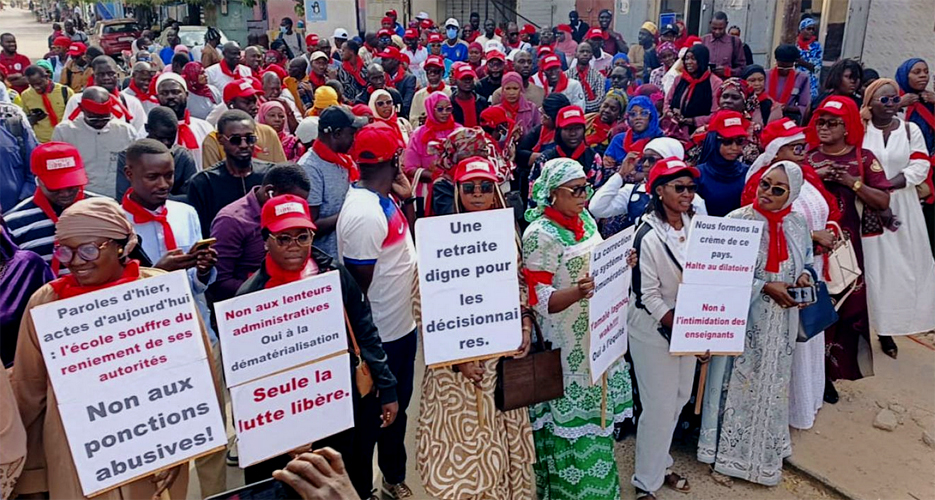
SENEGAL’S three-day general strike entered its second day on Thursday 22nd October with unions reporting widespread participation and increasing pressure on President Bassirou Diomaye Faye’s government as it seeks approval for a proposed $2.2 billion International Monetary Fund (IMF) financing programme.
The Front Syndical pour la Défense du Travail (FSDT), which announced the strike on September 19, is protesting against unfulfilled labour agreements, delayed payments and dismissals, drawing support from teachers, transport workers and employees of state-owned electricity utility Senelec.
The unions held a protest march in Dakar on October 20 before beginning the stoppage the following day. It is the FSDT’s second general strike since July 10, when it called a 24-hour stoppage and claimed participation of 77 per cent – 80 per cent.
The FSDT claimed 90% participation on the first day across education, healthcare, public administration, transport, energy and port operations, Seneweb reported. The union’s figure has not been independently verified.
SUTELEC secretary-general Mouhamed Habib Aidara said 91 per cent of non-requisitioned Senelec workers had joined the stoppage.
Aidara accused the authorities of exceeding their legal powers in requisitioning workers and said the union remained open to negotiations despite receiving no contact from the supervising ministry.
SUTELEC, the majority union at Senelec, is seeking payment of a performance bonus and opposing aspects of the utility’s restructuring. Energy Minister El Hadji Abdourahmane Diouf said on 19th October that proposed bonus terms had been agreed, but final approval rested with President Faye, according to the Senegalese Press Agency.
The FSDT’s broader demands include reinstatement of dismissed employees, payment of outstanding allowances, improved pension administration and implementation of previous agreements. It also opposes proposals to extend fixed-term employment contracts to four years.
The FSDT has also cited what it describes as excessive sugar import authorisations threatening jobs at privately held producer Compagnie Sucrière Sénégalaise (CSS), which employs about 8,000 people during its November-to-June campaign. The government said on 17th October it would suspend new sugar import authorisations for eight to nine months once CSS resumes production, expected in mid-November.
On 15th October, Prime Minister Ahmadou Al Aminou Lô, who replaced Ousmane Sonko in May, urged unions to observe a three-month moratorium on industrial action under a national social stability pact signed in May 2025. The unions rejected the proposed truce.
The Labour Ministry subsequently questioned the strike’s legality, while Dakar’s regional governor requisitioned designated Senelec and public transport operator Dakar Dem Dikk employees to maintain essential services, state broadcaster RTS reported.
The dispute comes as Senegal seeks to restore access to IMF financing following revelations of previously misreported borrowing, estimated by the IMF at more than $11bn, that pushed public debt above 130 per cent of GDP at the end of 2024 and led to the suspension of earlier IMF lending.
Moody’s Ratings downgraded Senegal to Caa2 from Caa1 on August 28, keeping a negative outlook amid mounting refinancing pressures. The government has continued to raise funds on the regional market, netting XOF69.95bn ($120million) at a 9th October auction in which three-year bonds yielded 8.16 per cent.
On 1st September, IMF staff reached a preliminary agreement with Senegalese authorities on a proposed 36-month, $2.2 billion Extended Credit Facility. The staff-level agreement is not final approval of the lending programme and does not authorise disbursements.
The arrangement still requires approval from IMF management and the Executive Board.
Before board approval, Senegal must take corrective measures addressing its earlier debt misreporting and secure financing assurances from its partners. No board approval or disbursement has been announced.
If approved, the programme would support reforms to strengthen revenue collection, improve public financial management and restore debt sustainability. Senegal launched a debt treatment plan on the same day as the staff-level agreement and is seeking agreements in principle with official creditors and bondholders by December 2026.
A bondholder group holding about $2.2 billion of Senegal’s roughly $5.2 billion in international bonds has appointed Alvarez & Marsal as financial adviser.
The government faces competing demands to restore fiscal credibility, while addressing workers’ complaints about purchasing power, employment conditions and outstanding public-sector obligations.
The strike is scheduled to conclude today (24th October), a week before the Youth Olympic Games open in Dakar on 31st October, adding urgency to efforts to resolve the labour confrontation.
Meanwhile, Nigerian health officials say test results have confirmed the country’s first case of the Bundibugyo strain of Ebola, which is behind a major outbreak in the Democratic Republic of the Congo (DRC), marking the disease’s first spread to West Africa in the current outbreak.
The case involves a woman who travelled from Uganda to the capital, Abuja, on October 3, the Nigeria Centre for Disease Control and Prevention (NCDC) said.
She was tested for Ebola on October 19 after health officials learned she had recently travelled to Uganda, one of the countries affected by the current outbreak. Officials confirmed the positive result on Tuesday.
‘We did three levels of tests, but all molecular. The strain was Bundibugyo,’ Olajumoke Babatunde, director of the public health laboratory service at the NCDC, said on Wednesday.
The World Health Organisation (WHO) also confirmed the strain, for which there is neither a vaccine nor a specific treatment.
An unnamed official said that the woman is a diplomat whose condition has deteriorated into ‘multi-organ failure’.
Ayoade Alakija, a Nigerian physician who co-chairs a G7 committee for investment in global health, said that it had taken 12 days since the woman fell sick for her to be tested for Ebola, potentially exposing many other people to the infection.
Nigerian authorities have identified 44 contacts, most of them healthcare workers. They include the patient’s husband, a Swiss national, who lives with her in Abuja.